


Stress Corrosion Cracking (SCC) Testing
Stress corrosion cracking tests are performed in labs to determine whether a material is vulnerable to stress corrosion cracking in an environmental medium. Stress Corrosion Cracking (SCC) is the most dangerous and destructive corrosion of all types of corrosion, and it contributes significantly to many equipment mishaps. Once micro cracks are developed, they grow much more quickly than other types of local corrosion.
TRUSTED BY


Stress Corrosion Cracking (SCC) Testing
- Overview
- Scope, Applications, and Benefits
- Test Process
- Specifications
- Instrumentation
- Results and Deliverables
Stress Corrosion Cracking (SCC) Testing Overview
Stress corrosion cracking (SCC) is a failure mode in which a susceptible material, subjected to sustained tensile stress in a specific corrosive environment, develops and propagates cracks at stress levels well below the material’s yield strength. Neither the mechanical stress alone nor the corrosive environment alone would cause cracking under these conditions – the failure results from the synergistic interaction of both. SCC is particularly dangerous because it can occur with little or no visible surface corrosion and progresses with limited warning before catastrophic fracture.
SCC testing applies controlled tensile stress to specimens immersed in or exposed to a defined corrosive medium and monitors for crack initiation and propagation over time. Stress is applied by constant load, constant displacement (bent beam or C-ring specimens), or slow strain rate methods, each of which emphasizes different aspects of the cracking behavior. The choice of method depends on whether the objective is determining a threshold stress below which cracking does not occur, measuring crack growth rate, or assessing susceptibility ranking across different materials or heat treatments.
Materials commonly evaluated for SCC susceptibility include high-strength aluminum alloys (particularly in the 2xxx and 7xxx series), stainless steels in chloride environments, titanium alloys in specific media, copper alloys in ammonia environments, and high-strength steels in hydrogen-generating conditions. SCC test data informs design allowable stress levels, alloy and temper selection, and protective measure requirements for structural components.

Stress Corrosion Cracking (SCC) Testing Scope, Applications, and Benefits
Scope
SCC testing applies to metallic alloys used in structural, pressure-containing, or load-bearing applications where sustained tensile stress and corrosive exposure can coexist in service. The test evaluates:
- Time to cracking at defined stress levels in a specific environment
- Threshold stress intensity for SCC initiation (K-ISCC)
- Crack growth rate as a function of stress intensity
- Susceptibility ranking of alloys, tempers, or surface treatments
- Effect of heat treatment, cold work, or residual stress on SCC resistance
- Performance of protective coatings and inhibitors in delaying SCC initiation
Applications
- High-strength aluminum alloy qualification for aerospace structures
- Stainless steel evaluation for chemical processing and nuclear environments
- Pressure vessel and pipeline material qualification
- Fastener and spring material SCC screening
- Alloy development and temper optimization programs
- Failure analysis of field fractures suspected of SCC origin
Benefits
- Identifies alloy-environment combinations susceptible to SCC before field use
- Establishes threshold stress data for design allowable calculations
- Supports alloy and temper down-selection with comparative susceptibility ranking
- Quantifies crack growth rates for damage tolerance analysis
- Generates data for material qualification packages and safety-critical applications
- Accelerated relative to natural field exposure timescales
Stress Corrosion Cracking (SCC) Testing Process
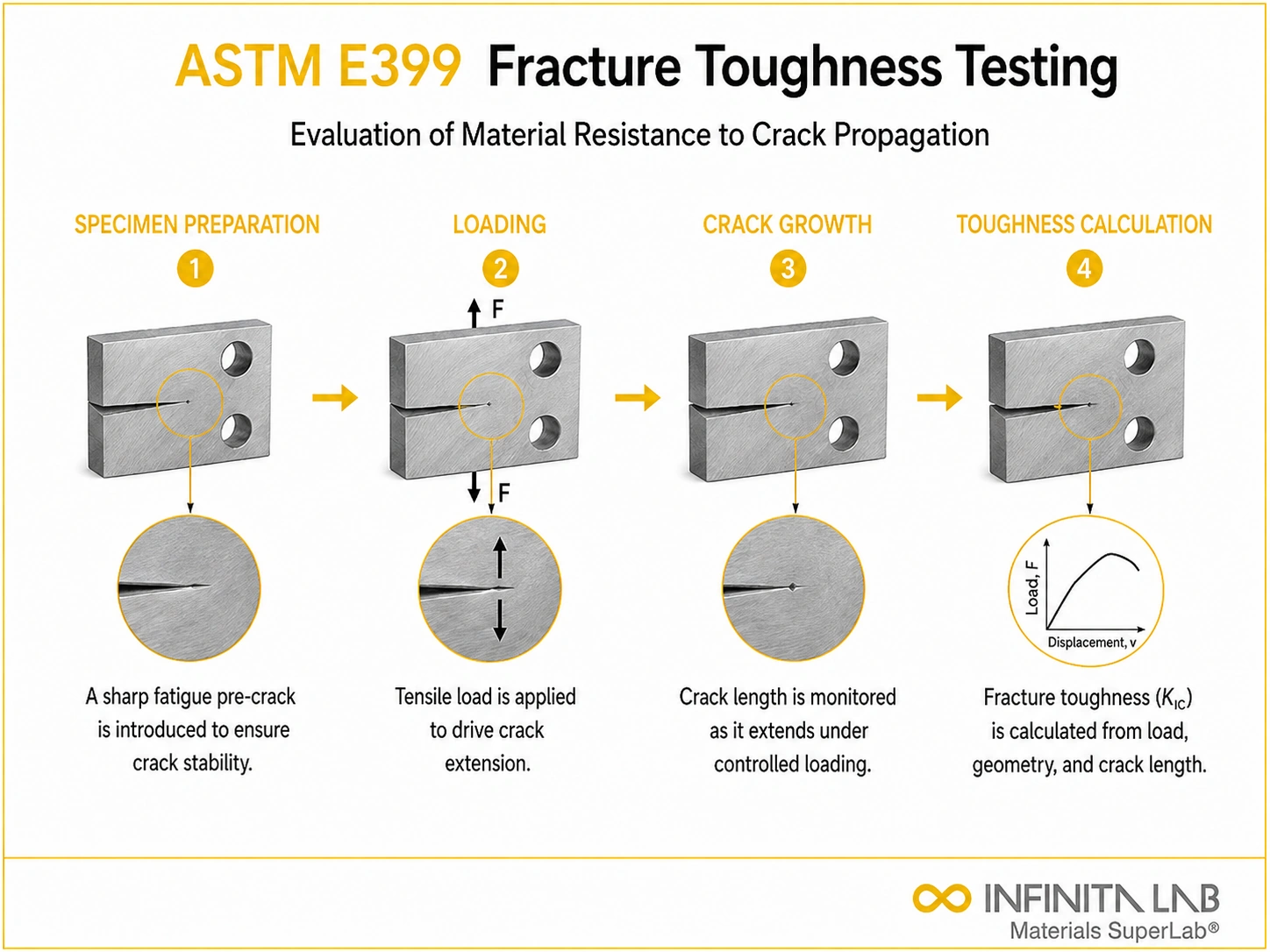
Specimen Preparation
Specimens are machined to the required geometry - smooth bar, precracked fracture mechanics, bent beam, or C-ring
1Loading and Environmental Setup
Specimens are loaded to the specified stress level using deadweights, bolt loading, or a test frame.
2Exposure and Monitoring
Specimens remain under load in the corrosive environment for the specified duration.
3Post-Test Examination
Specimens are removed, cleaned, and examined for cracking.
4Stress Corrosion Cracking (SCC) Testing Technical Specifications
| Parameter | Details |
|---|---|
| Applicable Standards | ASTM G44, G47, G49, G58, G103, NACE TM0177, NACE TM0198 |
| Test Methods | Constant load, constant displacement (bent beam, C-ring), slow strain rate |
| Common Environments | 3.5% NaCl solution, alternate immersion, EXCO solution (Al alloys), H2S (steels) |
| Applicable Materials | Aluminum alloys, stainless steels, titanium alloys, high-strength steels, copper alloys |
| Measured Parameters | Time to cracking, threshold stress, crack growth rate (da/dt or da/dK) |
| Output | Pass/fail at stress level, threshold stress value, crack growth rate data |


- Constant load frames or deadweight loading systems
- Bent beam and C-ring loading fixtures
- Slow strain rate test machine (SSRT)
- Corrosive solution exposure vessels and immersion tanks
- Optical and scanning electron microscopy for fracture surface examination
- Crack measurement tools and compliance gauges for precracked specimens
Instrumentation Used for Stress Corrosion Cracking (SCC) Testing
Stress Corrosion Cracking (SCC) Testing Results and Deliverables
- Time to cracking or fracture at each applied stress level
- Threshold stress or K-ISCC value where applicable
- Crack growth rate data as a function of stress intensity
- Fracture surface photographs confirming SCC morphology
- Pass/fail determination at specified stress levels
- Quality assurance documentation
Frequently Asked Question
A Stress Corrosion Cracking test evaluates a material's susceptibility to cracking when exposed to a corrosive environment while under tensile stress. It helps identify potential failure risks before components are used in service.
SCC testing is commonly performed on metals and alloys such as stainless steels, aluminum alloys, titanium alloys, nickel alloys, and brass, particularly for critical industrial applications.
Stress may be applied through constant load, constant strain, bent-beam fixtures, C-ring specimens, or other standardized methods designed to simulate service conditions.
Test environments vary depending on the application and material but may include salt solutions, humid atmospheres, acidic media, alkaline solutions, or other corrosive conditions relevant to the intended use.
Why Choose Infinita Lab for Advanced Materials Testing and Characterization?
At the core of this breadth is our network of 2,000+ accredited laboratories across the USA, offering access to over 10,000 testing methods and analytical services. From advanced materials characterization (SEM, TEM, RBS, XPS) to mechanical, chemical, environmental, biological, and standardized ASTM/ISO-compliant testing, we deliver unmatched flexibility, specialization, and scale. You are never limited by geography, facility, or methodology — Infinita Lab connects you to the right expertise and testing solution, every time.

Looking for a Trusted Partner for Accurate and Reliable Testing Services?
Send query us at hello@infinitalab.com or call us at (888) 878-3090 to learn more about our services and how we can support you.



Request a Quote
Submit your material details and receive testing procedures, pricing, and turnaround time within 24 hours.
 Quick Turnaround and Hasslefree process
 Confidentiality Guarantee
 Free, No-obligation Consultation
 100% Customer Satisfaction
