


Scanning Electron Microscopy (SEM)
This topic delves into the application of Scanning Electron Microscopy (SEM) in the field of materials characterization. It explores how SEM offers high-resolution imaging and detailed analysis of material surfaces, structures, and composition. SEM plays a crucial role in understanding the physical and chemical properties of materials, aiding in research, development, and quality control processes.
TRUSTED BY


Scanning Electron Microscopy (SEM)
- Overview
- Scope, Applications, and Benefits
- Test Process
- Specifications
- Instrumentation
- Results and Deliverables
Scanning Electron Microscopy (SEM) Overview
Scanning electron microscopy (SEM) uses a focused beam of electrons to generate high-resolution images of material surfaces at magnifications from roughly 10x to over 100,000x. Unlike optical microscopy, which is limited to visible light wavelengths and a resolution ceiling near 200 nanometers, SEM achieves nanometer-scale resolution by exploiting the much shorter wavelength of electrons. The electron beam scans across the specimen surface, and detectors collect the secondary electrons and backscattered electrons emitted in response to measure surface topography and compositional contrast respectively.
Secondary electron (SE) imaging produces topographic information with high depth of field, making it the primary mode for surface characterization, fracture surface analysis, and morphological studies. Backscattered electron (BSE) imaging provides compositional contrast – heavier elements appear brighter than lighter elements – which is useful for identifying phase distributions and second-phase particles in a matrix. Most SEM instruments are equipped with an energy-dispersive X-ray spectroscopy (EDS) detector, which allows elemental composition to be determined at any point or region of interest on the specimen.
SEM is applicable across essentially all solid material classes – metals, ceramics, polymers, composites, semiconductors, biological materials, and geological samples. It is used in failure analysis, quality control, research and development, process characterization, and contamination identification. The combination of morphological imaging and elemental analysis in a single instrument makes SEM one of the most versatile tools in materials characterization.

Scanning Electron Microscopy (SEM) Scope, Applications, and Benefits
Scope
SEM analysis applies to solid specimens that can be prepared to meet vacuum and size requirements of the instrument. Conductive materials can typically be examined without additional preparation. Non-conductive materials such as ceramics and polymers may require sputter coating with a thin conductive layer to prevent charge buildup. Key analysis areas include:
- Surface morphology characterization at high magnification
- Fracture surface analysis for failure mode identification
- Particle size, shape, and distribution measurement
- Coating and thin film thickness and morphology assessment
- Phase identification and distribution mapping with BSE imaging
- Elemental composition analysis using EDS at points, lines, or mapped areas
Applications
- Failure analysis of fracture surfaces and corrosion products
- Microstructural characterization of metals, ceramics, and composites
- Defect identification in welds, castings, and sintered components
- Contamination identification on electronic components and assemblies
- Thin film and coating characterization for semiconductors and optics
- Research and development for new material and process development
Benefits
- Resolution down to the nanometer scale, far beyond optical microscopy limits
- Large depth of field produces sharp images of rough or uneven surfaces
- Combined morphological and elemental analysis in a single instrument session
- Applicable to virtually all solid material types
- Non-destructive to the bulk material when used without cross-sectioning
- Wide magnification range supports both overview and high-resolution examination
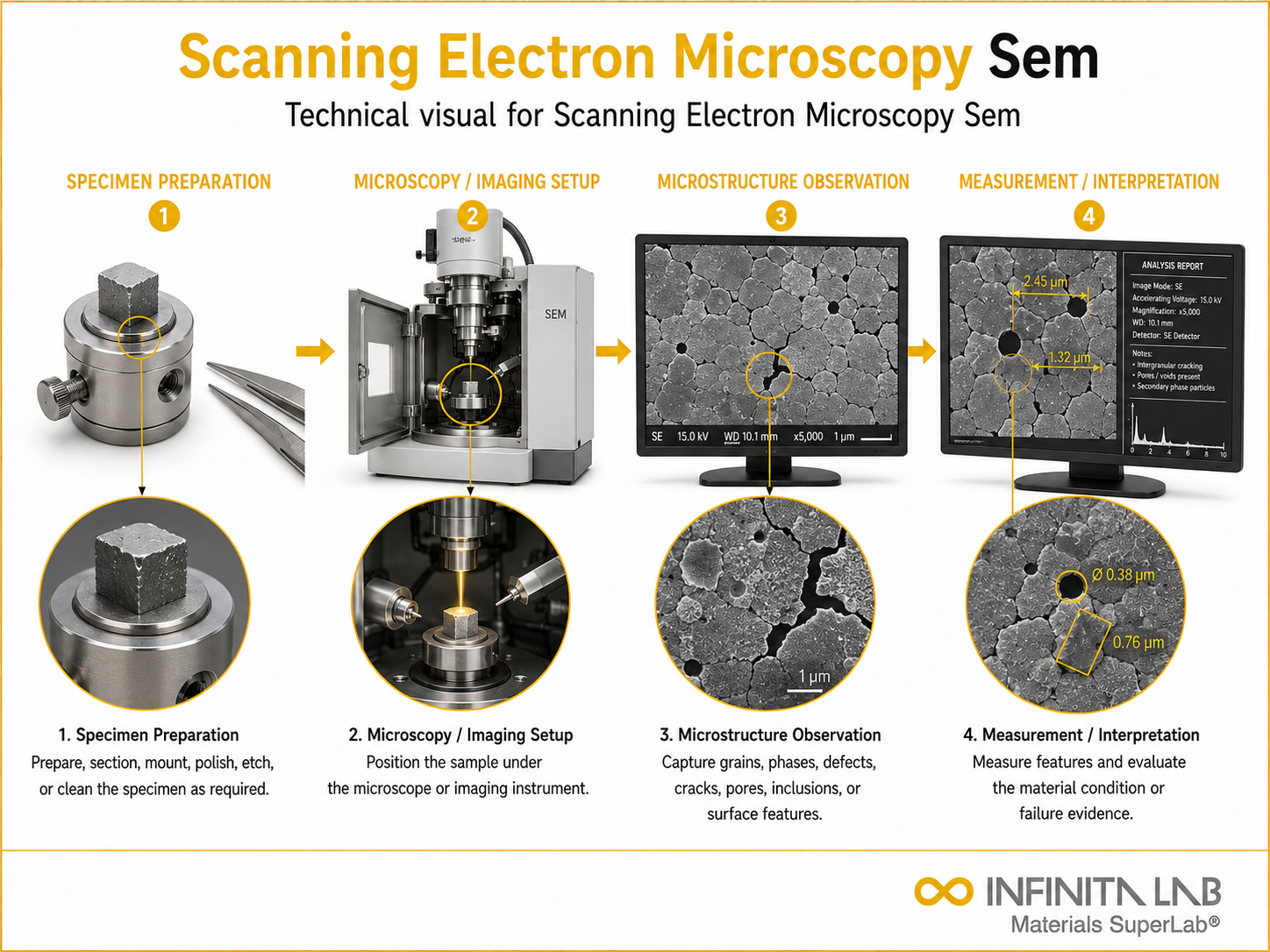
Scanning Electron Microscopy (SEM) Process
Specimen Preparation
Specimens are cleaned, sectioned if required, and mounted for the instrument.
1Instrument Setup
Accelerating voltage, beam current, and working distance are selected based on specimen type and required resolution.
2Imaging and Analysis
SE and BSE images are acquired at relevant magnifications.
3Data Compilation and Reporting
Images are annotated with scale bars and key features identified.
4Scanning Electron Microscopy (SEM) Technical Specifications
| Parameter | Details |
|---|---|
| Technique | Scanning electron microscopy |
| Imaging Modes | Secondary electron (SE), backscattered electron (BSE) |
| Elemental Analysis | Energy-dispersive X-ray spectroscopy (EDS) |
| Magnification Range | Approximately 10x to 300,000x |
| Resolution | Sub-10 nm at optimized conditions |
| Accelerating Voltage | 0.5 kV to 30 kV (material and application dependent) |


Instrumentation Used for Scanning Electron Microscopy (SEM)
- Scanning electron microscope with secondary and backscattered electron detectors
- Energy-dispersive X-ray spectroscopy (EDS) system
- Sputter coater for non-conductive specimen preparation
- Specimen preparation equipment (sectioning, polishing, mounting)
- Carbon evaporator for EDS-optimized conductive coating
- Image analysis software for measurement and quantification
Scanning Electron Microscopy (SEM) Results and Deliverables
- High-resolution SE and BSE images with calibrated scale bars
- EDS spectra and elemental composition data at regions of interest
- EDS elemental maps showing the distribution of key elements
- Annotated images identifying features, defects, or phases of interest
- Written analysis report with interpretation of findings
- Quality assurance documentation
Frequently Asked Questions
The fundamental application of an SEM is the interaction between a high-energy electron beam and the specimen under examination. Such interactions can provide information about the specimen's topology, composition, crystallography, and electrical properties, among many other characteristics.
The SEM technique provides nanocarriers with their morphology by scanning the surface with a focused beam of electrons. It also reveals data concerning the chemical composition, crystalline structure, and orientation of the materials from which the specimen is made.
The images are created by the electron beam from scanning electron microscopes (SEMs) with a resolution of a few nanometers. The electron source in this configuration emits electrons by a filament, which are then collimated into a beam inside the electron source. Once the electrons are inside, they are focused by the lens in the column toward the sample's surface to form an image.
It is frequently applied for quality assurance, material characterization, failure analysis, textural analysis, and topographical analysis in the business and scientific industries. In the manufacture of electronics, including the assembly of microchips.
An SEM detects two types of electrons: BSEs and SEs. BSEs are elastically reflected by the interactions between the beam and the sample. On the other hand, SEs are low-energy electrons emitted from the sample surface.
Why Choose Infinita Lab for Advanced Materials Testing and Characterization?
At the core of this breadth is our network of 2,000+ accredited laboratories across the USA, offering access to over 10,000 testing methods and analytical services. From advanced materials characterization (SEM, TEM, RBS, XPS) to mechanical, chemical, environmental, biological, and standardized ASTM/ISO-compliant testing, we deliver unmatched flexibility, specialization, and scale. You are never limited by geography, facility, or methodology — Infinita Lab connects you to the right expertise and testing solution, every time.

Looking for a Trusted Partner for Accurate and Reliable Testing Services?
Send query us at hello@infinitalab.com or call us at (888) 878-3090 to learn more about our services and how we can support you.



Request a Quote
Submit your material details and receive testing procedures, pricing, and turnaround time within 24 hours.
 Quick Turnaround and Hasslefree process
 Confidentiality Guarantee
 Free, No-obligation Consultation
 100% Customer Satisfaction
