


Micro-FTIR Spectroscopy Testing for Microscale Material Identification
Fourier-Transform Infrared Spectroscopy (FTIR) is a technique used to obtain an infrared spectrum of absorption or emission of a solid, liquid, or gas. Micro-Fourier Transform Infrared Spectrometry (Micro-FTIR) combines a microscope with an FTIR instrument, providing even more information about the chemical fingerprints for both organic and inorganic compounds that are components in trace evidence.
TRUSTED BY


Precision-driven testing for dimensional accuracy and compliance
- Overview
- Scope, Applications, and Benefits
- Test Process
- Specifications
- Instrumentation
- Results and Deliverables
Overview
Micro-Fourier Transform Infrared Spectroscopy (Micro-FTIR) is an advanced technique that combines infrared spectroscopy and microscopy. It is useful in identifying and determining the composition of materials at the micro-level.
The Micro-FTIR technique is very important in analysing inclusions, contaminants, coatings, films, or microsamples that cannot be easily analysed with conventional FTIR. This is because, with conventional FTIR, we can pass an infrared beam through a microscope, thus analysing materials at the micro-level without any damage.

Scope, Applications, and Benefits
Scope
Micro-FTIR, also referred to as Fourier Transform Infrared Microscopy, is an approach that has been developed specifically with the aim of analysing small quantities. It combines infrared and microscopy, enabling scientists to identify unknown materials, analyse functions, and detect contaminants in small quantities. This approach is particularly useful in cases where there is limited sample availability.
Applications
- Analysis of fibres, paints, and residues
- Polymer and composite microanalysis
- Coatings and thin film characterisation
- Micro-contaminant identification in cosmetics and industrial materials
- Failure analysis of small components
- Research and development of microscale materials
Benefits
- Enables chemical analysis at micrometre-scale regions
- Non-destructive testing of micro-samples
- Identifies contaminants or inclusions not detectable by bulk FTIR
- Supports quality control of small components
- Provides standardised spectral identification
- Improves accuracy in forensic and materials investigations
- Compatible with conventional FTIR databases
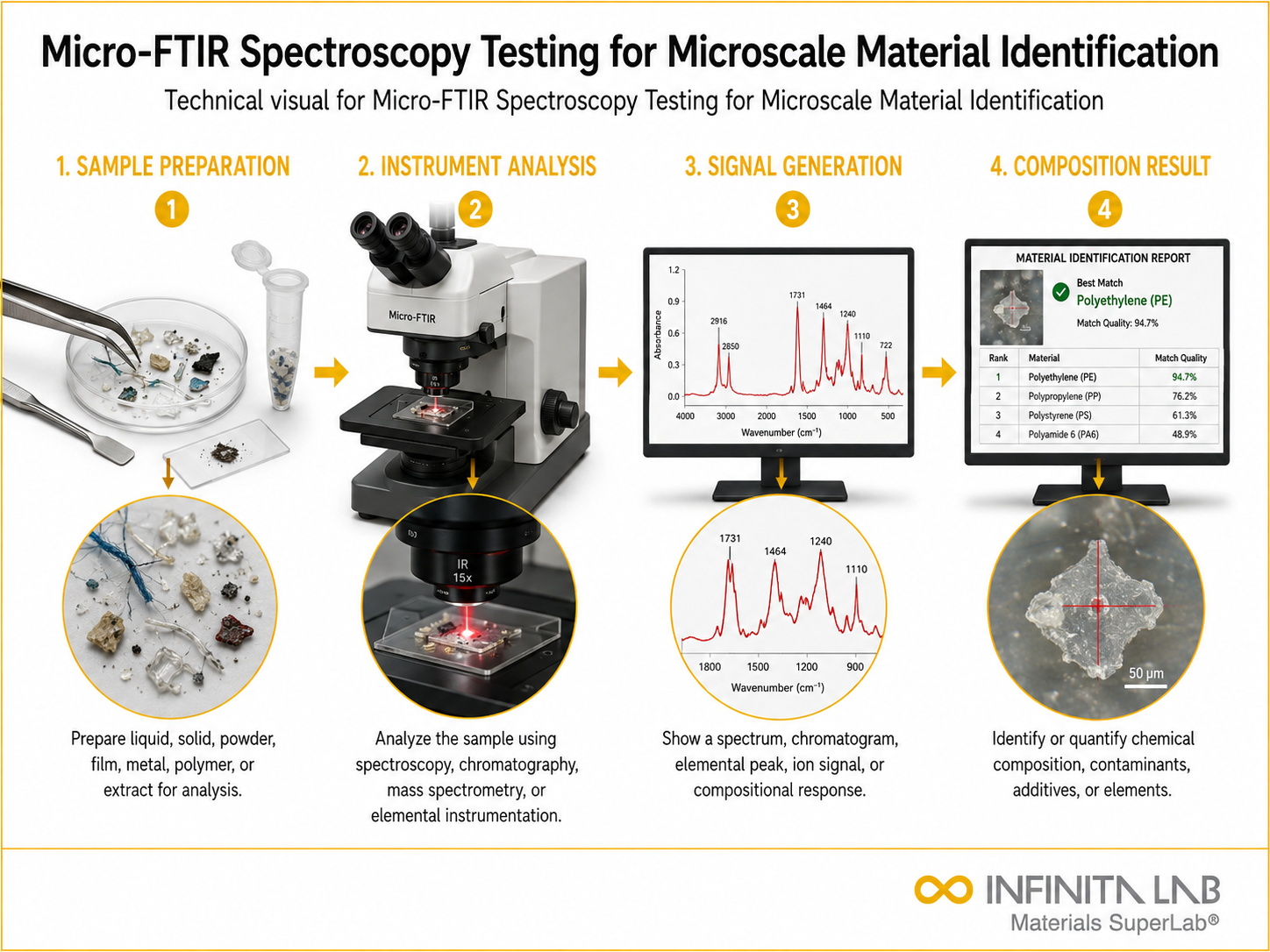
Test Process
Sample Preparation & Mounting
Micro-samples are mounted on IR-transparent slides or reflective substrates.
1Microscope Alignment & Measurement
Sample is positioned, focused, and irradiated with an IR beam.
2Spectral Acquisition
Interferograms are collected and converted into frequency-domain spectra.
3Data Analysis
Spectra are compared with reference databases to identify chemical composition and functional groups.
4Technical Specifications
| Parameter | Details |
|---|---|
| Applicable Materials | Solids, powders, coatings, thin films, micro-samples |
| Frequency Range | Mid-IR: 4000–50 cm⁻¹; Near-IR applicable above 4000 cm⁻¹ |
| Spatial Resolution | Typically 10–50 µm depending on aperture and optics |
| Output Format | % Transmission or % Reflectance vs Wavenumber (cm⁻¹) spectrum |
| Analysis Type | Qualitative and quantitative (if applicable) |
| Data Requirement | Reference spectral database for identification |


Instrumentation Used for Testing
- FTIR spectrometer with microscope attachment
- IR microscope with imaging capabilities
- ATR, DRIFTS, or reflective accessories for microanalysis
- IR-transparent slides or reflective substrates
- Microsample preparation tools (microtome, scalpel, or micro-press)
- Data acquisition and spectral analysis software
- Calibration standards for wavelength and intensity
Results and Deliverables
- FTIR spectrum of micro-scale regions
- Functional group and molecular identification
- Detection and analysis of micro-contaminants or inclusions
- Thin film or coating composition analysis
- Comparative spectral matching reports
- Reports
Frequently Asked Questions
Micro-FTIR is a technique that combines Fourier Transform Infrared Spectroscopy with optical microscopy. This allows us to perform a chemical analysis on a region as small as a micrometres. We can identify certain compounds and contaminants in these small regions.
Unlike the conventional FTIR, where a sample is analysed in its macro form, Micro-FTIR analyses a small microscopic region on the sample.
The resolution range is between 10 and 50 micrometres, and it depends on the microscope and the size of the aperture.
Preparation is minimal. Small samples are placed on IR-transparent slides or a reflective substrate. For some solids/thin films, microtomy may be performed.
Quantitative results are attainable with calibration standards and proper sampling techniques. It is possible to modify the guidelines of ASTM E168 for quantitative FTIR analysis for micro-samples.
Why Choose Infinita Lab for Advanced Materials Testing and Characterization?
At the core of this breadth is our network of 2,000+ accredited laboratories across the USA, offering access to over 10,000 testing methods and analytical services. From advanced materials characterization (SEM, TEM, RBS, XPS) to mechanical, chemical, environmental, biological, and standardized ASTM/ISO-compliant testing, we deliver unmatched flexibility, specialization, and scale. You are never limited by geography, facility, or methodology — Infinita Lab connects you to the right expertise and testing solution, every time.

Looking for a Trusted Partner for Accurate and Reliable Testing Services?
Send query us at hello@infinitlab.com or call us at (888) 878-3090 to learn more about our services and how we can support you.



Request a Quote
Submit your material details and receive testing procedures, pricing, and turnaround time within 24 hours.
 Quick Turnaround and Hasslefree process
 Confidentiality Guarantee
 Free, No-obligation Consultation
 100% Customer Satisfaction
