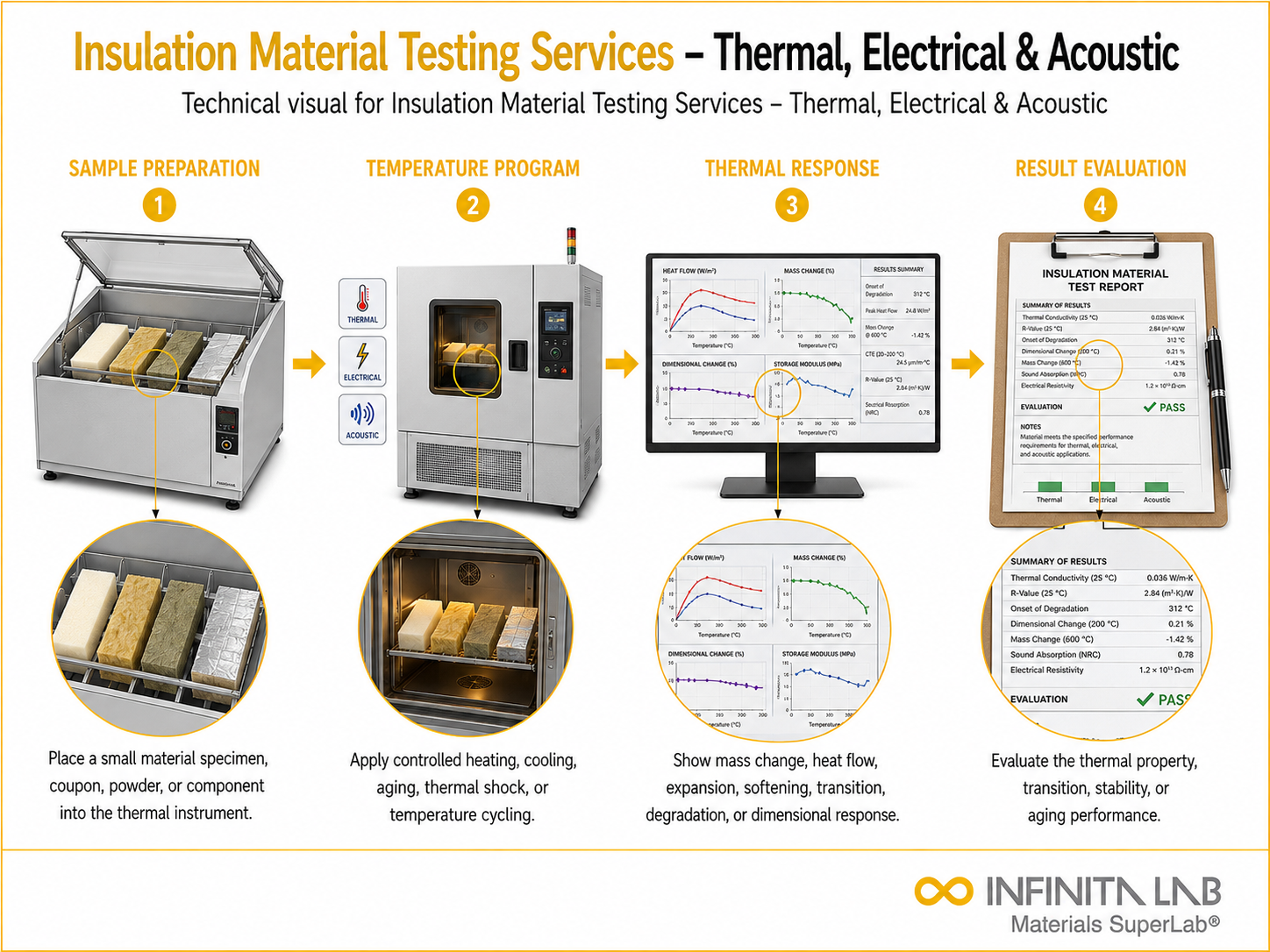


What Is Insulation Material?
Insulation material testing evaluates the thermal performance of materials by measuring their ability to resist heat transfer under controlled conditions. The primary parameter assessed is thermal conductivity, which determines how effectively a material insulates.
This testing is critical for ensuring energy efficiency, thermal stability, and reliability of performance in applications where temperature control is essential. It also considers factors such as material thickness, density, and environmental conditions that influence insulation behavior.

Applications and Benefits of Insulation Material Testing
Scope
Insulation material testing evaluates:
- Thermal conductivity (k-value, typically ~0.02–0.08 W/m·K)
- Thermal resistance (R-value, m²·K/W)
- Heat transfer rate (W/m²)
- Effect of thickness and density on insulation performance
- Steady-state heat flow behavior
Applications
- Building and construction insulation systems
- Power plants and energy infrastructure
- HVAC and refrigeration systems
- Electronic device thermal management
- Industrial process insulation
Benefits
- Improves energy efficiency and reduces heat loss
- Supports accurate material selection
- Enables performance comparison across insulation materials
- Enhances thermal design reliability
- Provides quantitative heat transfer data
Our Testing Procedure
Sample Preparation
Specimens are cut to standard dimensions and conditioned at ~23°C and 50% RH.
1Heat Application
The sample is placed between hot and cold plates ensuring proper thermal contact.
2Heat Application
A controlled temp gradient (ΔT typically 10–50°C) is applied to establish steady-state heat flow.
3Data Analysis
Heat flux and temperature difference are recorded to calculate thermal conductivity and R-value.
4Test parameters and requirements
| Parameter | Details |
|---|---|
| Standard | ASTM C518, ASTM C177, ISO 8301 |
| Applicable Materials | Foams, fiberglass, mineral wool, composites |
| Temperature Range | Typically 0°C to 100°C (extended for special tests) |
| Thickness Range | ~5 mm to 100 mm |
| Measured Outputs | Thermal conductivity (W/m·K), R-value |


- Heat Flow Meter (HFM) apparatus
- Guarded hot plate system
- Heat flux sensors
- Thermocouples/temperature sensors
- Controlled heat source
- Data acquisition system
Equipment and Instrumentation Used for Testing
What You Receive: Test Report, Data, and Certification
- Thermal conductivity (k-value) results
- Thermal resistance (R-value) calculations
- Heat transfer performance data
- Temperature vs heat flow curves
- Comparative insulation performance analysis
- Test Reports
Insulation Material FAQs
Insulation material testing measures how well a material resists heat transfer. It determines properties such as thermal conductivity and resistance, which are essential for evaluating insulation efficiency in various applications.
Thermal conductivity is a measure of how easily heat passes through a material. Lower k-values indicate better insulation performance, meaning the material resists heat flow more effectively.
R-value represents the thermal resistance of a material. It indicates how well the material prevents heat transfer, with higher R-values corresponding to better insulation performance.
Common materials include fiberglass, foam insulation, mineral wool, and composite insulation products used in construction, industrial systems, and thermal management applications.
Insulation testing ensures materials provide effective thermal resistance, reducing energy loss and improving efficiency. It is critical for maintaining temperature control and optimizing performance in buildings and industrial systems.
Why Choose Infinita Lab for Insulation Material Testing?
At the core of this breadth is our network of 2,000+ accredited laboratories across the USA, offering access to over 10,000 testing methods and analytical services. From advanced materials characterization (SEM, TEM, RBS, XPS) to mechanical, chemical, environmental, biological, and standardized ASTM/ISO-compliant testing, we deliver unmatched flexibility, specialization, and scale. You are never limited by geography, facility, or methodology — Infinita Lab connects you to the right expertise and testing solution, every time.

Looking for an Accredited Partner for Insulation Material Testing?
Send query us at hello@infinitalab.com or call us at (888) 878-3090 to learn more about our services and how we can support you.





