


Horizontal Electrospinning Guide Testing Services
Horizontal electrospinning is a promising technology that offers unique advantages over typical vertical electrospinning. It is a flexible process with several uses in materials science and nanotechnology due to its capacity to manufacture uniform and controllable nanofibers over a larger region. Its capacity for scalability also makes it an attractive option for industrial production. As the technology continues to develop and improve, it is anticipated to become an increasingly important instrument in the field of nanofiber production.
TRUSTED BY


Get compliant results — request your horizontal electrospinning guide testing quote
- Overview
- Scope, Applications, and Benefits
- Test Process
- Specifications
- Instrumentation
- Results and Deliverables
What Is Horizontal Electrospinning Guide?
Horizontal electrospinning is an advanced nanofiber fabrication technique in which polymer solutions are stretched into fine fibers using a high-voltage electric field, with the setup arranged parallel to the ground. Unlike conventional vertical systems, the collector is typically a rotating drum that enables controlled fiber deposition and alignment.
This method allows improved control over fiber orientation, uniformity, and scalability. By continuously rotating the collector, horizontal electrospinning supports large-area nanofiber production and is widely used in applications such as filtration, tissue engineering, and energy materials.

Applications and Benefits of Horizontal Electrospinning Guide Testing
Scope
Horizontal electrospinning evaluates:
- Nanofiber diameter (typically ~50 nm to 2 µm)
- Fiber alignment and orientation control
- Surface morphology and porosity
- Deposition uniformity across large areas
Applications
- Tissue engineering scaffolds
- Filtration membranes (air, water)
- Energy storage (battery separators, supercapacitors)
- Sensors and functional coatings
- Nanomaterials and research applications
Benefits
- Produces highly aligned and uniform nanofibers
- Enables large-area and continuous production
- Improves control over fiber morphology
- Scalable for industrial applications
- Enhances material performance due to high surface area
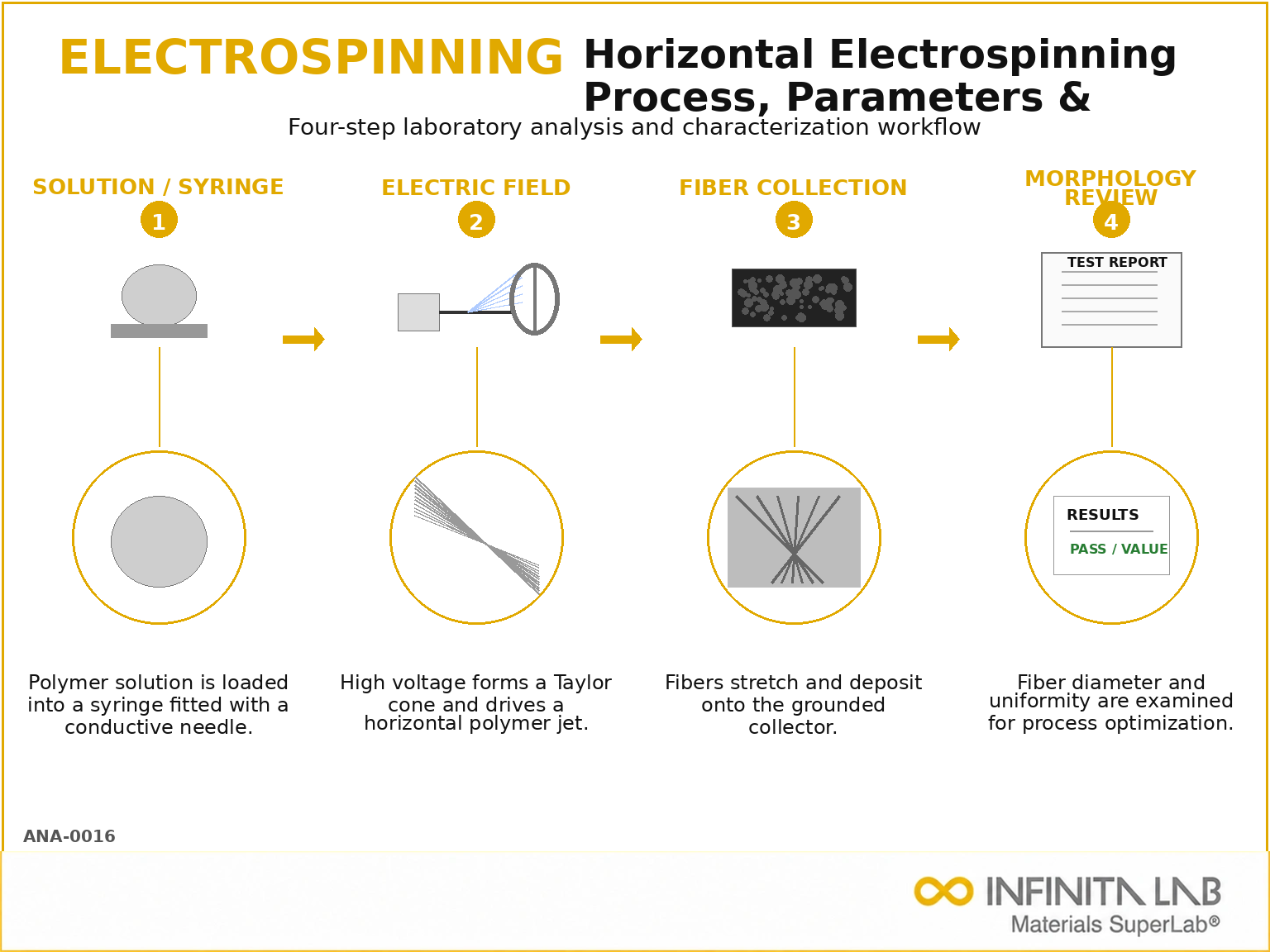
Our Testing Procedure
Solution Preparation
Polymer solution (typically 5–20 wt%) is prepared with controlled viscosity and conductivity.
1Voltage Application
High voltage (~10–30 kV) is applied between needle and collector to form a Taylor cone.
2Fiber Formation
A charged jet is ejected and stretched into nanofibers as solvent evaporates.
3Collection
Fibers are deposited on a rotating drum (speed ~100–2000 rpm) for alignment and uniformity.
4Test parameters and requirements
| Parameter | Details |
|---|---|
| Standard | Research-based / process-specific |
| Voltage Range | ~10–30 kV |
| Distance (Needle–Collector) | ~10–20 cm |
| Flow Rate | ~0.1–2 mL/h |
| Applicable Materials | Polymers, composites, nanomaterials |
| Measured Outputs | Fiber diameter, alignment, morphology |


- Electrospinning setup (horizontal configuration)
- High-voltage power supply
- Syringe pump (controlled flow rate)
- Spinneret/needle system
- Rotating drum collector
- Scanning Electron Microscope (SEM)
Equipment and Instrumentation Used for Testing
What You Receive: Test Report, Data, and Certification
- Nanofiber diameter distribution (nm–µm range)
- Fiber alignment and orientation analysis
- Surface morphology (SEM images)
- Porosity and structural uniformity data
- Comparative performance across process parameters
Horizontal Electrospinning Guide FAQs
Horizontal electrospinning is a nanofiber fabrication technique where the electrospinning setup is arranged parallel to the ground. It uses a rotating collector to improve fiber alignment and uniformity compared to traditional vertical systems.
Electrospinning typically uses high voltages in the range of 10–30 kV. This voltage creates an electric field strong enough to overcome surface tension and form a continuous polymer jet.
A rotating drum helps align fibers and ensures uniform deposition. It also enables continuous production over larger areas, improving scalability and consistency of nanofiber structures.
Fiber diameter is influenced by solution viscosity, voltage, flow rate, and distance between the needle and collector. Adjusting these parameters allows control over nanofiber size and morphology.
Horizontal electrospinning offers better fiber alignment, improved uniformity, and higher scalability. It is particularly useful for applications requiring structured nanofiber orientation and large-scale production.
Why Choose Infinita Lab for Horizontal Electrospinning Guide Testing?
At the core of this breadth is our network of 2,000+ accredited laboratories across the USA, offering access to over 10,000 testing methods and analytical services. From advanced materials characterization (SEM, TEM, RBS, XPS) to mechanical, chemical, environmental, biological, and standardized ASTM/ISO-compliant testing, we deliver unmatched flexibility, specialization, and scale. You are never limited by geography, facility, or methodology — Infinita Lab connects you to the right expertise and testing solution, every time.

Looking for an Accredited Partner for Horizontal Electrospinning Guide Testing?
Send query us at hello@infinitalab.com or call us at (888) 878-3090 to learn more about our services and how we can support you.



Request a Quote
Submit your material details and receive testing procedures, pricing, and turnaround time within 24 hours.
 Quick Turnaround and Hasslefree process
 Confidentiality Guarantee
 Free, No-obligation Consultation
 100% Customer Satisfaction
