


Dissolution Testing Services
Dissolution testing is used in the pharmaceutical industry to assess the batch-to-batch consistency of solid oral dosage forms and to predict in vivo drug release profiles. It is performed using Apparatus 1 and 2 according to USP Chapter 711. Six tablets are evaluated during Stage S1 and extra tablets may be tested in the following stages if necessary. The results are analyzed using HLPC or UV/Vis methods. Monographs detail the stages and tablet formulations.
TRUSTED BY


Get compliant results — request your dissolution testing quote
- Overview
- Scope, Applications, and Benefits
- Test Process
- Specifications
- Instrumentation
- Results and Deliverables
What Is Dissolution?
Dissolution testing measures the rate and extent to which the active pharmaceutical ingredient (API) is released from a solid oral dosage form into solution under defined, controlled conditions. It is one of the most important quality control tests in the pharmaceutical industry because the dissolution profile of a tablet or capsule is directly linked to how the drug becomes available for absorption in the body. A formulation that dissolves too slowly, too quickly, or inconsistently from batch to batch can fail to deliver the intended therapeutic effect.
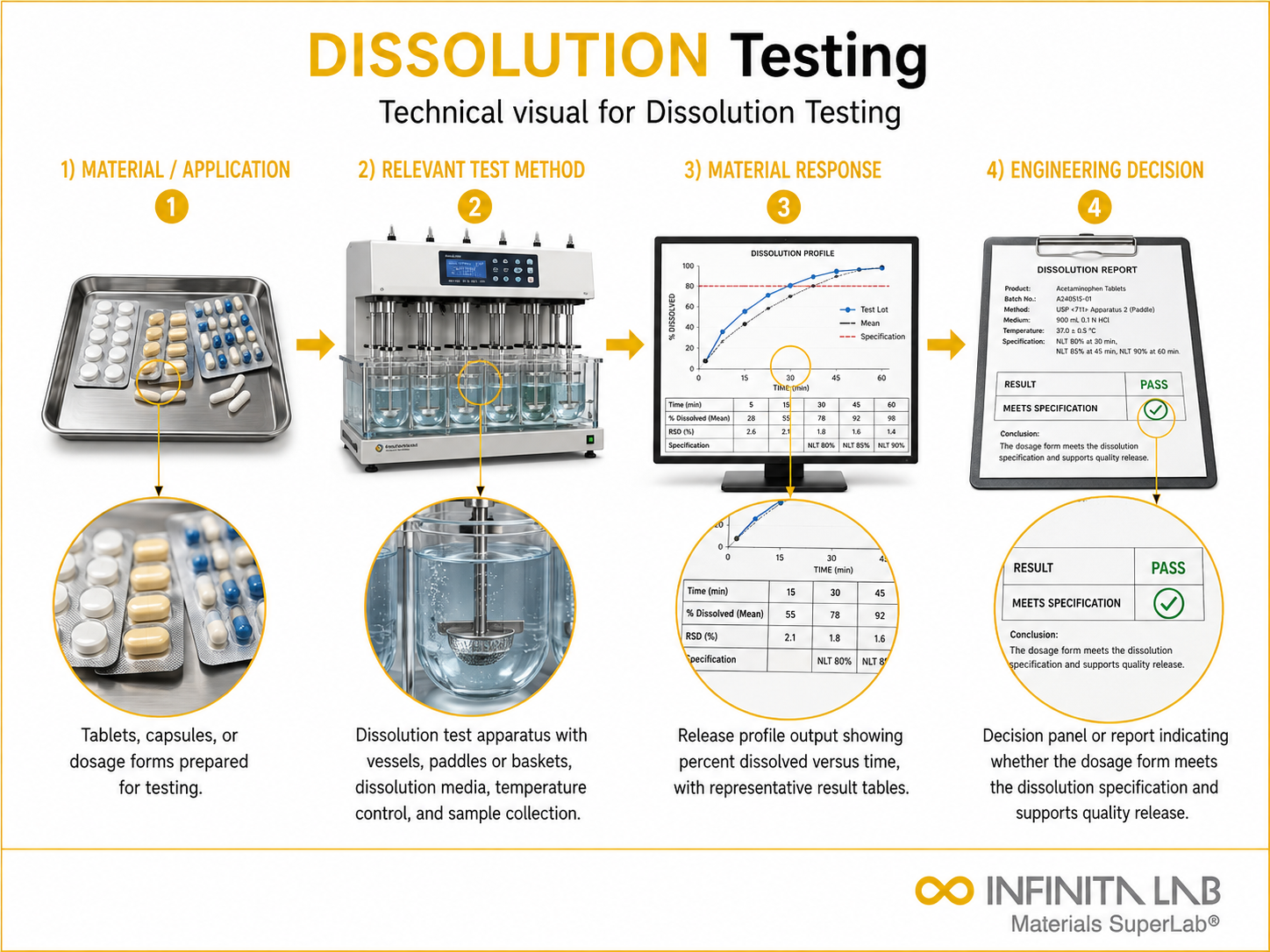
The test is performed using standardized dissolution apparatus – most commonly USP Apparatus 1 (rotating basket) and Apparatus 2 (paddle) – operating in a defined volume of dissolution medium held at body temperature (37°C). At specified time points, samples of the medium are withdrawn and the dissolved drug concentration is measured, typically by UV-Vis spectrophotometry or HPLC, to build a release profile over time.
Dissolution testing is governed by USP General Chapter 711 and is required for batch release, formulation development, stability studies, and bioequivalence assessment. Individual drug product monographs specify the apparatus, medium, rotation speed, time points, and acceptance criteria for each product, and the staged acceptance approach (S1, S2, S3) determines whether a batch meets requirements.

Applications and Benefits of Dissolution Testing
Scope
Dissolution testing covers the in vitro measurement of drug release from solid and semi-solid dosage forms under standardized conditions. The test method, apparatus, and acceptance criteria are defined per USP <711> and the applicable product monograph.
Key aspects of the test scope include:
- USP Apparatus 1 (Basket) – the dosage form is enclosed in a rotating wire-mesh basket; suited for floating dosage forms, capsules, and products that would otherwise stick to the vessel
- USP Apparatus 2 (Paddle) – the dosage form sits at the bottom of the vessel while a paddle rotates above it; the most widely used configuration for tablets
- Additional apparatus – Apparatus 3 (reciprocating cylinder), Apparatus 4 (flow-through cell), and others for modified-release, transdermal, and specialized dosage forms
- Staged acceptance (S1/S2/S3) – testing begins with 6 units (S1); if acceptance is not met, additional units are tested at S2 (6 more) and S3 (12 more) per the tolerance criteria in USP 711
- Analytical quantification – dissolved drug is measured by UV-Vis spectrophotometry or HPLC depending on the API and the presence of interfering excipients
- Applicable dosage forms – immediate-release and extended-release tablets and capsules, suspensions, chewable tablets, transdermal patches, and other oral and topical delivery forms
Applications
- Batch release quality control – routine dissolution testing of production batches against the monograph acceptance criteria before release to market; one of the core release tests for solid oral products
- Formulation development – comparing dissolution profiles of formulation variants during development to optimize disintegration, release rate, and excipient selection
- Generic drug development and bioequivalence – dissolution profile comparison between a generic product and the reference listed drug, used to support biowaivers and demonstrate comparable in vitro release
- Stability studies – monitoring whether the dissolution profile of a product changes over its shelf life under various storage conditions, which can indicate physical or chemical changes in the formulation
- Modified-release product characterization – verifying that extended-release, delayed-release, or enteric-coated products release the drug according to their intended profile across multiple time points
- Post-approval changes (SUPAC) – dissolution testing to support manufacturing site changes, equipment changes, or formulation modifications without requiring new clinical studies
- Quality investigations – dissolution testing as part of investigating product complaints, out-of-specification results, or suspected formulation issues
Benefits
- Directly linked to in vivo drug availability – for many products, the dissolution profile is the best in vitro predictor of how the drug will be released and become available in the body, making it far more meaningful than a simple content assay alone
- Detects batch-to-batch variability that other tests miss – two batches can have identical assay and content uniformity but very different release behavior; dissolution is the test that catches this
- Staged acceptance avoids unnecessary rejection – the S1/S2/S3 approach provides a statistically sound way to accept batches that meet requirements while testing enough units to make a reliable determination
- Supports biowaivers and reduces clinical burden – for eligible products, dissolution profile comparison can support a biowaiver, avoiding the cost and time of in vivo bioequivalence studies
- Established, internationally recognized method – USP <711> and the equivalent EP and JP chapters are accepted worldwide, so dissolution data generated to these standards supports submissions across markets
Dissolution Testing Process
Prepare the System
Prepare and degas the dissolution medium, maintain it at 37 ± 0.5°C, and set the required apparatus, speed, and volume.
1Introduce Samples
Place six dosage units into the vessels and start the apparatus and test timer simultaneously.
2Sample and Analyse
Withdraw samples at specified intervals, filter them, and measure dissolved drug content using UV-Vis or HPLC.
3Evaluate Results
Calculate the percentage dissolved and assess compliance using the S1, S2, and S3 acceptance stages.
4Dissolution Testing Technical Specifications
| Parameter | Details |
|---|---|
| Apparatus | USP Apparatus 1 (Basket), Apparatus 2 (Paddle); Apparatus 3/4 for specialized forms |
| Medium Temperature | 37 ± 0.5°C |
| Dissolution Medium | Per monograph - buffers, SGF, SIF, water, or surfactant-containing media |
| Rotation Speed | Typically 50–100 rpm (paddle/basket); per monograph |
| Medium Volume | Commonly 500, 900, or 1000 mL; per monograph |
| Acceptance Stages | S1 (6 units), S2 (+6 units), S3 (+12 units) per USP <711> tolerances |
| Analytical Method | UV-Vis spectrophotometry or HPLC |
| Dosage Forms | Immediate-release and modified-release tablets/capsules, suspensions, transdermals |


- Dissolution test apparatus (USP Apparatus 1 and 2) with temperature-controlled water bath
- Automated or manual sampling system
- UV-Vis spectrophotometer
- HPLC system (for drugs requiring chromatographic quantification)
- Media degassing system
- Calibrated thermometers and tachometer for apparatus qualification
- Analytical balance and volumetric glassware for medium preparation
Instrumentation Used for Dissolution Testing
What You Receive: Test Report, Data, and Certification
- Dissolution test report – apparatus, medium, rotation speed, temperature, time points, and percent dissolved for each unit at each time point
- Dissolution profile – tabulated and plotted percent-dissolved-versus-time data for the tested units
- Stage determination – S1/S2/S3 stage reached and pass/fail outcome against the monograph acceptance criteria
- Individual and mean results – per-vessel data with mean, range, and %RSD across the units tested
- Analytical raw data – UV absorbance or HPLC chromatograms and calculation records supporting the reported values
- Method and product identification – product name, batch/lot number, dosage strength, and monograph reference
Dissolution FAQs
It helps evaluate drug-release performance, formulation consistency and manufacturing quality. It is widely used during product development, quality control, stability studies and regulatory assessment.
Common systems include Apparatus 1, basket; Apparatus 2, paddle; Apparatus 3, reciprocating cylinder; and Apparatus 4, flow-through cell. Selection depends on the dosage form and release characteristics.
In the basket method, the dosage unit is placed inside a rotating wire-mesh basket immersed in the dissolution medium. It is often useful for capsules and dosage forms that float.
The paddle method places the dosage form at the bottom of a vessel while a paddle rotates above it. It is one of the most widely used methods for tablets and capsules.
The dissolution medium is the liquid in which the dosage form releases the drug. Water, buffers, dilute acids or media containing suitable surfactants may be used depending on the product.
Why Choose Infinita Lab for Dissolution Testing
At the core of this breadth is our network of 2,000+ accredited laboratories across the USA, offering access to over 10,000 testing methods and analytical services. From advanced materials characterization (SEM, TEM, RBS, XPS) to mechanical, chemical, environmental, biological, and standardized ASTM/ISO-compliant testing, we deliver unmatched flexibility, specialization, and scale. You are never limited by geography, facility, or methodology — Infinita Lab connects you to the right expertise and testing solution, every time.

Looking for an Accredited Partner for Dissolution Testing?
Send query us at hello@infinitalab.com or call us at (888) 878-3090 to learn more about our services and how we can support you.



Request a Quote
Submit your material details and receive testing procedures, pricing, and turnaround time within 24 hours.
 Quick Turnaround and Hasslefree process
 Confidentiality Guarantee
 Free, No-obligation Consultation
 100% Customer Satisfaction
