


Disinfection Efficacy Testing Services
Disinfectant tests are conducted to ensure the safety of sanitizing products used in the market. Different materials and standards are used to evaluate the disinfectant's efficacy, such as hand sanitizers, sporicides, fungicides, and USP General Chapter 1072 and The Official Techniques of Analysis of AOAC International. Experts also conduct virus and virucidal testing to measure the effectiveness of disinfectants on viruses.
TRUSTED BY


Get compliant results — request your disinfection efficacy testing quote
- Overview
- Scope, Applications, and Benefits
- Test Process
- Specifications
- Instrumentation
- Results and Deliverables
What Is Disinfection Efficacy?
Disinfection efficacy testing measures how effectively a disinfectant or sanitizing product kills or reduces target microorganisms under defined test conditions. The testing covers a range of product types — including surface disinfectants, hand sanitizers, sporicides, fungicides, and virucidal agents — and is conducted using standardized protocols that simulate real-world use conditions as closely as possible.
The tests are designed to generate quantitative data on microbial reduction, expressed as log reduction values, against specific organisms at defined contact times, concentrations, and surface or carrier conditions. The choice of test method depends on the product type, intended use environment, and the organisms the product claims to be effective against.
For any company bringing a disinfectant product to market, or evaluating disinfection protocols used in their facilities, efficacy data generated under recognized standards is the baseline requirement for substantiating performance claims and satisfying regulatory review.

Applications and Benefits of Disinfection Efficacy Testing
Scope
Disinfection efficacy testing covers the evaluation of antimicrobial products and surface decontamination procedures against bacteria, fungi, spores, and viruses. Testing is conducted using validated quantitative methods that measure the log reduction in viable organisms following exposure to the test product under specified conditions of concentration, contact time, temperature, and organic soil load.
Commonly referenced standards and methods include:
- AOAC International Official Methods — including AOAC 955.14 (germicidal spray), AOAC 961.02 (use-dilution), and AOAC 966.04 (sporicidal activity), widely accepted for EPA registration submissions
- USP General Chapter <1072> — disinfectants and antiseptics, covering testing scope and interpretation for pharmaceutical and healthcare environments
- ASTM E2315 — assessment of antimicrobial activity using a time-kill procedure
- EN 13697 / EN 1276 — European standard quantitative surface and suspension tests for bactericidal and fungicidal activity
- EPA DIS/TSS protocols — for products subject to EPA registration under FIFRA
- ISO 22196 — measurement of antibacterial activity on plastics and non-porous surfaces
Applications
- Disinfectant product development — generating efficacy data to support label claims for new products targeting hospital, food processing, or consumer markets
- Food and beverage processing — testing sanitisers used on food contact surfaces for efficacy against common foodborne pathogens such as Salmonella, E. coli, and Listeria
- Veterinary and agricultural settings — evaluation of disinfectants used in animal housing, veterinary clinics, and equipment decontamination
- Surface material antimicrobial claims — testing of antimicrobial-treated surfaces, coatings, or materials to verify and quantify their activity against target organisms
- Virucidal testing — quantitative evaluation of disinfectants against specific viruses, including enveloped and non-enveloped strains, using appropriate surrogate or target virus test systems
Benefits
- Quantifies actual microbial kill rather than estimating it — log reduction data gives a precise, reproducible measure of product performance that a label claim or in-house assessment cannot provide
- Matches the method to the intended use — suspension tests, carrier tests, and surface tests each model a different use condition; selecting the right method produces data that reflects real-world performance
- Covers a broad range of organisms in one study scope — bacteria, fungi, spores, and viruses can all be addressed under one testing engagement with the appropriate lab
- Supports product differentiation — head-to-head efficacy data against competitor products or across concentration ranges gives formulation teams and commercial teams concrete data to work with
- Required for regulatory submissions in many markets — EPA, FDA, and international health authorities require specific method-generated data before a disinfectant product can make efficacy claims
Our Testing Procedure
Test Design
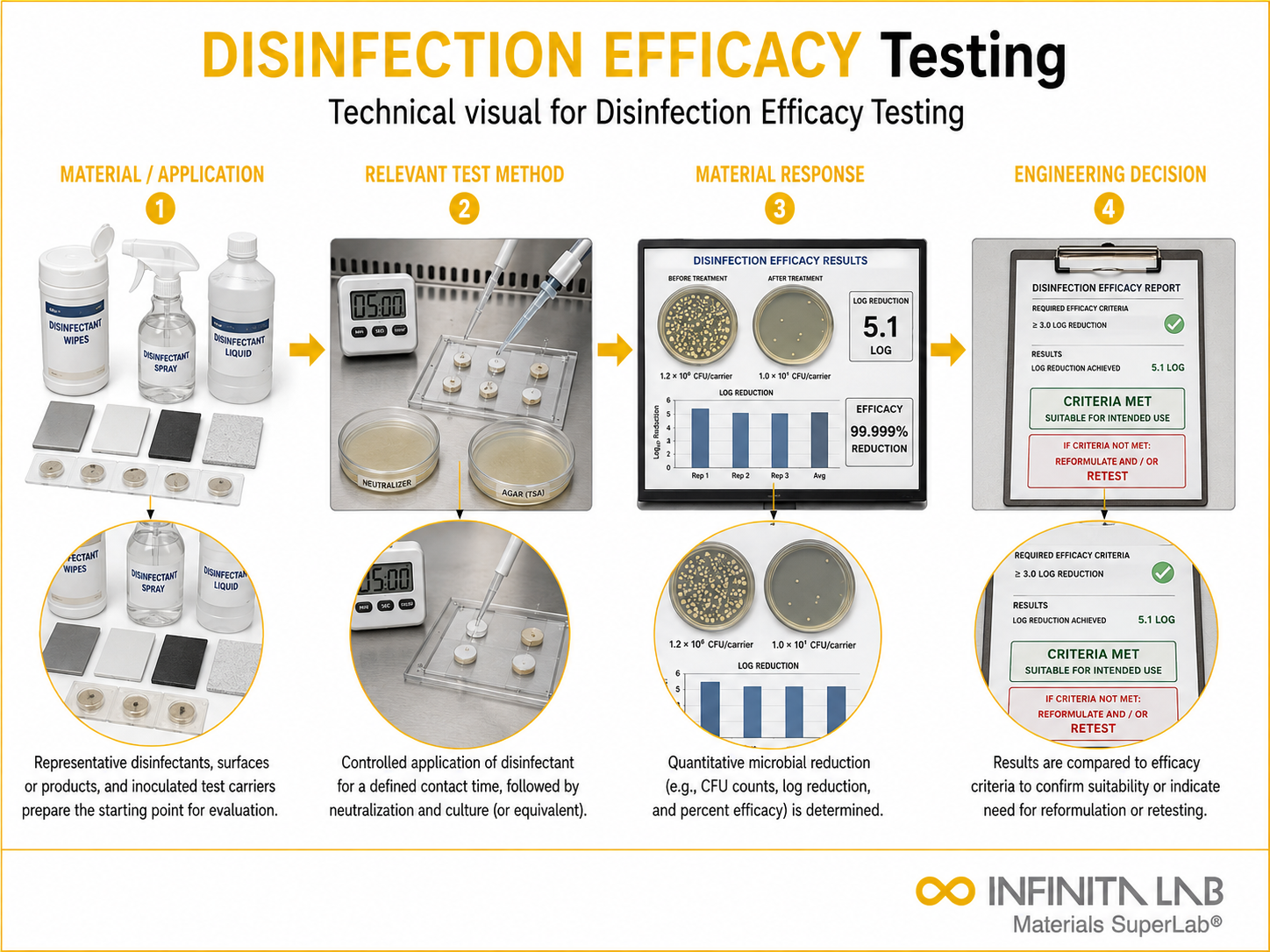
The protocol is defined based on product type, target organisms, contact time, concentration, temperature, and required test method.
1Inoculum and Surface Preparation
A standardized organism culture is prepared and applied to selected carriers or test surfaces under controlled conditions.
2Product Exposure
The test product is applied for the specified contact time, followed by immediate neutralization to stop antimicrobial activity.
3Counting and Reporting
Surviving organisms are recovered, counted, and compared with controls to calculate log reduction and determine whether the product meets acceptance criteria.
4Test parameters and requirements
| Parameter | Details |
|---|---|
| Test Types | Suspension tests, carrier/coupon tests, surface tests, time-kill studies |
| Target Organisms | Gram-positive and Gram-negative bacteria, fungi, bacterial spores, viruses (enveloped and non-enveloped) |
| Applicable Methods | AOAC Official Methods, USP <1072>, ASTM E2315, EN 1276, EN 13697, ISO 22196, EPA DIS/TSS |
| Contact Times | As specified by method or client — typically 30 seconds to 10 minutes |
| Product Types | Surface disinfectants, sanitizers, hand sanitizers, sporicides, fungicides, virucidal agents |
| Reported Output | Log reduction values, pass/fail against method acceptance criteria, viable count data |
| Soil Load Conditions | Clean conditions or defined organic soil load (e.g. 0.3% BSA or 5% serum) per method |
| Test Temperature | Typically 20°C or 25°C; other temperatures as specified |
| Culture Collection | ATCC or equivalent certified reference strains |


- Biosafety cabinet (BSC Class II) for containment
- Incubators with temperature control
- Vortex mixer and pipetting equipment for inoculum preparation
- Colony counter or automated plate reader
- Autoclave for sterilization
- Spectrophotometer for inoculum standardization
- Appropriate containment infrastructure for viral testing (BSL-2 or BSL-3 as required)
Equipment and Instrumentation Used for Testing
What You Receive: Test Report, Data, and Certification
- Test report — full documentation of test method, organisms tested, product concentration, contact time, soil load conditions, and viable counts for treated and control samples
- Log reduction values — calculated reduction for each test condition and replicate
- Pass/fail determination — outcome against the acceptance criteria of the applicable method
- Raw plate count data — colony counts or TCID₅₀ values for each replicate and time point
- Neutralizer validation data — confirmation that the neutralizer used effectively stopped product activity without independently affecting organism viability
- Photographic or chain-of-custody records — as applicable to the test scope and lab requirements
Disinfection Efficacy FAQs
It covers chemical analysis of hydrochloric acid, including total acidity, Baum é gravity, iron content, sulfated ash, color, and total sulfur.
Chemical manufacturers, semiconductor fabs, and reagent suppliers who need to verify HCl purity or grade before use.
It is a multi-parameter standard — each quality parameter (acidity, iron, sulfur, etc.) has its own prescribed analytical procedure within the standard.
It supports grade classification across technical, reagent, and high-purity HCl grades across both dilute and concentrated concentration ranges.
Results are reported in SI units with individual values for each parameter, supported by method references for traceability.
Why Choose Infinita Lab for Disinfection Efficacy Testing?
At the core of this breadth is our network of 2,000+ accredited laboratories across the USA, offering access to over 10,000 testing methods and analytical services. From advanced materials characterization (SEM, TEM, RBS, XPS) to mechanical, chemical, environmental, biological, and standardized ASTM/ISO-compliant testing, we deliver unmatched flexibility, specialization, and scale. You are never limited by geography, facility, or methodology — Infinita Lab connects you to the right expertise and testing solution, every time.

Looking for an Accredited Partner for Disinfection Efficacy Testing?
Send query us at hello@infinitalab.com or call us at (888) 878-3090 to learn more about our services and how we can support you.



Request a Quote
Submit your material details and receive testing procedures, pricing, and turnaround time within 24 hours.
 Quick Turnaround and Hasslefree process
 Confidentiality Guarantee
 Free, No-obligation Consultation
 100% Customer Satisfaction
