


High-Temperature Electrical Resistance of Ceramics
Two methodologies are used in ASTM D1829 to assess the electrical resistance of ceramics at high temperatures. This test method can be used to assess the volume resistivity and insulation resistance of ceramic materials. Imperial units are used to express values.
TRUSTED BY


High-Temperature Electrical Resistance of Ceramics
- Overview
- Scope, Applications, and Benefits
- Test Process
- Specifications
- Instrumentation
- Results and Deliverables
High-Temperature Electrical Resistance of Ceramics Overview
Electrical resistance testing of ceramics at elevated temperatures measures how a ceramic material’s resistivity changes as temperature increases. Most ceramics that behave as electrical insulators at room temperature undergo significant changes in resistance at high temperatures – some transition from insulating to semiconducting behavior, while others remain stable insulators well above 1000 degrees Celsius. Knowing this transition behavior is critical for applications where ceramic components are used in high-temperature electrical or electronic environments.
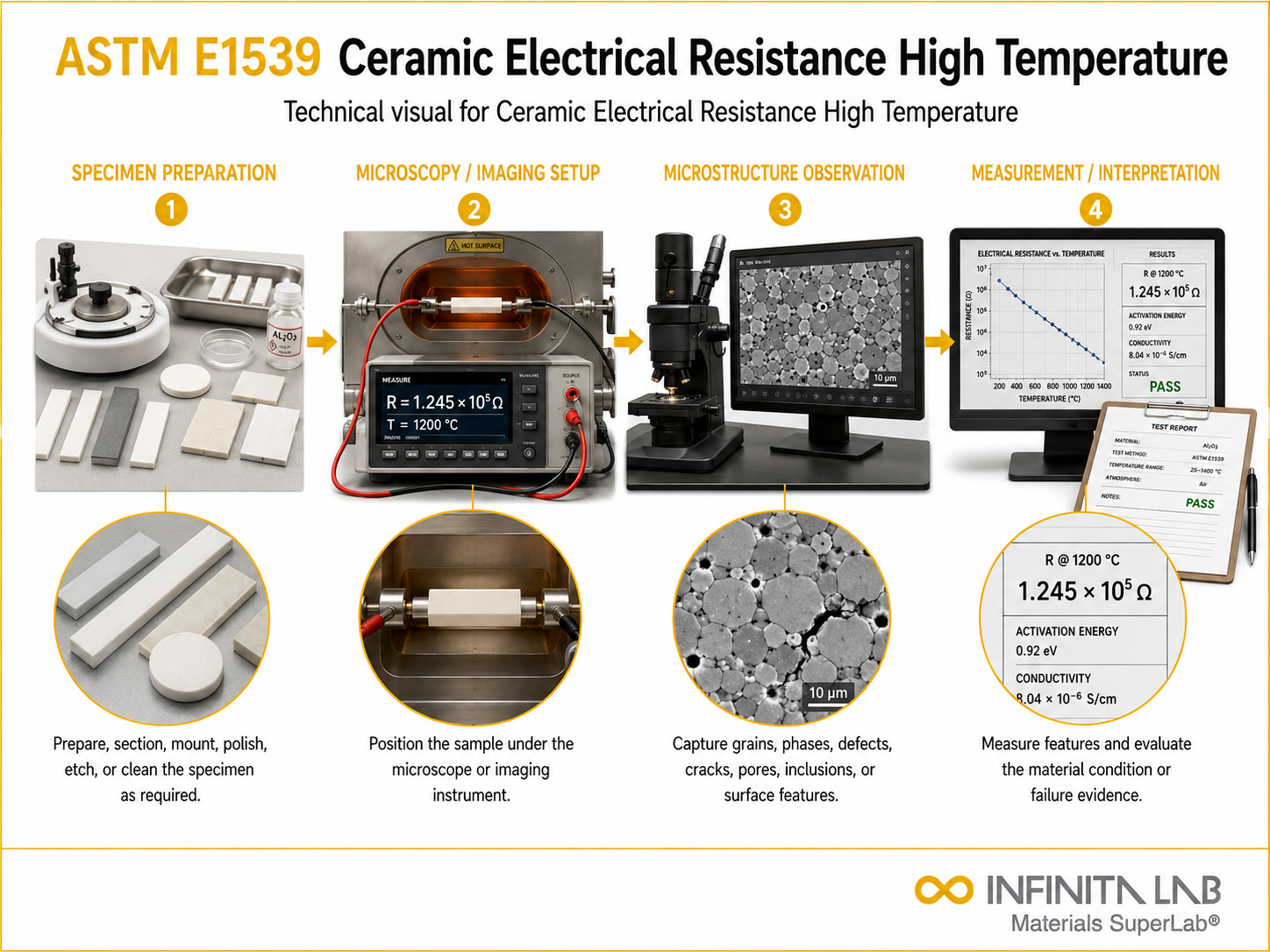
The test applies a defined voltage across a prepared ceramic specimen held at a controlled elevated temperature, and measures the resulting current. Resistance is calculated from these values, and resistivity is derived by accounting for specimen geometry. Measurements are typically taken across a temperature sweep to characterize the full resistance-temperature relationship rather than at a single point.
This testing is relevant to technical ceramics used in kiln furniture, high-temperature insulators, spark plug bodies, ceramic substrates for power electronics, and refractory electrical components. The data determines whether a ceramic maintains acceptable insulating properties at service temperatures, or whether it will begin conducting and cause electrical failure or leakage.

High-Temperature Electrical Resistance of Ceramics Scope, Applications, and Benefits
Scope
High-temperature electrical resistance testing applies to advanced technical ceramics, oxide ceramics, nitride ceramics, carbide ceramics, and ceramic composites used in electrically demanding service conditions. The test characterizes:
- Volume resistivity as a function of temperature
- Insulation resistance under applied DC voltage at elevated temperature
- Transition temperature at which resistivity drops below acceptable thresholds
- Resistance stability under extended high-temperature dwell conditions
- Effect of atmosphere (air, inert gas, vacuum) on electrical properties
Applications
- High-temperature electrical insulator qualification
- Ceramic substrate evaluation for power electronics
- Spark plug and ignition component material testing
- Kiln furniture and refractory component characterization
- Ceramic seal and feedthrough qualification for vacuum systems
- Research and development for new technical ceramic formulations
Benefits
- Reveals resistance-temperature behavior across the full service range
- Identifies thermal breakdown thresholds before component deployment
- Supports material selection for high-temperature electrical insulation applications
- Detects microstructural or compositional defects that affect electrical properties
- Provides data for finite element thermal-electrical modeling
- Enables comparison of ceramic grades under identical controlled conditions
High-Temperature Electrical Resistance of Ceramics Process
Specimen Preparation
Ceramic specimens are prepared to specified dimensions and electrode contacts are applied.
1Furnace Setup and Temperature Control
Specimens are loaded into the high-temperature test fixture.
2Resistance Measurement
DC voltage is applied across the specimen at each test temperature.
3Data Analysis and Reporting
Resistivity is calculated from resistance and specimen geometry.
4High-Temperature Electrical Resistance of Ceramics Technical Specifications
| Parameter | Details |
|---|---|
| Measured Property | Electrical resistance and volume resistivity |
| Temperature Range | Ambient to 1200 degrees Celsius (material and method dependent) |
| Test Voltage | DC, defined by material resistivity range |
| Applicable Materials | Technical ceramics, oxide ceramics, nitride ceramics, ceramic composites |
| Specimen Geometry | Disc, rod, or bar per electrode configuration requirements |
| Output Units | Ohm-cm (volume resistivity), Ohm (resistance) |


Instrumentation Used for High-Temperature Electrical Resistance of Ceramics
- High-temperature resistance furnace with controlled atmosphere capability
- High-resistance electrometer or picoammeter
- DC voltage source with programmable output
- High-temperature electrode fixtures and guard ring electrodes
- Thermocouple or pyrometer for specimen temperature measurement
- Data acquisition system for continuous logging
High-Temperature Electrical Resistance of Ceramics Results and Deliverables
- Resistance and volume resistivity at each test temperature
- Resistivity-temperature curve across the full sweep range
- Identification of any transition or breakdown temperatures
- Atmosphere conditions and thermal profile records
- Specimen geometry and electrode configuration data
- Quality assurance documentation
Frequently Asked Questions
Many ceramics are used in high-temperature environments where their electrical properties can change significantly. High-temperature resistance testing helps evaluate material stability, insulation performance, and suitability for demanding applications.
This testing is widely used in electronics, aerospace, automotive, energy, and industrial manufacturing sectors where ceramic components operate under elevated temperatures and must maintain reliable electrical performance.
Depending on the ceramic composition, resistance may increase or decrease as temperature rises. Measuring this behavior helps engineers understand conductivity trends and predict in-service performance.
Yes. Changes in electrical resistance during or after thermal exposure can indicate degradation mechanisms such as microcracking, phase transformations, contamination, or loss of insulating properties.
Why Choose Infinita Lab for Advanced Materials Testing and Characterization?
At the core of this breadth is our network of 2,000+ accredited laboratories across the USA, offering access to over 10,000 testing methods and analytical services. From advanced materials characterization (SEM, TEM, RBS, XPS) to mechanical, chemical, environmental, biological, and standardized ASTM/ISO-compliant testing, we deliver unmatched flexibility, specialization, and scale. You are never limited by geography, facility, or methodology — Infinita Lab connects you to the right expertise and testing solution, every time.

Looking for a Trusted Partner for Accurate and Reliable Testing Services?
Send query us at hello@infinitalab.com or call us at (888) 878-3090 to learn more about our services and how we can support you.



Request a Quote
Submit your material details and receive testing procedures, pricing, and turnaround time within 24 hours.
 Quick Turnaround and Hasslefree process
 Confidentiality Guarantee
 Free, No-obligation Consultation
 100% Customer Satisfaction
