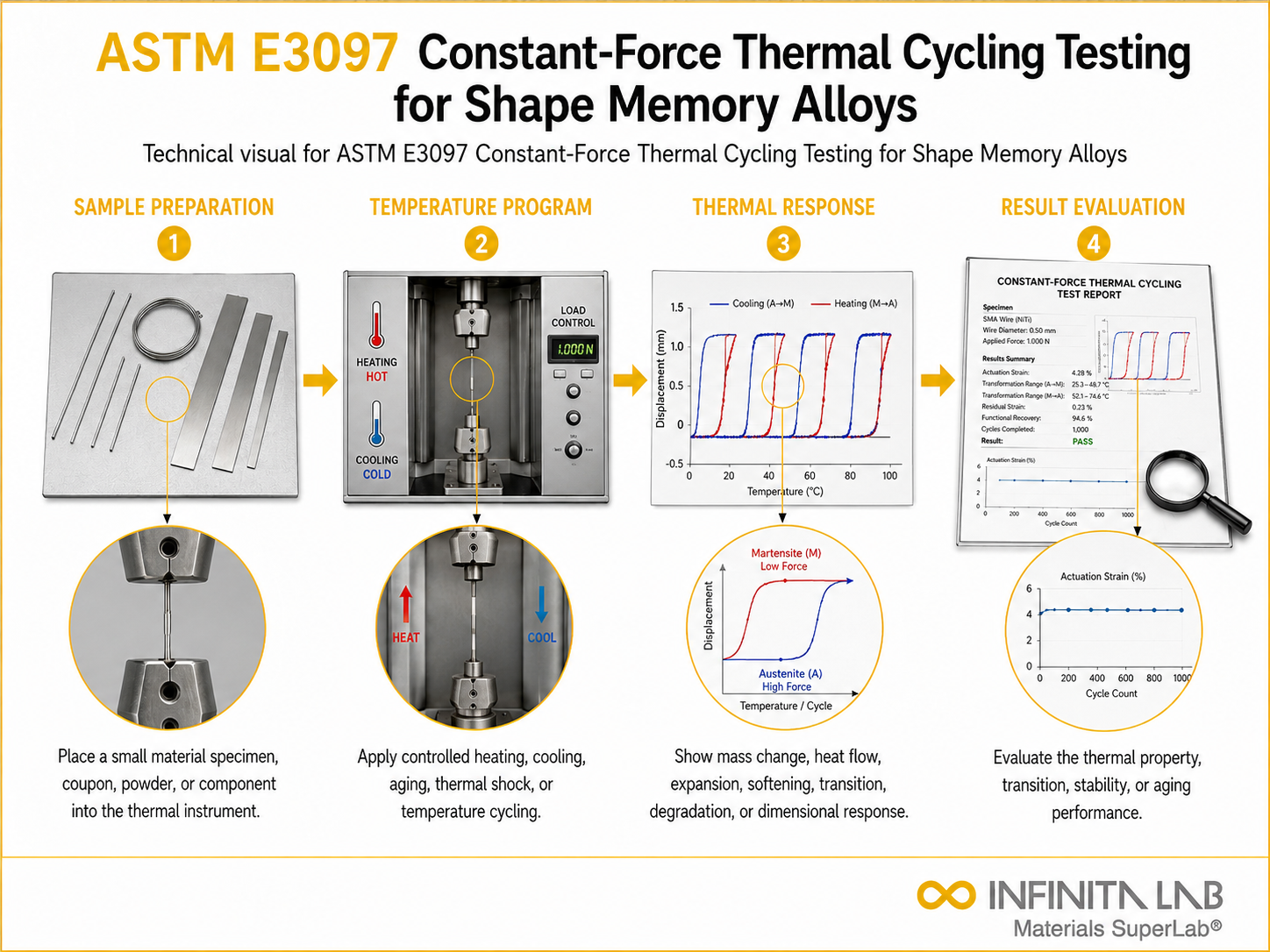


ASTM E3097 Mechanical Thermal Cycling Overview
ASTM E3097 describes a standard test method for evaluating the behavior of shape memory alloys (SMAs) under mechanical uniaxial constant force during thermal cycling. This test assesses the material’s ability to undergo repeated phase transformations under constant load.
Shape memory alloys exhibit unique properties, such as the shape memory effect and superelasticity, that are highly dependent on temperature and stress. This standard provides a controlled method to study thermomechanical response, functional fatigue, and stability under cyclic conditions.

Scope, Applications, and Benefits
Scope
ASTM E3097 outlines procedures for testing SMAs under constant force while undergoing thermal cycling. It evaluates:
- Transformation strain during heating and cooling
- Phase transformation temperatures (As, Af, Ms, Mf)
- Functional fatigue behavior
- Stability of shape memory response
Applications
- Biomedical devices (stents, actuators)
- Aerospace actuators and control systems
- Automotive components
- Smart materials and sensors
- Research and development of SMAs
Benefits
- Evaluates thermomechanical performance under realistic conditions
- Helps predict functional fatigue and durability
- Supports material design and optimization
- Enables reliable SMA component development
- Ensures compliance with material testing standards
ASTM E3097 Thermal Cycling Test Process
Specimen Preparation
SMA specimen is prepared with defined geometry and mounted in the test frame.
1Load Application
A constant uniaxial force is applied and maintained throughout the test.
2Thermal Cycling
The specimen is cyclically heated and cooled through transformation temperatures.
3Measurement & Recording
Strain, temperature, and transformation behavior are continuously recorded over cycles.
4ASTM E3097 Mechanical Thermal Cycling Technical Specifications
| Parameter | Details |
|---|---|
| Applicable Materials | Shape memory alloys (e.g., NiTi and similar alloys) |
| Loading Type | Constant uniaxial force |
| Temperature Range | Typically -50°C to 150°C (depends on SMA composition) |
| Measured Outputs | Transformation strain, temperature, hysteresis behavior |
| Cycling Type | Repeated heating and cooling cycles |


- Universal testing machine or SMA testing system
- Load frame with constant force control
- Environmental chamber or thermal cycling furnace
- Extensometer or strain measurement device
- Thermocouples or temperature sensors
- Data acquisition system
Instrumentation Used for Testing
Results and Deliverables
- Transformation strain vs temperature curves
- Phase transformation temperatures (As, Af, Ms, Mf)
- Functional fatigue and stability data
- Hysteresis behavior analysis
- Material performance evaluation reports
- Compliance reports
Frequently Asked Question
It measures the thermomechanical response of shape memory alloys under constant force during repeated thermal cycling, including transformation strain, phase transformation temperatures, and hysteresis behavior to evaluate functional stability, durability, and performance under service-like conditions.
This test is important because it helps predict how shape memory alloys behave under real operating conditions, ensuring reliability, durability, and consistent performance in applications such as biomedical devices, actuators, and aerospace components subjected to cyclic thermal loading.
ASTM E3097 is primarily used for shape memory alloys such as nickel-titanium (NiTi) and similar thermally activated materials that exhibit phase transformation behavior and are used in applications requiring controlled deformation and recovery under temperature changes.
The test provides transformation strain, phase transformation temperatures (As, Af, Ms, Mf), hysteresis behavior, and functional fatigue characteristics, which are essential for understanding material performance, stability, and long-term reliability under repeated thermal and mechanical cycling conditions.
Industries such as biomedical, aerospace, automotive, and advanced materials rely on ASTM E3097 to evaluate shape memory alloys for applications involving actuators, stents, sensors, and smart systems where cyclic thermal and mechanical performance is critical.
Why Choose Infinita Lab for Advanced Materials Testing and Characterization?
At the core of this breadth is our network of 2,000+ accredited laboratories across the USA, offering access to over 10,000 testing methods and analytical services. From advanced materials characterization (SEM, TEM, RBS, XPS) to mechanical, chemical, environmental, biological, and standardized ASTM/ISO-compliant testing, we deliver unmatched flexibility, specialization, and scale. You are never limited by geography, facility, or methodology — Infinita Lab connects you to the right expertise and testing solution, every time.

Looking for a Trusted Partner for Accurate and Reliable Testing Services?
Send query us at hello@infinitalab.com or call us at (888) 878-3090 to learn more about our services and how we can support you.





