


ASTM E23: Charpy Impact Testing Services
ASTM E23 test method describes notched-bar impact testing of metals by the Charpy (simple-beam) test and the Izod (cantilever-beam) test.
TRUSTED BY


Get ASTM E23 compliant results — request your charpy impact testing quote
- Overview
- Scope, Applications, and Benefits
- Test Process
- Specifications
- Instrumentation
- Results and Deliverables
What Is ASTM E23 Charpy Impact?
ASTM E23 is the standard test method for notched bar impact testing of metallic materials, covering both the Charpy (simple-beam) and Izod (cantilever-beam) test configurations. The test measures the energy absorbed by a material when it fractures under a single high-velocity impact from a pendulum hammer. That absorbed energy value, reported in joules or foot-pounds, is a direct measure of the material’s toughness -its ability to resist sudden fracture rather than deform gradually.
The test is particularly important for understanding how a material behaves at different temperatures. Many metals that are tough and ductile at room temperature become brittle and prone to sudden fracture as temperatures drop. ASTM E23 is widely used to characterize the ductile-to-brittle transition behavior, which is critical in applications where a material is subjected to cold environments or dynamic loading.
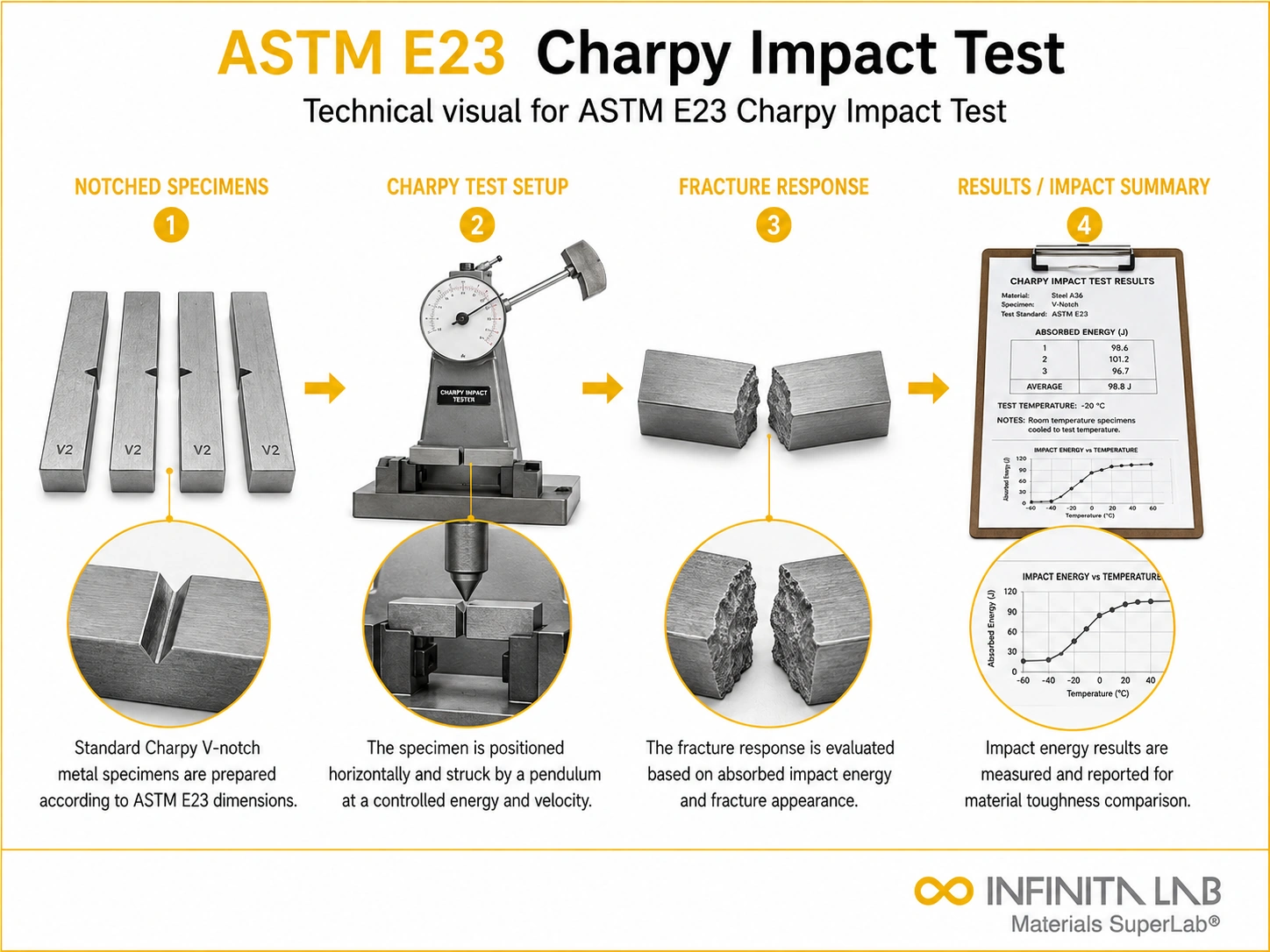
Standard Charpy specimens are 55 mm x 10 mm x 10 mm with either a V-notch or U-notch machined at the center. The notch is not just a geometric feature -it acts as a stress concentrator that forces fracture to initiate at a controlled location, making results consistent and repeatable across labs and material lots.

Applications and Benefits of ASTM E23 Charpy Impact Testing
Scope
ASTM E23 covers the determination of impact energy absorbed during the fracture of notched metallic specimens under pendulum impact loading. The standard defines specimen geometry and notch dimensions for both Charpy and Izod configurations; machine requirements and verification procedures; specimen temperature-conditioning methods for sub-ambient and elevated-temperature testing; and procedures for measuring lateral expansion, percent shear fracture, and absorbed energy. It applies to a wide range of metallic materials, including steels, aluminum alloys, titanium alloys, and nickel-based alloys. It is used to characterize both ductile and brittle fracture behavior, as well as the transition between them.
Applications
- Structural steel qualification for pressure vessels and pipelines
- Low-temperature toughness evaluation for arctic and cryogenic service
- Heat treatment and processing verification for metallic components
- Weld joint and heat-affected zone (HAZ) toughness assessment
- Aerospace alloy qualification and incoming material verification
- Automotive and heavy equipment component material selection
- Nuclear and defense material performance characterization
- Failure analysis and root cause investigation for fracture events
Benefits
- Quantifies toughness with a single, fast, low-cost test
- Identifies ductile-to-brittle transition temperature critical for cold-service applications
- Applicable to a wide range of metals and alloy systems
- Covers both Charpy and Izod methods under one standard
- Results directly support material selection, design decisions, and supplier evaluation
- Sub-size specimen options available when full-size material is not accessible
- Fracture appearance and lateral expansion data add dimension beyond energy values alone
Our ASTM E23 Testing Procedure
Specimen Preparation
Standard specimens are machined with a V-notch or U-notch per ASTM E23 requirements.
1Temperature Conditioning
Specimens are conditioned to the required test temperature using a liquid bath or environmental chamber.
2Impact Testing
The conditioned specimen is placed in the Charpy or Izod fixture and struck by a pendulum hammer.
3Post-Fracture Examination and Reporting
Fractured specimens are examined for lateral expansion and percent shear fracture area.
4ASTM E23 Test Parameters and Requirements
| Parameter | Details |
|---|---|
| Standard | ASTM E23 |
| Test Methods Covered | Charpy (simple-beam), Izod (cantilever-beam) |
| Standard Specimen Size | 55 mm x 10 mm x 10 mm |
| Notch Types | V-notch, U-notch (keyhole notch for Izod) |
| Applicable Materials | Metallic materials -steels, aluminum, titanium, nickel alloys |
| Test Temperature Range | Sub-ambient (cryogenic) to elevated temperature |
| Reported Outputs | Absorbed energy (J or ft-lbf), lateral expansion, percent shear fracture |


- Pendulum impact testing machine (Charpy / Izod configuration)
- Specimen notching machine with V-notch and U-notch capability
- Temperature conditioning bath or environmental chamber
- A thermocouple or a calibrated thermometer for temperature verification
- Specimen transfer tongs for sub-ambient testing
- Optical or digital measurement tools for lateral expansion and fracture surface examination
- Verification specimens and machine calibration standards
Equipment and Instrumentation Used for ASTM E23 Testing
What You Receive: Test Report, Data, and Certification
- Absorbed impact energy per specimen in joules and/or foot-pounds
- Average energy values across replicate specimens at each test temperature
- Lateral expansion measurements from fractured specimen halves
- Percent shear fracture area from fracture surface examination
- Ductile-to-brittle transition temperature data where multiple temperatures are tested
- Specimen configuration and notch type used
- Test temperature and conditioning method details
- Test report with all recorded values, observations, and material identification
ASTM E23 Charpy Impact FAQs
ASTM E23 establishes standard methods for determining the impact resistance of materials, especially metals, through notched bar testing.
The standard specimen for conducting the Charpy impact testing is a rectangular bar with 55 mm length × 10 mm width × 10 mm thickness and has either a V-notch or U-notch machined in its center.
Metals like steel, aluminum, titanium, and nickel alloys are commonly tested using ASTM E23, particularly in industries where impact resistance is crucial.
Low energy absorption value indicates that the material is brittle and may quickly fail due to sudden impact or shock-loading conditions. Hence, it is a critical parameter in determining the suitability of materials in specific applications in cold environments.
Why Choose Infinita Lab for Charpy Impact Testing
At the core of this breadth is our network of 2,000+ accredited laboratories across the USA, offering access to over 10,000 testing methods and analytical services. From advanced materials characterization (SEM, TEM, RBS, XPS) to mechanical, chemical, environmental, biological, and standardized ASTM/ISO-compliant testing, we deliver unmatched flexibility, specialization, and scale. You are never limited by geography, facility, or methodology — Infinita Lab connects you to the right expertise and testing solution, every time.

Need ASTM E23 Charpy Impact Testing You Can Rely On?
Send query us at hello@infinitalab.com or call us at (888) 878-3090 to learn more about our services and how we can support you.



Request a Quote
Submit your material details and receive testing procedures, pricing, and turnaround time within 24 hours.
 Quick Turnaround and Hasslefree process
 Confidentiality Guarantee
 Free, No-obligation Consultation
 100% Customer Satisfaction
