


ASTM E1681: Environment Assisted Cracking Testing Services
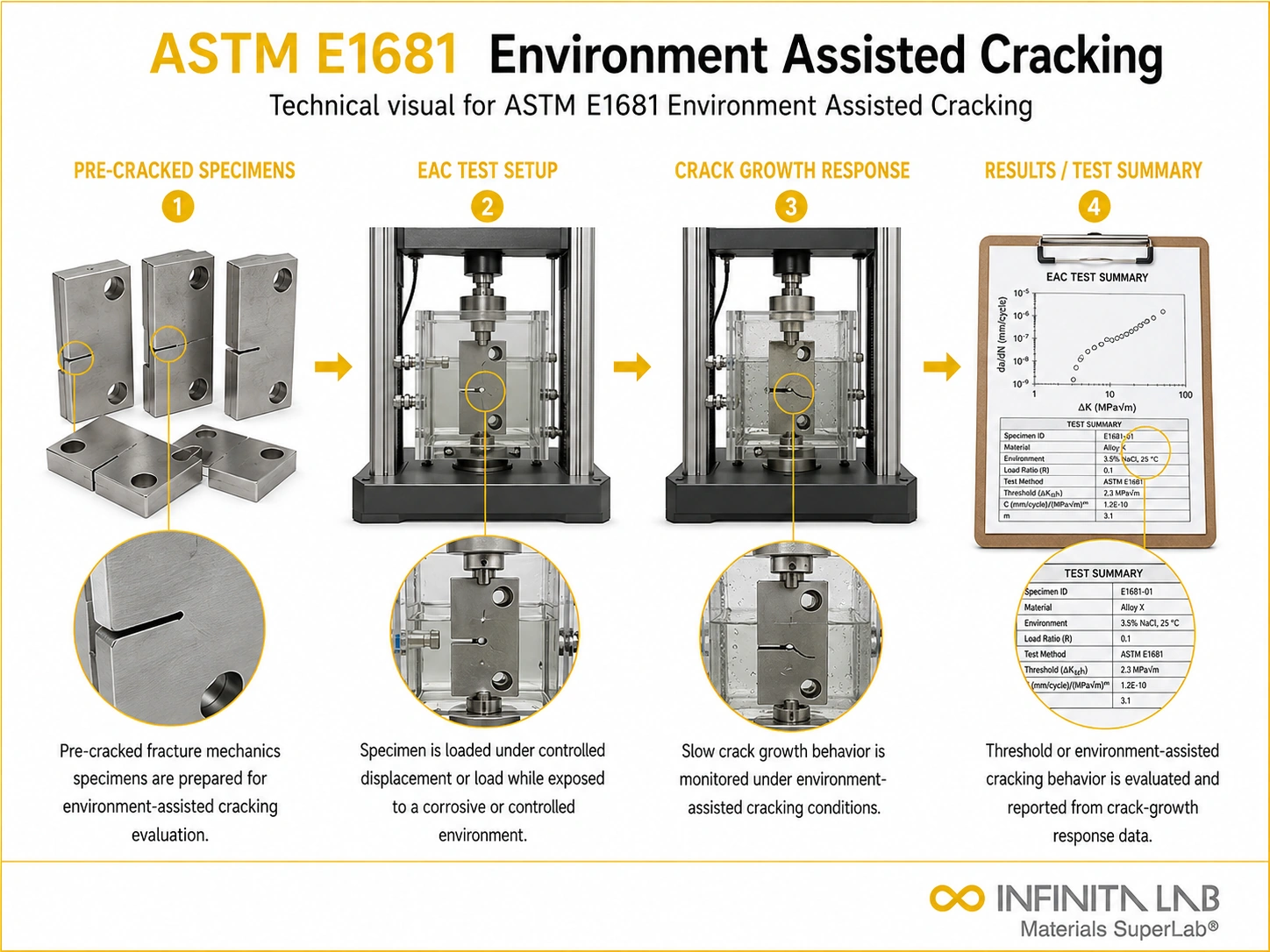
ASTM E1681-03 Test Method determines the threshold stress intensity factor for environment-assisted cracking of metallic materials. A KEAC or KIEAC value represents a characteristic measurement of environment-assisted cracking resistance in a pre-cracked specimen exposed to an environment under sustained tensile loading. Test results are affected by force relaxation in constant displacement bolt-loaded compact specimens for some material/environment conditions.
TRUSTED BY


Get ASTM E1681 compliant results — request your environment assisted cracking testing quote
- Overview
- Scope, Applications, and Benefits
- Test Process
- Specifications
- Instrumentation
- Results and Deliverables
What Is ASTM E1681 Environment Assisted Cracking?
ASTM E1681 is the standard test method for determining the threshold stress intensity factor for environment-assisted cracking (EAC) of metallic materials. Environment-assisted cracking is a failure mode in which a material cracks under sustained tensile stress in the presence of a specific chemical environment, at stress levels far below those that would cause fracture in an inert environment. The environment accelerates crack initiation and growth by degrading the material at the crack tip through mechanisms including stress corrosion cracking (SCC), hydrogen embrittlement (HE), and liquid metal embrittlement (LME).
The key output from this test is KEAC -the threshold stress intensity factor for environment-assisted cracking -also written as KIEAC when plane strain conditions are confirmed. Below this threshold, pre-existing cracks in a susceptible material-environment combination will not propagate under sustained load. Above it, they will. This value is used in fracture mechanics-based design and fitness-for-service assessments to set safe operating stress limits for components exposed to aggressive environments, and it is a critical input for determining inspection intervals and remaining life in oil and gas, chemical process, aerospace, and nuclear applications.
Two loading methods are defined in the standard: constant load testing, in which a dead weight or lever arm maintains a fixed applied force on the specimen, and constant displacement testing, using bolt-loaded compact specimens, in which a bolt maintains a fixed crack-opening displacement. Constant load testing is simpler and more accurate for KEAC determination, but constant displacement testing is more practical for long-duration tests and field simulation. The standard notes that force relaxation in bolt-loaded specimens under certain material-environment conditions can affect results, and that this needs to be considered when interpreting KEAC values from constant-displacement tests.

Applications and Benefits of ASTM E1681 Environment Assisted Cracking Testing
Scope
ASTM E1681 covers the determination of KEAC -the threshold stress intensity factor for environment-assisted cracking -in metallic materials using pre-cracked specimens exposed to a test environment under sustained tensile loading. Two loading configurations are defined: constant load (dead-weight or lever arm) and constant displacement (bolt-loaded compact specimen). Specimen geometries include compact tension (CT), wedge-opening load (WOL), and double cantilever beam (DCB) configurations, with stress intensity factor solutions provided for each. The test environment is applied by immersion, drip, or enclosure, depending on the environment and specimen geometry. Test duration is determined by the time required to determine whether cracking initiates and propagates, typically ranging from days to weeks, depending on the material’s susceptibility and environmental aggressiveness. The standard addresses plane strain validity requirements, force relaxation in bolt-loaded specimens, and post-test fractographic examination. Results apply to mode I (opening) crack growth under the combined action of stress and environment.
Applications
- Stress corrosion cracking (SCC) threshold determination for high-strength steels in aqueous chloride, sulfide, or caustic environments
- Hydrogen embrittlement (HE) threshold characterization for steels, titanium alloys, and nickel alloys in hydrogen-containing environments
- KEAC determination for aerospace structural alloys in saltwater or humid air environments
- Pipeline and pressure vessel material qualification for sour service (H2S-containing) environments per NACE MR0175/ISO 15156
- Fitness-for-service assessment for in-service components with known or suspected flaws in corrosive environments
- Material comparison and selection for applications where EAC is a design concern
- Effect of heat treatment, strength level, or microstructure on EAC susceptibility
- Qualification testing for coatings, inhibitors, or cathodic protection systems intended to reduce EAC risk
Benefits
- Provides a fracture mechanics-based threshold value directly usable in damage tolerance and fitness-for-service calculations
- Defines the stress intensity below which pre-existing flaws will not propagate in a given material-environment combination
- Two loading configurations accommodate both precise laboratory measurement and practical long-duration exposure scenarios.
- Applicable to a wide range of EAC mechanisms -SCC, hydrogen embrittlement, liquid metal embrittlement
- Results support material selection, heat treatment optimization, and specification of safe operating stress limit.s
- Post-test fractographic examination links the threshold value to the physical crack growth and mechanism at the fracture surface.
- Recognized by NACE, ASME, and aerospace standards as a reference method for EAC characterization
Our ASTM E1681 Testing Procedure
Specimen Preparation and Pre-Cracking
CT, WOL, or DCB specimens are machined to the required dimensions.
1Environment Exposure Setup
The test environment is prepared and applied to the specimen by immersion in a test cell, drip application, or sealed enclosure
2Sustained Loading and Crack Monitoring
The specimen is held at the specified load or displacement in the test environment for the required duration.
3Post-Test Evaluation and Reporting
After the test, specimens are broken open, and the fracture surface is examined.
4ASTM E1681 Test Parameters and Requirements
| Parameter | Details |
|---|---|
| Standard | ASTM E1681-03 (Reapproved 2013) |
| ASTM Committee | E08 – Fatigue and Fracture |
| EAC Mechanisms Covered | Stress corrosion cracking (SCC), hydrogen embrittlement (HE), liquid metal embrittlement (LME) |
| Loading Methods | Constant load (dead weight or lever arm), constant displacement (bolt-loaded compact specimen) |
| Specimen Geometries | Compact tension (CT), wedge-opening load (WOL), double cantilever beam (DCB) |
| Loading Mode | Mode I (opening mode) |


- Servo-hydraulic or dead-weight loading frame for constant load testing
- Bolt-loaded compact specimen fixtures for constant displacement testing
- Calibrated load cell for load monitoring and verification
- Crack opening displacement gauge or clip gauge for crack length tracking
- Electrical potential drop (EPD) system for continuous crack length monitoring,g where applicable
- Environmental test cell, immersion tank, or sealed enclosure for environmental applications
- pH meter, conductivity meter, and solution preparation equipment for environmental control
- Optical microscope and scanning electron microscope (SEM) for post-test fractographic examination
Equipment and Instrumentation Used for ASTM E1681 Testing
What You Receive: Test Report, Data, and Certification
- KEAC or KIEAC value in MPa root-m or ksi root-in -the threshold stress intensity factor for environment-assisted cracking
- Crack growth versus time data showing whether cracking initiated and propagated at each tested stress intensity level.
- Initial and final crack length measurements with stress intensity calculations
- Post-test fracture surface images showing the extent of EAC crack growth and fracture morphology.y
- Test environment identity, concentration, temperature, and pH throughout the test duration
- Loading method, specimen geometry, and K-solution used
- Force relaxation data for bolt-loaded specimens, where applicable
- Material identification, heat treatment condition, and mechanical properties
- Full test report with all data, fractographic images, and KEAC determination formatted for material qualification, fitness-for-service, or design documentation
ASTM E1681 Environment Assisted Cracking FAQs
ASTM E1681 measures the threshold stress intensity factor (K_ISCC) at which environment-assisted cracking begins in metallic materials. It helps identify the stress level where crack growth initiates under combined mechanical load and environmental exposure.
Unlike pure fatigue, environment-assisted cracking occurs due to the combined effect of stress and a reactive environment such as moisture, hydrogen, or corrosive media. This can lead to crack growth at lower stress levels than expected under mechanical loading alone.
The standard is commonly applied to high-strength alloys such as steels, aluminum alloys, titanium alloys, and other structural metals where susceptibility to stress corrosion cracking or hydrogen-assisted cracking is a concern.
Key factors include the chemical environment (corrosive medium, humidity, hydrogen concentration), temperature, loading rate, and specimen geometry. Even small variations in environment or pre-cracking conditions can significantly affect results.
Knowing the threshold helps engineers design safer components by ensuring operational stresses remain below the crack initiation limit in real service environments. It is critical for preventing sudden brittle failures in high-stress, corrosive conditions.
Why Choose Infinita Lab for Environment Assisted Cracking Testing
At the core of this breadth is our network of 2,000+ accredited laboratories across the USA, offering access to over 10,000 testing methods and analytical services. From advanced materials characterization (SEM, TEM, RBS, XPS) to mechanical, chemical, environmental, biological, and standardized ASTM/ISO-compliant testing, we deliver unmatched flexibility, specialization, and scale. You are never limited by geography, facility, or methodology — Infinita Lab connects you to the right expertise and testing solution, every time.

Need ASTM E1681 Environment Assisted Cracking Testing You Can Rely On?
Send query us at hello@infinitalab.com or call us at (888) 878-3090 to learn more about our services and how we can support you.



Request a Quote
Submit your material details and receive testing procedures, pricing, and turnaround time within 24 hours.
 Quick Turnaround and Hasslefree process
 Confidentiality Guarantee
 Free, No-obligation Consultation
 100% Customer Satisfaction
