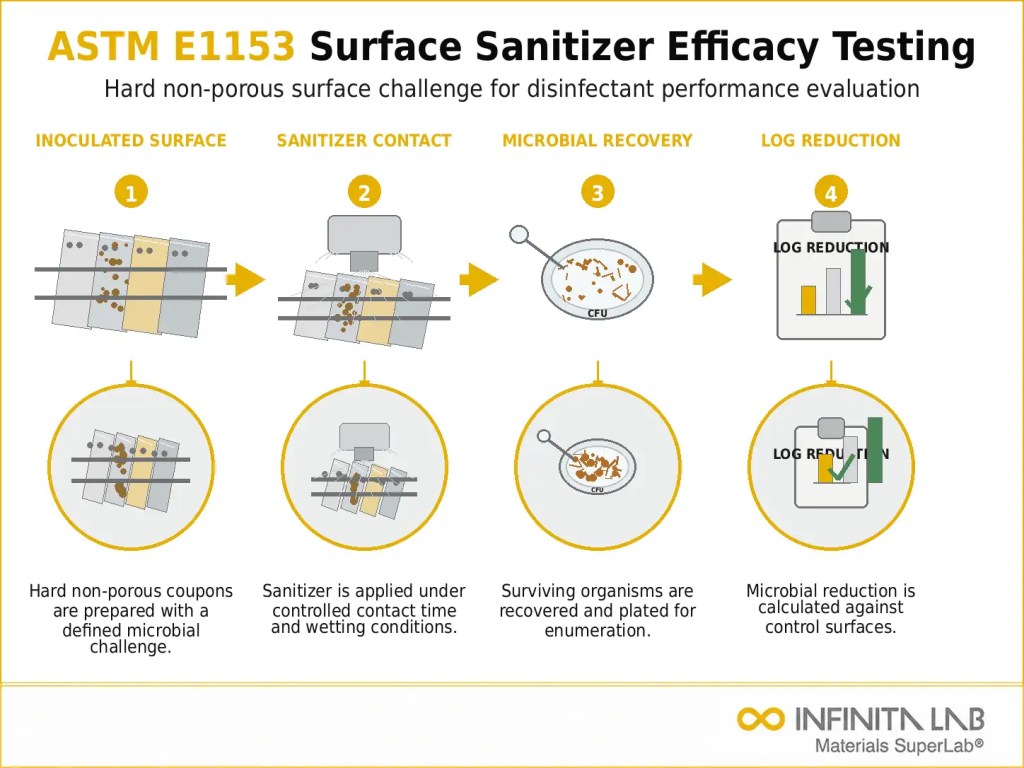


What Is ASTM E1153 Surface Sanitizer Efficacy?
ASTM E1153 specifies a standardized quantitative carrier test method to evaluate the effectiveness of sanitizers on inanimate, hard, nonporous, non-food contact surfaces. The method measures the reduction of selected microorganisms on contaminated carriers after treatment with a sanitizer under controlled conditions.
This test is widely used to validate sanitizer performance for environmental hygiene applications such as floors, walls, and equipment exteriors. By determining microbial reduction levels, ASTM E1153 ensures that products meet required efficacy standards. It supports regulatory compliance, product development, and quality assurance by providing reproducible and comparable antimicrobial performance data.
Applications and Benefits of ASTM E1153 Surface Sanitizer Efficacy Testing
Scope
ASTM E1153 defines procedures to determine sanitizer efficacy by measuring reduction of microorganisms on nonporous surfaces using a carrier-based test system. It ensures controlled contamination, exposure, and recovery for reliable antimicrobial evaluation.
- Evaluates sanitizers on hard, nonporous, non-food contact surfaces
- Uses carrier-based contamination and recovery methodology
- Measures reduction of specific test microorganisms
- Applicable to liquid and spray sanitizing formulations
- Conducted under controlled laboratory conditions
Applications
- Evaluation of surface sanitizers for industrial environments
- Validation of cleaning products for public facilities
- Hygiene product development and formulation testing
- Regulatory compliance and product registration
- Quality control of antimicrobial products
- Comparative analysis of sanitizer effectiveness
Benefits
- Provides standardized and reproducible efficacy data
- Ensures reliable microbial reduction measurement
- Supports regulatory approval and labeling claims
- Enables comparison across different sanitizer formulations
- Enhances hygiene and contamination control assurance
- Improves product development and optimization
Our ASTM E1153 Testing Procedure
Carrier Inoculation
Test surfaces are inoculated with a known concentration of microorganisms and dried under controlled conditions.
1Sanitizer Application
The sanitizer is applied to the contaminated carriers for a specified contact time.
2Neutralization and Recovery
Surviving microorganisms are neutralized and recovered using appropriate techniques.
3Microbial Enumeration
Recovered organisms are cultured and counted to determine reduction levels.
4ASTM E1153 Test Parameters and Requirements
| Parameter | Details |
|---|---|
| Standard | ASTM E1153 |
| Test Principle | Quantitative carrier-based evaluation of microbial reduction on treated surfaces |
| Applicable Products | Liquid or spray sanitizers for non-food contact surfaces |
| Test Surfaces | Hard, nonporous materials such as glass, stainless steel, or plastic |
| Test Organisms | Specified bacterial strains |
| Measurement Output | Log₁₀ reduction in microbial population |
| Inoculum Level | Typically ≥10⁵–10⁶ CFU per carrier |
| Contact Time | Defined exposure duration as per product label or protocol |


- Sterile carriers (glass, stainless steel, plastic)
- Microbial culture media and Petri dishes
- Incubator for bacterial growth
- Pipettes and dilution equipment
- Neutralizing agents
- Colony counter
- Laminar airflow cabinet
- Data recording system
Equipment and Instrumentation Used for ASTM E1153 Testing
What You Receive: Test Report, Data, and Certification
- Log reduction values of test microorganisms
- Sanitizer efficacy performance data
- Compliance with ASTM E1153 criteria
- Test report with methodology and conditions
- Comparative analysis of product performance
- Validation data for regulatory submission
ASTM E1153 Surface Sanitizer Efficacy FAQs
ASTM E1153 evaluates the ability of sanitizers to reduce microbial contamination on hard, nonporous surfaces by quantifying log reductions, ensuring products meet hygiene performance requirements for environmental surface disinfection.
Carrier methods simulate real-world contamination on surfaces, providing a realistic assessment of sanitizer performance compared to suspension tests, which may not reflect actual surface interactions.
Log reduction represents the decrease in microbial population on a logarithmic scale. Higher log reductions indicate greater sanitizer effectiveness in reducing contamination on treated surfaces.
Errors include improper neutralization, inconsistent inoculation, contamination, and inaccurate microbial counting, all of which can affect reliability.
By validating sanitizer effectiveness, the standard ensures reliable microbial control on surfaces, reducing contamination risks and improving overall hygiene standards.
Antimicrobial surface testing evaluates the ability of a sanitizer or antimicrobial treatment to reduce microorganisms on treated surfaces. Under ASTM E1153, a precleaned, hard, nonporous surface is inoculated with specified bacteria and treated with the test sanitizer. After the prescribed contact time, microorganisms are recovered and quantified to determine the reduction in viable bacterial counts compared with untreated control samples. The results help assess the effectiveness of sanitizing products on non-food-contact surfaces.
ASTM E1153 evaluates the antimicrobial efficacy of sanitizers and one-step cleaner-sanitizer products on inanimate, hard, nonporous, non-food-contact surfaces. Test carriers are inoculated with specified microorganisms, including Staphylococcus aureus and Klebsiella pneumoniae or Klebsiella aerogenes. The test product is applied under controlled conditions, and surviving microorganisms are recovered and counted. The percentage reduction in viable microorganisms is calculated against untreated controls to determine sanitizer effectiveness.
Why Choose Infinita Lab for Surface Sanitizer Efficacy Testing
When your Surface Sanitizer Efficacy results have to hold up - for compliance, a customer audit, or an engineering decision - ASTM E1153 accuracy and an unbiased third-party report matter more than price. Infinita Lab routes your ASTM E1153 surface sanitizer efficacy testing to ISO/IEC 17025-accredited U.S. partner labs with hands-on method experience, so you get defensible data, transparent reporting, and turnaround times built around your project deadline - not ours.

Need ASTM E1153 Surface Sanitizer Efficacy Testing You Can Rely On?
Send query us at hello@infinitalab.com or call us at (888) 878-3090 to learn more about our services and how we can support you.



