


ASTM D7869: Transportation Coating Xenon Arc Guide Testing Services
A decade of research by experts in the automotive, aerospace, coatings, and weathering testing industries led to ASTM D7869, which is based on ASTM G155. Since it is thought to be a far better simulation than the more traditional test techniques and processes, this methodology is gaining popularity.
TRUSTED BY


Get ASTM D7869 compliant results — request your transportation coating xenon arc guide testing quote
- Overview
- Scope, Applications, and Benefits
- Test Process
- Specifications
- Instrumentation
- Results and Deliverables
What Is ASTM D7869 Transportation Coating Xenon Arc Guide?
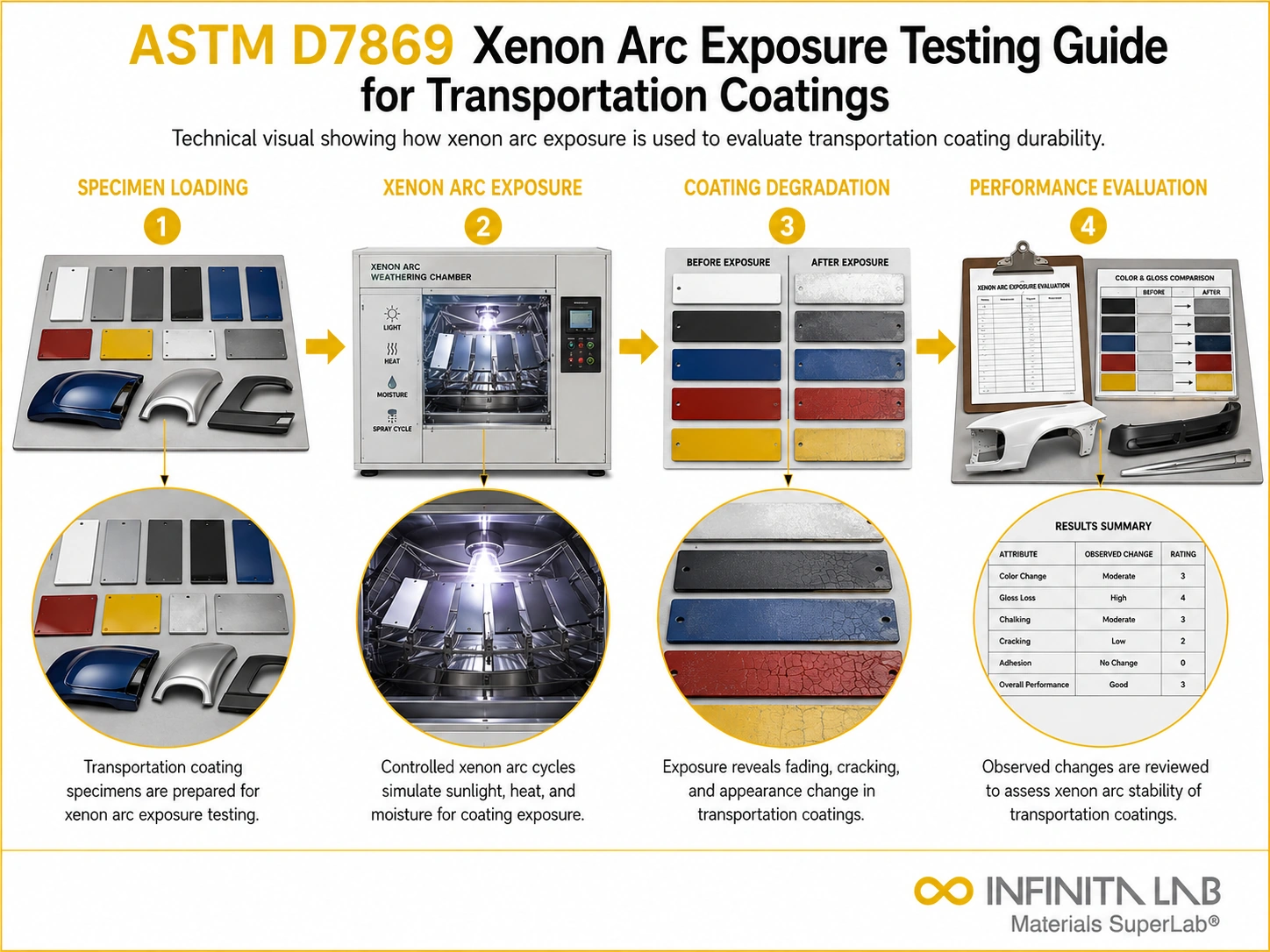
ASTM D7869 evaluates the durability of transportation coatings under accelerated weathering using a xenon arc light source that closely simulates full-spectrum sunlight. The test reproduces environmental stressors such as UV radiation, visible light, heat, and moisture to assess coating degradation behavior.
This method is critical for predicting long-term performance of coatings used in transportation systems. It helps identify failure modes such as color fading, gloss loss, cracking, and delamination, ensuring coatings maintain protective and aesthetic properties under real service conditions.

Applications and Benefits of ASTM D7869 Transportation Coating Xenon Arc Guide Testing
Scope
This test assesses coating performance under simulated environmental exposure using controlled xenon arc radiation, temperature, and moisture cycles.
- Evaluates UV, visible light, and thermal degradation of coatings
- Applicable to automotive, rail, and aerospace coatings
- Simulates sunlight, humidity, and water spray conditions
- Assesses color change, gloss retention, and surface defects
- Supports durability validation and lifecycle prediction
- Identifies coating formulation weaknesses
Applications
- Automotive exterior coating validation
- Rail and transportation coating durability
- Aerospace coating performance testing
- Paint and coating formulation development
- Quality control and product qualification
- Long-term environmental exposure simulation
Benefits
- Simulates full-spectrum sunlight exposure
- Accelerates long-term weathering effects
- Identifies degradation and failure mechanisms
- Supports product durability improvement
- Ensures compliance with industry standards
- Reduces field failure risks
Our ASTM D7869 Testing Procedure
Sample Preparation
Coated panels are cleaned and conditioned to ensure consistent surface conditions and representative coating thickness.
1Controlled Xenon Exposure
Samples are exposed to xenon arc light with controlled irradiance, temperature, and humidity to simulate environmental conditions.
2Cyclic Environmental Stressing
Cycles of light, moisture, and temperature are applied to replicate real-world weathering effects.
3Performance Evaluation
Samples are periodically assessed for color change, gloss loss, cracking, and adhesion degradation.
4ASTM D7869 Test Parameters and Requirements
| Parameter | Details |
|---|---|
| Measurement Principle | Accelerated weathering using xenon arc radiation |
| Sample Type | Coated panels and painted substrates |
| Radiation Source | Xenon arc lamp (full-spectrum simulation) |
| Irradiance Control | Specified W/m² range |
| Environmental Factors | UV, temperature, humidity, water spray |
| Test Cycle | Light and moisture exposure cycles |
| Evaluation Parameters | Color change (ΔE), gloss retention (%) |
| Temperature Range | Controlled black panel temperature |


- Xenon arc weathering tester
- Irradiance control system
- Temperature and humidity controllers
- Water spray system
- Gloss meter
- Color spectrophotometer
Equipment and Instrumentation Used for ASTM D7869 Testing
What You Receive: Test Report, Data, and Certification
- Coating durability and degradation report
- Color change and gloss retention data
- Surface defect analysis (cracking, peeling)
- Performance comparison results
- Compliance with ASTM D7869
- Test certification documentation
ASTM D7869 Transportation Coating Xenon Arc Guide FAQs
Xenon arc reproduces the full solar spectrum, including UV, visible, and infrared radiation, enabling more realistic simulation of photochemical and thermal degradation compared to UV-only methods that lack spectral completeness.
Photodegradation involves bond breakage due to UV energy, leading to oxidation, polymer chain scission, and pigment degradation, which collectively cause fading, chalking, and loss of mechanical integrity.
High-energy UV photons break polymer backbone bonds, generating free radicals that react with oxygen, initiating chain scission and oxidation reactions that progressively degrade coating integrity.
UV creates reactive sites in polymers, while moisture accelerates hydrolysis and oxidation reactions, producing a synergistic effect that significantly increases degradation rate compared to isolated environmental factors.
Higher panel temperatures accelerate chemical reaction rates, increase polymer mobility, and enhance diffusion of oxygen and moisture, intensifying degradation mechanisms such as oxidation and embrittlement.
Why Choose Infinita Lab for Transportation Coating Xenon Arc Guide Testing
At the core of this breadth is our network of 2,000+ accredited laboratories across the USA, offering access to over 10,000 testing methods and analytical services. From advanced materials characterization (SEM, TEM, RBS, XPS) to mechanical, chemical, environmental, biological, and standardized ASTM/ISO-compliant testing, we deliver unmatched flexibility, specialization, and scale. You are never limited by geography, facility, or methodology — Infinita Lab connects you to the right expertise and testing solution, every time.

Need ASTM D7869 Transportation Coating Xenon Arc Guide Testing You Can Rely On?
Send query us at hello@infinitalab.com or call us at (888) 878-3090 to learn more about our services and how we can support you.



Request a Quote
Submit your material details and receive testing procedures, pricing, and turnaround time within 24 hours.
 Quick Turnaround and Hasslefree process
 Confidentiality Guarantee
 Free, No-obligation Consultation
 100% Customer Satisfaction
