


ASTM D7457: Chloride Aromatic Hydrocarbons Microcoulometry Testing Services
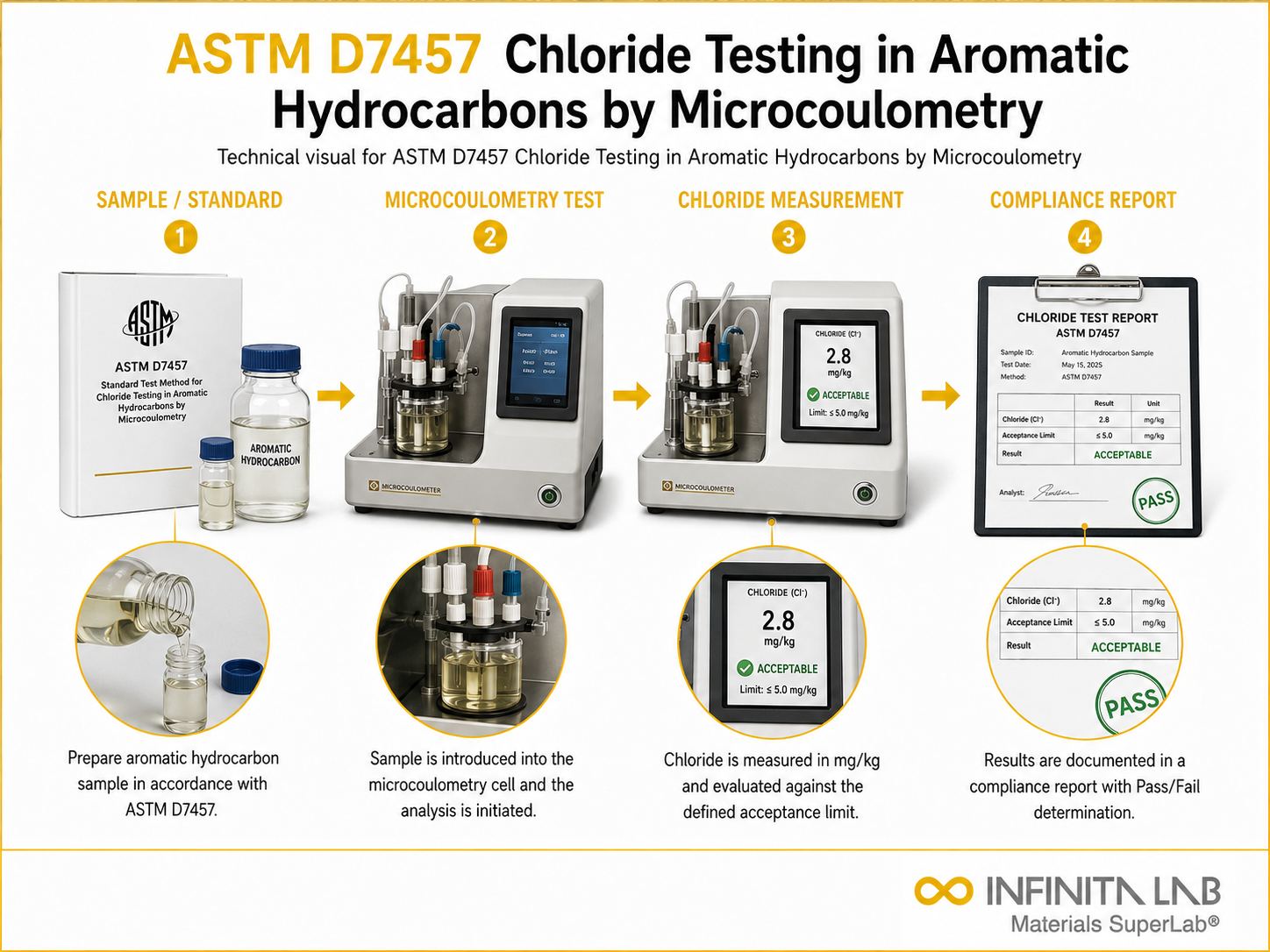
As specified by ASTM D7457, this test technique includes the detection of chloride in aromatic hydrocarbons, their derivatives, and related compounds. Typically, chlorides in aromatics only come from organic sources. Although not expected, the presence of metallic or inorganic chlorides is theoretically feasible, and this method makes no claims about how to recover those substances. The data gathered from this test can be utilized for several things, including product development, quality control, and regulatory compliance.
TRUSTED BY


Get ASTM D7457 compliant results — request your chloride aromatic hydrocarbons microcoulometry testing quote
- Overview
- Scope, Applications, and Benefits
- Test Process
- Specifications
- Instrumentation
- Results and Deliverables
What Is ASTM D7457 Chloride Aromatic Hydrocarbons Microcoulometry?
ASTM D7457 describes a standard test method for determining the chloride content in aromatic hydrocarbons and related chemical products by microcoulometry. Chloride contamination in aromatic chemicals can cause corrosion, catalyst poisoning, and product quality failures, making accurate quantification essential for process control and specification compliance.
This method offers high sensitivity and specificity for chloride detection, enabling quality assurance in petrochemical processing, chemical manufacturing, and solvent production. It is applicable to a broad range of aromatic hydrocarbon matrices.

Applications and Benefits of ASTM D7457 Chloride Aromatic Hydrocarbons Microcoulometry Testing
Scope
ASTM D7457 covers the determination of:
- Total chloride content in aromatic hydrocarbons
- Chloride in related chemical products and solvents
- Chloride concentrations at trace to moderate levels
- Organic and inorganic chloride forms detectable after combustion
Applications
- Petrochemical process stream quality control
- Aromatic solvent specification compliance testing
- Chemical intermediate and product purity assessment
- Catalyst protection by monitoring feed chloride levels
- Environmental compliance testing of chemical effluents
Benefits
- High sensitivity for trace chloride detection
- Specific, interference-free measurement by microcoulometry
- Applicable to a wide range of aromatic matrices
- Supports regulatory and specification compliance
- Rapid analysis with minimal sample preparation
Our ASTM D7457 Testing Procedure
Sample Introduction
Inject a precise volume of the aromatic hydrocarbon sample into the combustion furnace.
1Combustion
Combust the sample in a controlled oxygen atmosphere to convert all chloride to HCl gas.
2Coulometric Titration
Combustion gases enter the microcoulometer, where generated silver ions react with HCl to form AgCl.
3Quantification
Calculate chloride concentration from the electrical charge consumed during the coulometric titration; report in mg/kg or ppm.
4ASTM D7457 Test Parameters and Requirements
| Parameter | Details |
|---|---|
| Standard | ASTM D7457 |
| Test Principle | Combustion microcoulometry |
| Applicable Materials | Aromatic hydrocarbons and related chemicals |
| Detection Range | Trace to moderate chloride levels (ppm range) |
| Measured Output | Total chloride concentration |
| Units | mg/kg (ppm) |


- Microcoulometer with silver titration cell
- Combustion furnace with temperature control
- Oxygen supply and flow control system
- Microsyringe for precise sample injection
- Data acquisition and integration software
- Certified chloride reference standards
Equipment and Instrumentation Used for ASTM D7457 Testing
What You Receive: Test Report, Data, and Certification
- Total chloride concentration in mg/kg (ppm)
- Calibration curve and method validation data
- Pass/fail assessment against specification limits
- Batch-to-batch chloride trend analysis
- Analytical report with uncertainty estimates
- Process control data for petrochemical operations
ASTM D7457 Chloride Aromatic Hydrocarbons Microcoulometry FAQs
Chloride in aromatic hydrocarbon streams can poison catalysts in downstream chemical processes, cause corrosion in pipelines and equipment, and result in non-compliance with product specifications
The combustion step converts both organic chloride (C-Cl bonds) and inorganic chloride to HCl, so the method measures total chloride from all sources in the sample.
Microcoulometry measures the electrical charge required to generate a reagent (silver ions) that reacts stoichiometrically with the analyte (HCl). The charge is proportional to the amount of chloride present, enabling precise quantification at trace levels.
The method is capable of detecting chloride at sub-ppm levels, though the practical detection limit depends on sample matrix, injection volume, and instrument calibration.
Sulfur can interfere with the silver coulometric cell if sulfur combustion products are not removed before the titration cell. The test setup typically includes a scrubber or selective combustion conditions to minimize sulfur interference.
Why Choose Infinita Lab for Chloride Aromatic Hydrocarbons Microcoulometry Testing
At the core of this breadth is our network of 2,000+ accredited laboratories across the USA, offering access to over 10,000 testing methods and analytical services. From advanced materials characterization (SEM, TEM, RBS, XPS) to mechanical, chemical, environmental, biological, and standardized ASTM/ISO-compliant testing, we deliver unmatched flexibility, specialization, and scale. You are never limited by geography, facility, or methodology — Infinita Lab connects you to the right expertise and testing solution, every time.

Looking for an Accredited Partner for ASTM D7457 Chloride Aromatic Hydrocarbons Microcoulometry Testing?
Send query us at hello@infinitalab.com or call us at (888) 878-3090 to learn more about our services and how we can support you.



Request a Quote
Submit your material details and receive testing procedures, pricing, and turnaround time within 24 hours.
 Quick Turnaround and Hasslefree process
 Confidentiality Guarantee
 Free, No-obligation Consultation
 100% Customer Satisfaction
