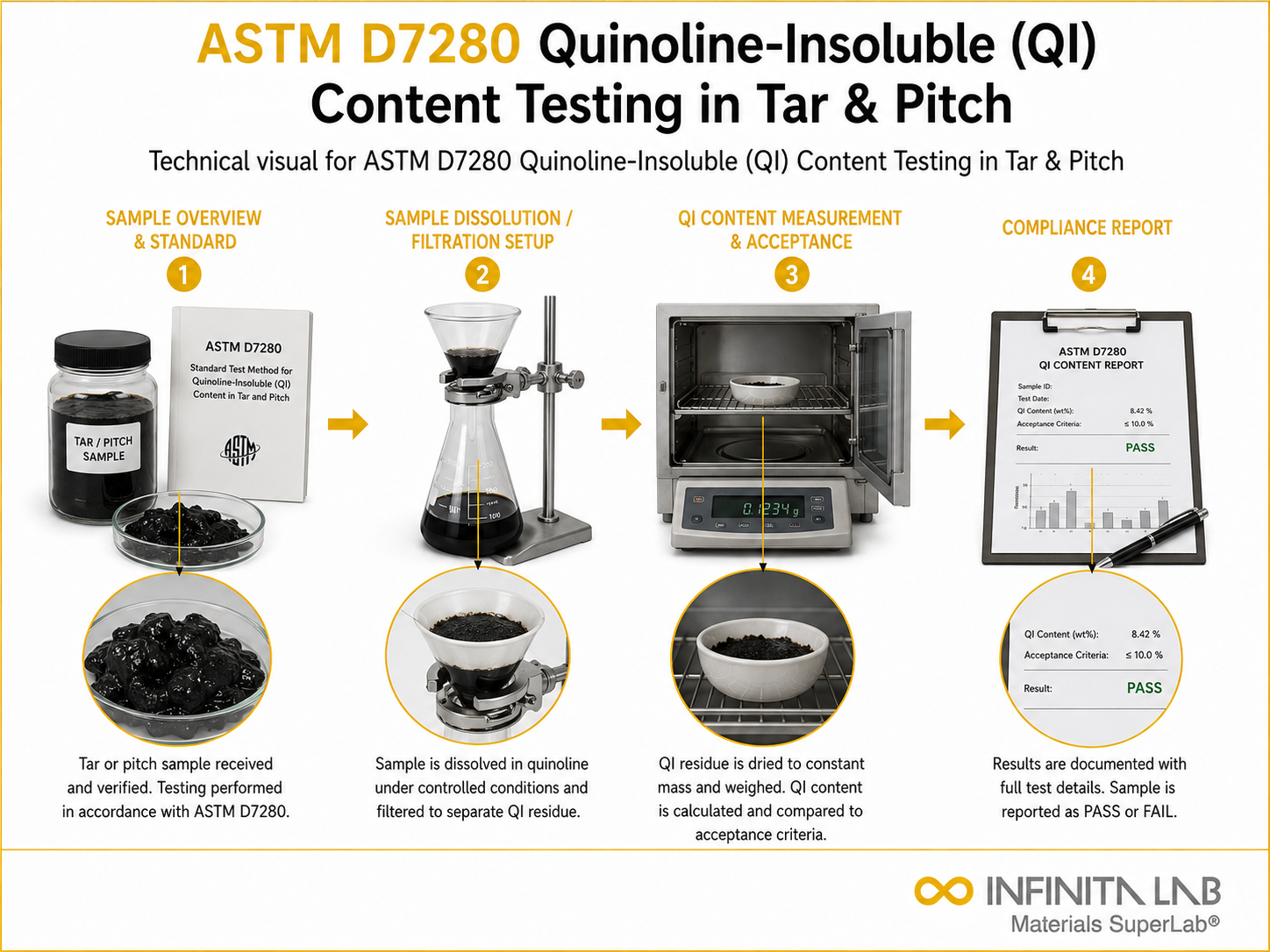


What Is ASTM D7280 Tar Pitch Quinoline Insoluble?
ASTM D7280 describes a test method for determining the quinoline insoluble (QI) content of coal tar, pitch, and related materials using stainless steel crucible filtration. QI consists of primary carbon particles and other high-molecular-weight insoluble material suspended in pitch, and its content significantly influences pitch processing, binder performance in carbon and graphite products, and anode quality in aluminum smelting.
Accurate QI determination is critical for pitch suppliers, carbon product manufacturers, and aluminum producers to ensure consistent electrode and refractory binder performance.

Applications and Benefits of ASTM D7280 Tar Pitch Quinoline Insoluble Testing
Scope
ASTM D7280 applies to coal tar pitch, modified pitch, and tar products and determines:
- Quinoline insoluble (QI) content as weight percent of total pitch
- Contribution of primary QI (alpha particles) to electrode porosity and structure
- Comparability with ISO methods for international trade applications
- Effect of QI on pitch softening point and processability
Applications
- Aluminum smelter anode binder pitch quality control
- Graphite electrode pitch binder specification compliance
- Carbon and graphite refractory binder characterization
- Coal tar distillation pitch quality assurance
- Research on pitch structure and electrode performance
Benefits
- More precise than Gooch crucible filtration method
- Stainless steel crucible provides consistent pore size and reusability
- Applicable to a wide range of pitch types and viscosities
- Provides reproducible data for international pitch trade
- Supports electrode quality and performance optimization
Our ASTM D7280 Testing Procedure
Sample Dissolution
A weighed pitch sample is dissolved in hot quinoline to solubilize all non-QI components.
1Filtration
The hot solution is filtered through a tared stainless steel crucible; QI particles are retained on the crucible filter.
2Washing and Drying
The crucible is washed with hot quinoline to remove residual pitch, then dried to constant mass in an oven.
3QI Calculation
QI content is the crucible mass gain after filtration divided by the sample mass, expressed as wt%.
4ASTM D7280 Test Parameters and Requirements
| Parameter | Details |
|---|---|
| Standard | ASTM D7280 |
| Test Principle | Hot quinoline extraction and stainless steel crucible filtration |
| Applicable Materials | Coal tar pitch, tar, modified pitch |
| Dissolution Temperature | 75–80°C for quinoline dissolution |
| Crucible Type | Stainless steel with defined pore size |
| Measured Output | QI content (wt%) |


- Stainless steel filtration crucibles (defined pore size)
- Hot plate or heating mantle for quinoline dissolution
- Vacuum filtration apparatus
- Analytical balance (0.1 mg resolution)
- Drying oven (105°C)
- Quinoline solvent (reagent grade)
Equipment and Instrumentation Used for ASTM D7280 Testing
Results and Deliverables
- QI content (wt%) with replicate values
- Precision data compared to method repeatability limits
- Comparison to pitch specification or historical data
- Test report with sample identification and method details
- Certificate of analysis for pitch lot acceptance
ASTM D7280 Tar Pitch Quinoline Insoluble FAQs
QI consists primarily of free carbon particles (alpha carbon), high-molecular-weight condensed ring compounds, and inorganic ash that do not dissolve in quinoline solvent at 75°C.
QI in anode binder pitch forms a carbon skeleton during baking; appropriate QI levels contribute to anode density and strength, while excessive QI can increase porosity and reduce anode performance.
D7280 uses a stainless steel crucible with more consistent pore size and improved reproducibility compared to the asbestos Gooch crucible method, and is compatible with international ISO standards.
Yes — quinoline is toxic and requires appropriate ventilation, PPE, and waste disposal; testing should be conducted in a properly equipped laboratory fume hood following safety protocols.
Aluminum anode binder pitches typically specify QI between 6–12%; graphite electrode pitches may require lower QI (1–5%) for better impregnation of graphite pores.
Why Choose Infinita Lab for Tar Pitch Quinoline Insoluble Testing
When your Tar Pitch Quinoline Insoluble results have to hold up - for compliance, a customer audit, or an engineering decision - ASTM D7280 accuracy and an unbiased third-party report matter more than price. Infinita Lab routes your ASTM D7280 tar pitch quinoline insoluble testing to ISO/IEC 17025-accredited U.S. partner labs with hands-on method experience, so you get defensible data, transparent reporting, and turnaround times built around your project deadline - not ours.

Looking for an Accredited Partner for ASTM D7280 Tar Pitch Quinoline Insoluble Testing?
Send query us at hello@infinitalab.com or call us at (888) 878-3090 to learn more about our services and how we can support you.





