


ASTM D6739: Silica Ph Value Testing Services
ASTM D6739 measures the pH of a silica solution or dispersion. The pH level of silica is known to affect the vulcanization of some rubber compounds. The values stated in SI are considered standard.
TRUSTED BY


Get ASTM D6739 compliant results — request your silica ph value testing quote
- Overview
- Scope, Applications, and Benefits
- Test Process
- Specifications
- Instrumentation
- Results and Deliverables
What Is ASTM D6739 Silica Ph Value?
ASTM D6739 is a standard test method for determining the pH value of precipitated silica and silica gel. The pH of silica is a critical quality parameter that affects its compatibility with rubber formulations, coating systems, and other applications where silica serves as a functional filler, reinforcing agent, or adsorbent.
The pH influences silica surface chemistry, dispersibility, and interaction with coupling agents such as silanes. ASTM D6739 provides a standardized slurry-based pH measurement procedure that ensures reproducible and meaningful results across different silica grades and production batches.

Applications and Benefits of ASTM D6739 Silica Ph Value Testing
Scope
ASTM D6739 evaluates:
- pH of aqueous slurries of precipitated silica and silica gel
- Surface acidity or alkalinity of silica at standardized concentration
- Quality consistency between production batches and suppliers
- Influence of surface pH on downstream formulation compatibility
Applications
- Rubber compound silica filler quality control
- Pharmaceutical and food-grade silica specification compliance
- Coatings and adhesives silica additive characterization
- Personal care product silica ingredient assessment
- Catalyst support and chromatography-grade silica qualification
Benefits
- Ensures consistent silica surface chemistry for downstream processing
- Identifies batch deviations affecting rubber cure and compound properties
- Supports silica/silane coupling agent compatibility assessment
- Simple, rapid test requiring minimal equipment
- Enables supplier qualification and incoming material control
Our ASTM D6739 Testing Procedure
Slurry Preparation
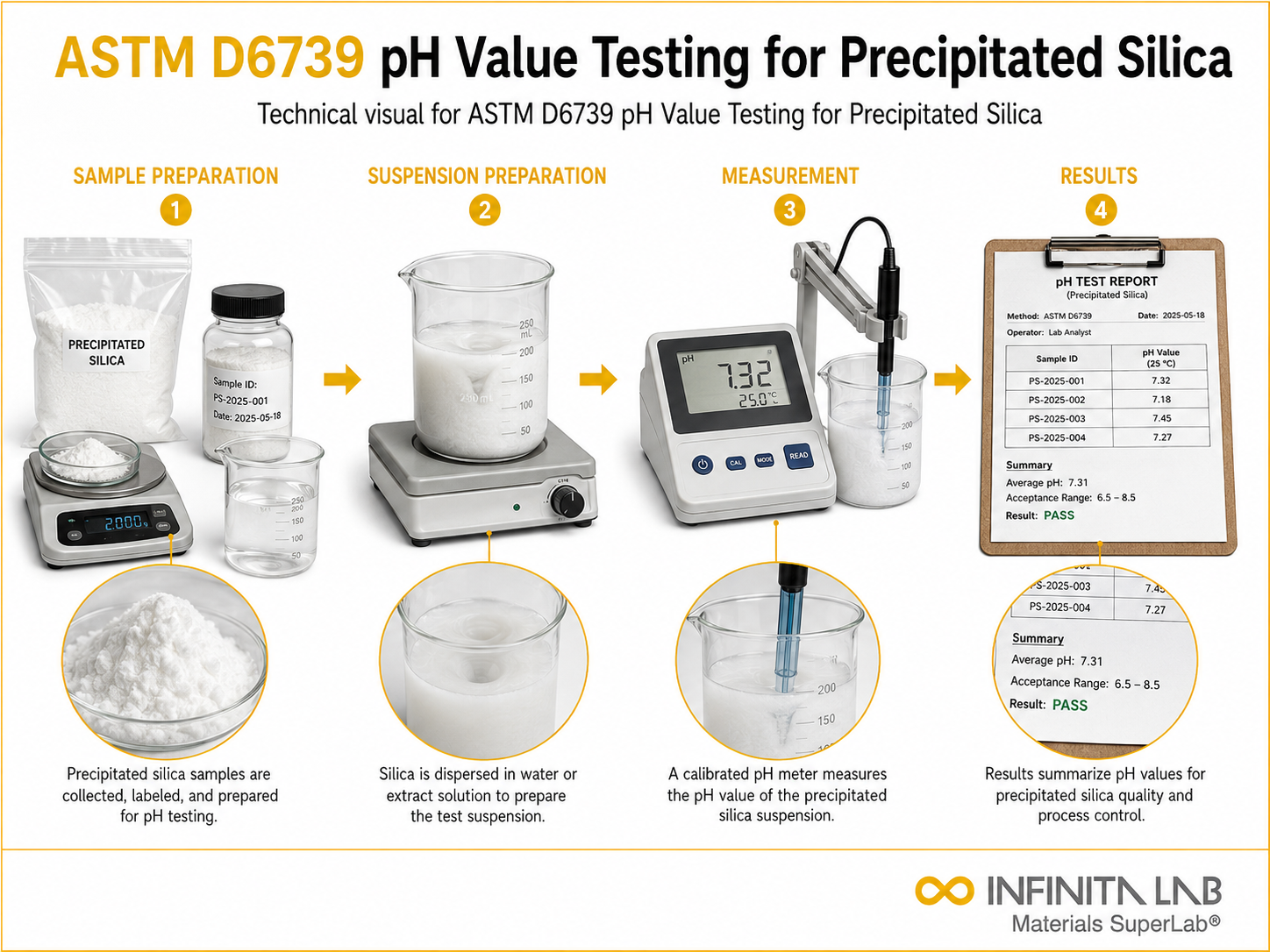
A specified mass of silica is dispersed in a defined volume of deionized water and stirred for a standard time to form a uniform slurry.
1pH Electrode Calibration
The pH meter is calibrated with two NIST-traceable buffer solutions bracketing the expected pH range of the silica.
2pH Measurement
The calibrated pH electrode is immersed in the silica slurry and pH is read after stabilization at controlled temperature.
3Reporting
pH value is recorded and compared against product specification limits; results are reported to the nearest 0.1 pH unit.
4ASTM D6739 Test Parameters and Requirements
| Parameter | Details |
|---|---|
| Standard | ASTM D6739 |
| Applicable Materials | Precipitated silica and silica gel |
| Measurement Medium | Aqueous slurry at specified silica concentration |
| Instrument | Calibrated pH meter with glass electrode |
| Temperature | Controlled (typically 23 ± 2°C) |
| Reporting Precision | 0.1 pH unit |


- Calibrated pH meter with combination glass/reference electrode
- NIST-traceable pH buffer solutions (e.g., pH 4, 7, 10)
- Analytical balance for precise silica weighing
- Deionized or distilled water (specified conductivity)
- Magnetic stirrer and stir bar
Equipment and Instrumentation Used for ASTM D6739 Testing
What You Receive: Test Report, Data, and Certification
- pH value of the silica slurry (to 0.1 unit precision)
- Temperature-corrected measurement data
- Batch pH compliance against specification limits
- Comparative pH data across lots and suppliers
- Incoming material inspection and quality control records
ASTM D6739 Silica Ph Value FAQs
Silica pH affects the cure rate of sulfur-vulcanized rubber. Highly acidic silica can retard cure, while alkaline silica may accelerate it. pH also influences silane coupling agent hydrolysis and silica dispersion in the compound.
Precipitated silica typically falls in the pH range of 5.5–8.5 when measured as an aqueous slurry. Silica gels may span a broader range depending on their intended application and surface treatment.
Tap water contains dissolved ions that can artificially shift the pH reading. Deionized or distilled water of defined low conductivity eliminates this interference for reliable, reproducible results.
Silane-treated or surface-modified silicas may exhibit different pH values than untreated precipitated silica due to changes in surface hydroxyl group chemistry introduced by the surface modification process.
ASTM D6739 is primarily specified for precipitated silica and silica gel. Fumed silica pH measurements may use similar slurry-based approaches, but separate methods or modified protocols may be more appropriate for fumed silica grades.
Why Choose Infinita Lab for Silica Ph Value Testing?
At the core of this breadth is our network of 2,000+ accredited laboratories across the USA, offering access to over 10,000 testing methods and analytical services. From advanced materials characterization (SEM, TEM, RBS, XPS) to mechanical, chemical, environmental, biological, and standardized ASTM/ISO-compliant testing, we deliver unmatched flexibility, specialization, and scale. You are never limited by geography, facility, or methodology — Infinita Lab connects you to the right expertise and testing solution, every time.

Looking for an Accredited Partner for ASTM D6739 Silica Ph Value Testing?
Send query us at hello@infinitalab.com or call us at (888) 878-3090 to learn more about our services and how we can support you.



Request a Quote
Submit your material details and receive testing procedures, pricing, and turnaround time within 24 hours.
 Quick Turnaround and Hasslefree process
 Confidentiality Guarantee
 Free, No-obligation Consultation
 100% Customer Satisfaction
