


ASTM D6111: Plastic Lumber Bulk Density Specific Gravity Testing Services
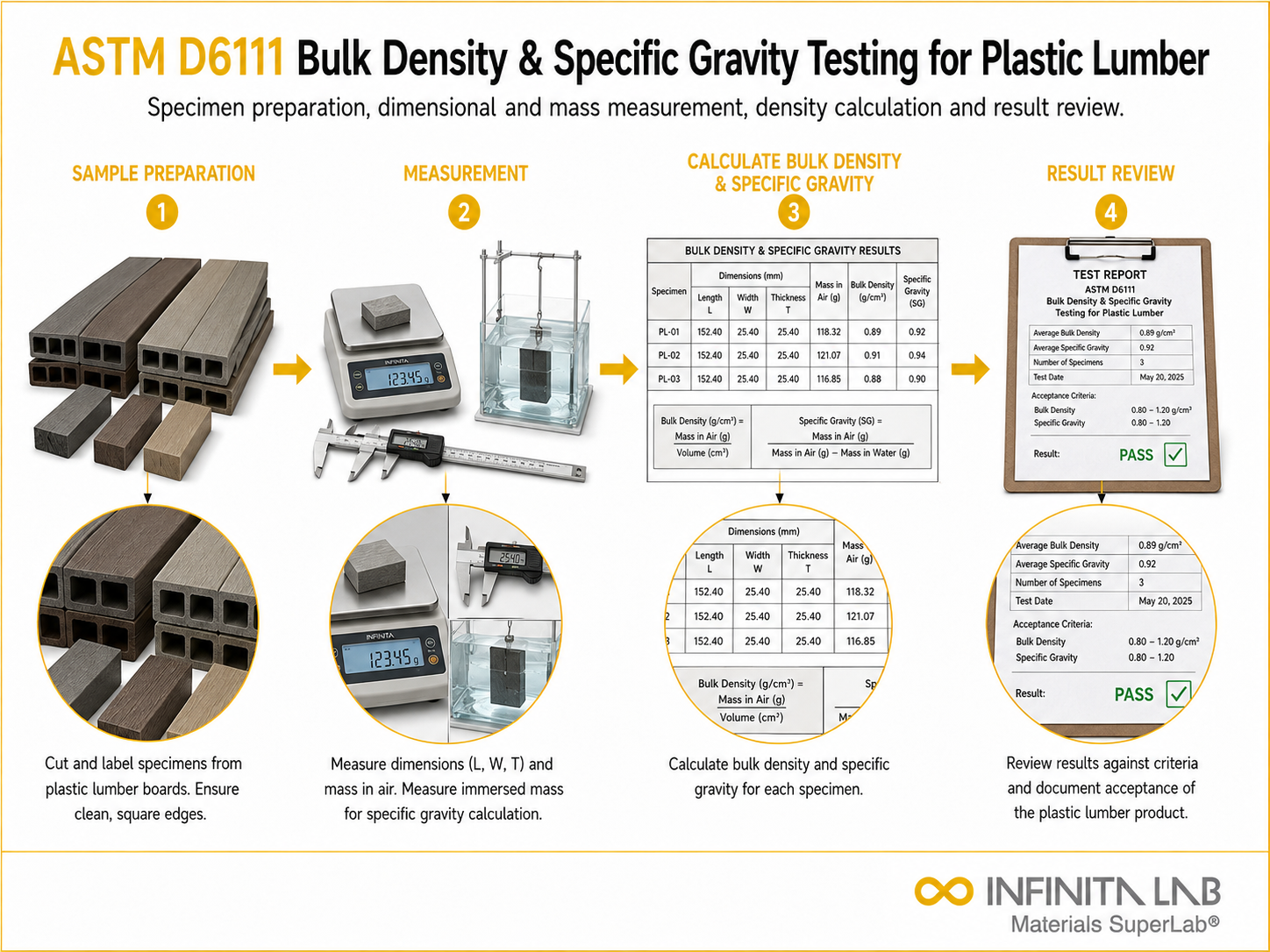
ASTM D6111 test method determines the properties of plastic lumber products by measuring their bulk density and specific gravity. Such products show viscoelastic behavior and are tested by weighing one piece of water. The final results of this test method are expressed in SI units.
TRUSTED BY


Get ASTM D6111 compliant results — request your plastic lumber bulk density specific gravity testing quote
- Overview
- Scope, Applications, and Benefits
- Test Process
- Specifications
- Instrumentation
- Results and Deliverables
What Is ASTM D6111 Plastic Lumber Bulk Density Specific Gravity?
ASTM D6110 describes a standard test method for determining the Charpy impact resistance of notched plastic specimens. The high-strain-rate test quantifies the energy absorbed by a material during fracture and directly measures toughness.
This test involves a notched specimen being struck by a pendulum hammer at controlled velocity. Measured energy absorption during fracture, in joules, indicates the material’s resistance to sudden impact forces. ASTM D6110 is widely used to evaluate the durability, resilience, and mechanical performance of plastic materials across industries.

Applications and Benefits of ASTM D6111 Plastic Lumber Bulk Density Specific Gravity Testing
Scope
ASTM D6110 evaluates the impact resistance of plastic materials using notched specimens.
It assesses:
- Energy absorption during fracture
- Ductile versus brittle fracture behavior
- Material toughness
- Temperature-dependent fracture performance
- Resistance to sudden mechanical shocks
- Reliability of plastic components
This method applies to rigid and semi-rigid plastic materials used in industrial and consumer applications.
Applications
- Automotive components (bumpers, dashboards, fuel systems)
- Aerospace plastic parts
- Consumer goods
- Construction materials
- Electrical enclosures
- Packaging components
- Research and development testing
Benefits
- Provides standardized impact resistance data
- Supports informed material selection
- Enhances product safety and durability
- Enables comparison between plastic grades
- Assists in quality control programs
- Helps predict real-world performance
Our ASTM D6111 Testing Procedure
Specimen Preparation
Standard specimens are prepared with precise dimensions and a machined notch.
1Apparatus Setup & Impact Testing
The specimen is mounted on the anvil and struck by a pendulum hammer at controlled velocity.
2Energy Measurement & Correction
Absorbed fracture energy is recorded and corrected for friction and windage losses.
3Data Normalization
Results are normalized based on specimen dimensions.
4ASTM D6111 Test Parameters and Requirements
| Parameter | Details |
|---|---|
| Applicable Materials | Rigid and semi-rigid plastics |
| Specimen Dimensions | 55 × 10 × 10 mm |
| Notch Type | Standard V-notch |
| Output Units | Joules (J) |
| Measured Outputs | Impact energy, impact resistance |


- Charpy pendulum impact tester
- Precision specimen holder
- Calibrated energy scale
- Notching machine
- Temperature conditioning chamber (if required)
- Data recording system
Equipment and Instrumentation Used for ASTM D6111 Testing
What You Receive: Test Report, Data, and Certification
- Absorbed impact energy values (J)
- Impact resistance calculations
- Fracture mode classification (brittle/ductile)
- Comparative material performance reports
ASTM D6111 Plastic Lumber Bulk Density Specific Gravity FAQs
This test measures plastic lumber's bulk density and specific gravity, through which performance and reliability will be assessed.
They directly affect how high strength-to-weight ratios translate to cost efficacy and application suitability.
The test requires a balance, immersion cage, immersion vessel, sinker, and wire setup.
Specimens are weighed in air and water, and the weights are used to calculate density and specific gravity.
The results aid in quality control, product acceptance/rejection, and optimizing the design and application of plastic lumber.
Why Choose Infinita Lab for Plastic Lumber Bulk Density Specific Gravity Testing?
At the core of this breadth is our network of 2,000+ accredited laboratories across the USA, offering access to over 10,000 testing methods and analytical services. From advanced materials characterization (SEM, TEM, RBS, XPS) to mechanical, chemical, environmental, biological, and standardized ASTM/ISO-compliant testing, we deliver unmatched flexibility, specialization, and scale. You are never limited by geography, facility, or methodology — Infinita Lab connects you to the right expertise and testing solution, every time.

Need ASTM D6111 Plastic Lumber Bulk Density Specific Gravity Testing You Can Rely On?
Send query us at hello@infinitalab.com or call us at (888) 878-3090 to learn more about our services and how we can support you.



Request a Quote
Submit your material details and receive testing procedures, pricing, and turnaround time within 24 hours.
 Quick Turnaround and Hasslefree process
 Confidentiality Guarantee
 Free, No-obligation Consultation
 100% Customer Satisfaction
