


ASTM D494: Phenolic Resin Acetone Extraction Testing Services
Accredited ASTM D494 phenolic resin acetone extraction testing from Infinita Lab, performed to the exact standard requirements - accurate, reproducible results with full documentation for compliance, R&D, and quality control programs.
TRUSTED BY


Get ASTM D494 compliant results - request your phenolic resin acetone extraction testing quote
- Overview
- Scope, Applications, and Benefits
- Test Process
- Specifications
- Instrumentation
- Results and Deliverables
What Is ASTM D494 Phenolic Resin Acetone Extraction?
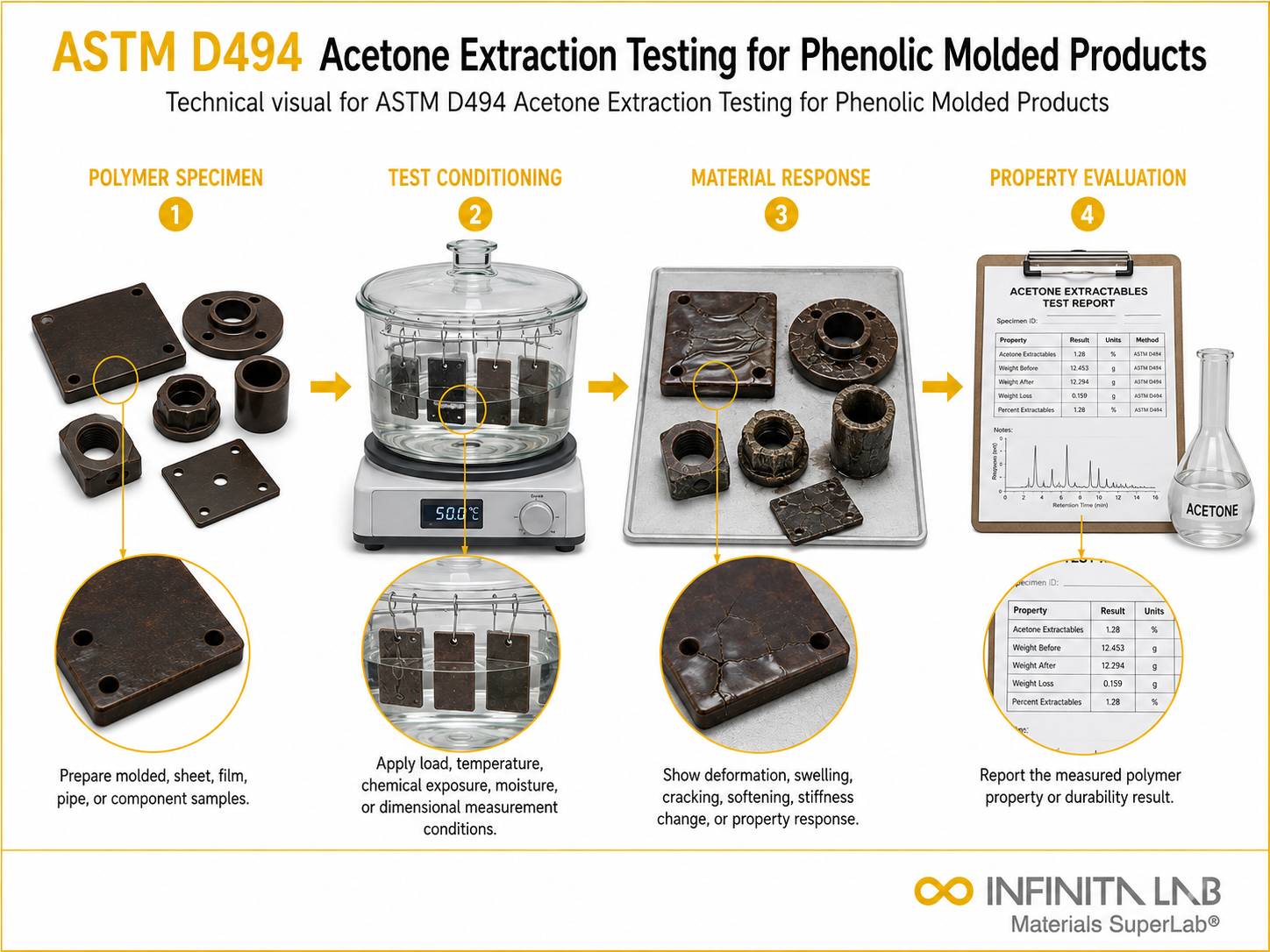
ASTM D494 defines a standardized method for determining the acetone-extractable content of phenolic molding compounds and related phenolic resin products. The acetone extraction provides information about the proportion of unreacted or partially reacted phenolic resin components — primarily free phenol, free formaldehyde, low-molecular-weight oligomers, and uncured resin fractions — that are soluble in acetone and can be extracted from the cured or partially cured phenolic product.
The method involves immersing a weighed specimen in acetone for a specified period, then drying the extracted specimen and weighing the mass loss. The acetone-extractable content is calculated as the percent weight loss and reflects the degree of cure and the content of volatile or soluble components in the phenolic material. This is an important quality control test for phenolic molding compounds used in electrical, automotive, and industrial applications.

Applications and Benefits of ASTM D494 Phenolic Resin Acetone Extraction Testing
Scope
ASTM D494 evaluates:
- Acetone-extractable content of phenolic molding compounds
- Degree of cure assessment of phenolic resins
- Free and partially reacted resin content
- Batch-to-batch consistency of phenolic compound cure state
- Effect of molding conditions on extractable content
- Compliance with the acetone extract specification limits
Applications
- Phenolic electrical switch and connector molding compounds
- Automotive brake pad phenolic binders
- Industrial phenolic laminate resins
- Phenolic foam insulation materials
- Abrasive wheel phenolic binder quality control
- Phenolic resin manufacturer quality control
- Research and development in phenolic resin chemistry
Benefits
- Provides a measure of phenolic resin cure completeness
- Detects undercured or improperly processed phenolic compounds
- Supports molding process parameter optimization
- Enables compliance with phenolic compound specifications
- Identifies batch deviations in resin content
- Provides data for failure analysis of phenolic component failures
Our ASTM D494 Testing Procedure
Specimen Preparation
Phenolic product specimen is cut, weighed, and placed in a Soxhlet or immersion extraction vessel.
1Acetone Extraction
Specimen is extracted with acetone at the specified temperature and duration.
2Drying
Extracted specimen is dried to constant weight in an oven.
3Calculation
Acetone-extractable content is calculated as percent mass loss relative to original specimen weight.
4ASTM D494 Test Parameters and Requirements
| Parameter | Details |
|---|---|
| Test Principle | Solvent extraction (acetone) followed by gravimetric determination |
| Extraction Solvent | Acetone |
| Applicable Materials | Phenolic molding compounds and resins |
| Output Units | Weight percent (%) |
| Measured Outputs | Acetone-extractable content |


- Soxhlet extraction apparatus or immersion vessel
- Analytical balance (0.1 mg resolution)
- Drying oven
- Desiccator
- Reflux condenser
- Data recording system
Equipment and Instrumentation Used for ASTM D494 Testing
What You Receive: Test Report, Data, and Certification
- Acetone-extractable content (weight percent)
- Pre- and post-extraction specimen weights
- Batch compliance evaluation
- Cure state assessment data
- Compliance reports
ASTM D494 Phenolic Resin Acetone Extraction FAQs
ASTM D494 determines acetone-extractable content in phenolic products. It evaluates presence of unreacted components or impurities, helping assess cure quality and material consistency in phenolic resins and molded products.
Key parameters include extraction time, solvent purity, temperature control, sample preparation, and drying conditions. Controlled conditions ensure accurate measurement of extractable content in phenolic materials.
The test measures percentage of material extracted by acetone. Results indicate level of unreacted resin or additives affecting performance and stability.
ASTM D494 applies to phenolic resins and molded phenolic products used in electrical, automotive, and industrial applications where material purity and curing are critical.
ASTM D494 results depend on extraction efficiency and sample preparation. Some components may not dissolve completely, requiring additional analytical methods for comprehensive material characterization.
Why Choose Infinita Lab for Phenolic Resin Acetone Extraction Testing?
When your Phenolic Resin Acetone Extraction results have to hold up - for compliance, a customer audit, or an engineering decision - ASTM D494 accuracy and an unbiased third-party report matter more than price. Infinita Lab routes your ASTM D494 phenolic resin acetone extraction testing to ISO/IEC 17025-accredited U.S. partner labs with hands-on method experience, so you get defensible data, transparent reporting, and turnaround times built around your project deadline - not ours.

Need ASTM D494 Phenolic Resin Acetone Extraction Testing You Can Rely On?
Send query us at hello@infinitalab.com or call us at (888) 878-3090 to learn more about our services and how we can support you.



Request a Quote
Submit your material details and receive testing procedures, pricing, and turnaround time within 24 hours.
 Quick Turnaround and Hasslefree process
 Confidentiality Guarantee
 Free, No-obligation Consultation
 100% Customer Satisfaction
