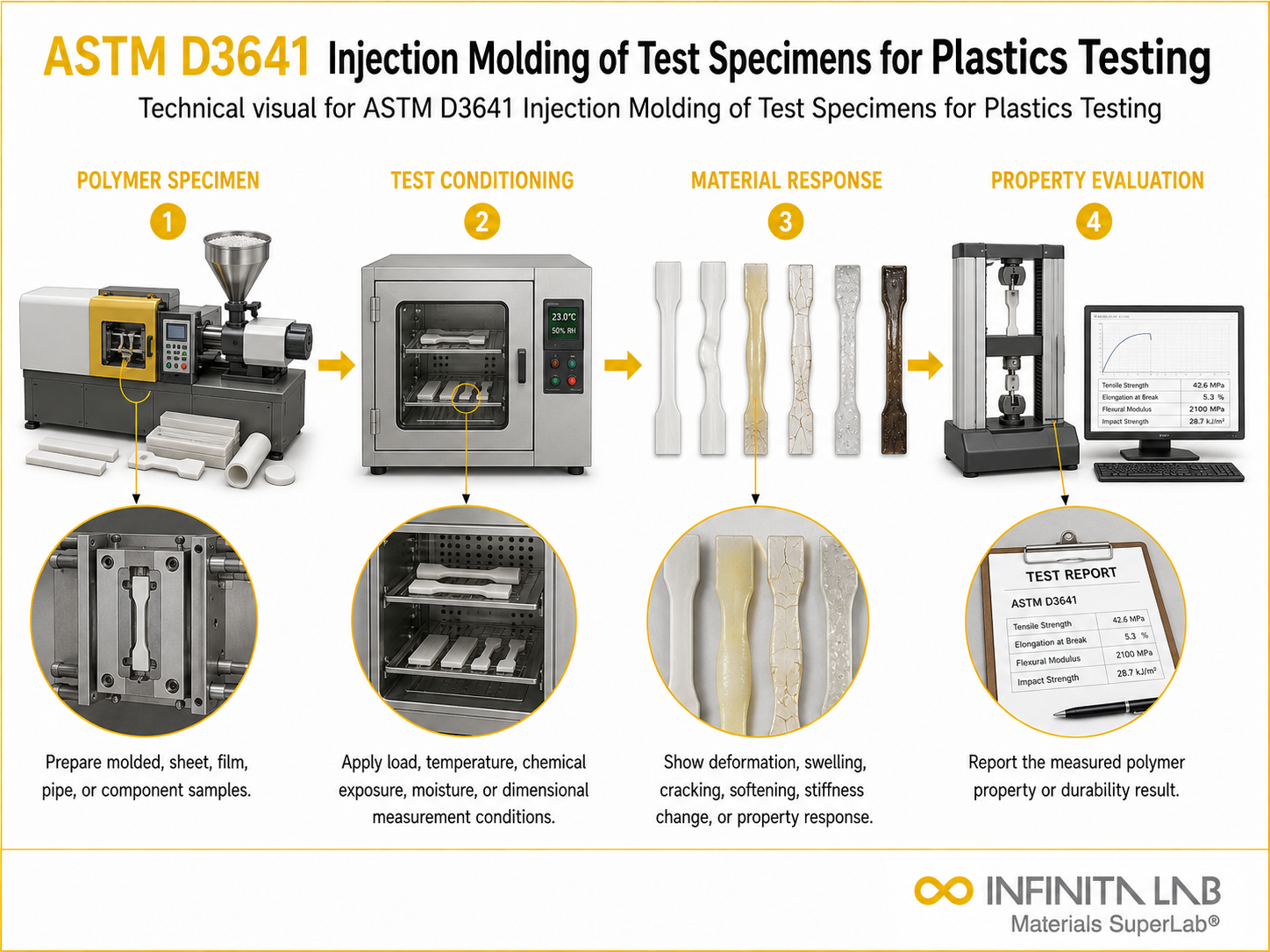


Overview
ASTM D3641 is a standard practice that describes the preparation of plastic test specimens using injection moulding techniques. The standard provides guidelines to produce consistent and reproducible specimens used for evaluating the mechanical and physical properties of thermoplastic materials.
This standard ensures that specimens used for laboratory testing are manufactured under controlled conditions so that test results accurately represent the properties of the plastic material. ASTM D3641 is commonly used in material development, quality control, and research laboratories.

Scope, Applications, and Benefits
Scope
ASTM D3641 specifies the procedures and conditions required for preparing thermoplastic test specimens by injection moulding. It ensures uniform specimen production for reliable property testing.
The standard also provides recommendations for mould design, moulding parameters, and specimen conditioning to maintain consistency during testing.
The scope includes:
Preparation of thermoplastic test specimens by injection moulding
Standard mould designs and specimen dimensions
Control of moulding parameters such as temperature and pressure
Specimen conditioning before testing
Ensuring repeatability and consistency in material testing
Applications
Mechanical property testing of thermoplastics
Material research and development
Quality control in plastic manufacturing
Injection moulding process evaluation
Standardized specimen preparation for laboratory testing
Benefits
Produces uniform and repeatable test specimens
Improves accuracy of material property measurements
Supports standardized plastic testing procedures
Reduces variability in laboratory testing results
Helps evaluate processing behavior of thermoplastics
Test Process
Material Preparation
Thermoplastic material is dried and prepared to ensure proper processing during injection moulding.
1Injection Moulding
The material is melted and injected into a mould to form test specimens of specified dimensions.
2Cooling and Ejection
The moulded specimens are cooled under controlled conditions and carefully removed from the mould.
3Conditioning and Inspection
Specimens are conditioned under standard conditions and inspected before testing.
4Technical Specifications
| Parameter | Details |
|---|---|
| Material Type | Thermoplastic polymers used for injection moulding. |
| Specimen Production Method | Injection moulding using standardized mould cavities. |
| Specimen Dimensions | Produced according to standardized shapes used in mechanical testing. |
| Processing Temperature | Controlled according to polymer type and manufacturer recommendations. |
| Injection Pressure | Applied to ensure complete mould filling and specimen uniformity. |
| Cooling Conditions | Controlled cooling to prevent deformation or internal stress. |
| Specimen Conditioning | Typically conditioned at standard laboratory temperature and humidity |
| Quality Requirements | Specimens should be free from voids, warping, or surface defects. |


Injection Moulding Machine
Standardized Test Specimen Mould
Temperature Control System
Pressure Control System
Cooling System
Measurement Tools (Vernier caliper or micrometer)
Instrumentation Used for Testing
Results and Deliverables
Properly moulded standardized test specimens
Dimensional verification of specimens
Processing parameter documentation
Specimen quality inspection report
Complete laboratory preparation report
Frequently Asked Question
ASTM D3641 is a standard practice for preparing plastic test specimens using injection moulding techniques. It ensures that specimens used in testing are produced consistently for reliable material property evaluation.
Proper specimen preparation ensures that the measured mechanical and physical properties accurately represent the material. Poorly prepared specimens can lead to incorrect or inconsistent test results
Injection moulding allows the production of specimens with precise dimensions, consistent structure, and controlled processing conditions.
Factors such as mould temperature, injection pressure, cooling time, and material preparation can significantly affect specimen quality.
Conditioning ensures that specimens reach stable temperature and humidity levels, allowing accurate and reproducible test results.
Why Choose Infinita Lab for Advanced Materials Testing and Characterization?
At the core of this breadth is our network of 2,000+ accredited laboratories across the USA, offering access to over 10,000 testing methods and analytical services. From advanced materials characterization (SEM, TEM, RBS, XPS) to mechanical, chemical, environmental, biological, and standardized ASTM/ISO-compliant testing, we deliver unmatched flexibility, specialization, and scale. You are never limited by geography, facility, or methodology — Infinita Lab connects you to the right expertise and testing solution, every time.

Looking for a Trusted Partner for Accurate and Reliable Testing Services?
Send query us at hello@infinitalab.com or call us at (888) 878-3090 to learn more about our services and how we can support you.





