


Stress Relaxation Testing for Polymers, Elastomers & Metals
Stress Relaxation of Materials, also known as the creep test, refers to the thermomechanical phenomena that cause elastic strain to change gradually to plastic, even at stress levels below the yield strength. Stress relaxation causes contact force to continuously degrade because contact force is only produced by elastic strain and not by plastic strain. As a result, the contact interface's resistance gradually rises, contaminating it and decreasing the signal's integrity and reliability.
TRUSTED BY


Precision Testing Solutions for Accurate, Reliable, and Standards-Compliant Results
- Overview
- Scope, Applications, and Benefits
- Test Process
- Specifications
- Instrumentation
- Results and Deliverables
Stress Relaxation Testing Overview
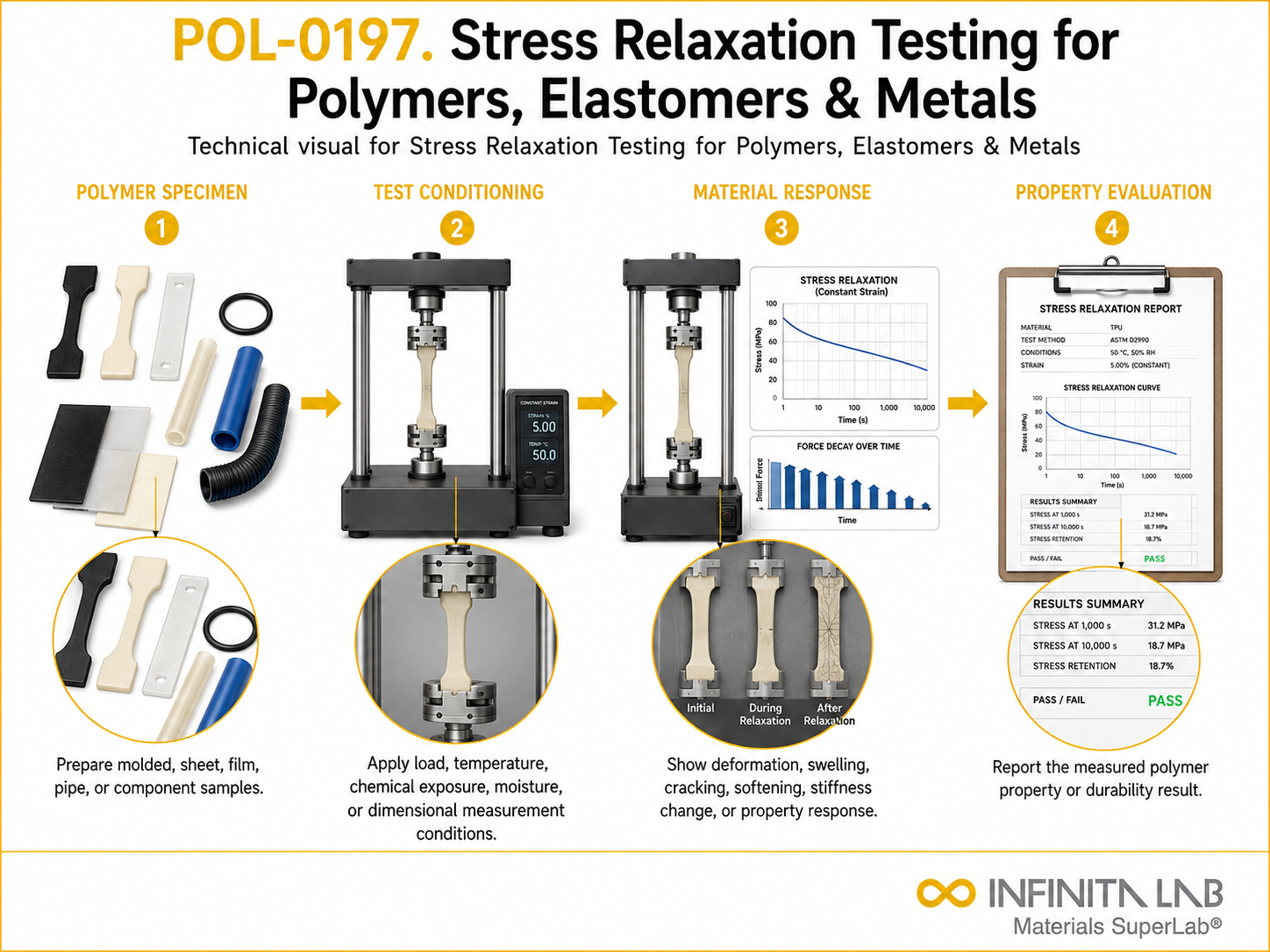
Stress relaxation testing is used to evaluate how a material’s internal stress decreases over time when it is held at a constant strain. This behavior is critical for understanding the long-term performance of materials subjected to sustained deformation, especially in applications involving fastening, sealing, or structural loading.
The test is commonly conducted under standards such as ASTM E328, where a specimen is initially loaded and constrained, and the decrease in stress required to maintain that constraint is measured over time. It provides insight into viscoelastic and plastic deformation behavior under constant strain conditions.

Scope, Applications, and Benefits
Scope
Stress relaxation testing evaluates:
- Time-dependent decrease in stress under constant strain
- Viscoelastic and plastic deformation behavior
- Long-term material stability
- Stress retention capability
- Material performance under sustained loading
Applications
- Bolted joints and fasteners
- Springs and elastic components
- Gaskets and sealing materials
- Polymers, metals, and composites
- Structural and mechanical assemblies
Benefits
- Predicts long-term material performance
- Prevents loss of preload in fasteners
- Supports the design of durable components
- Helps select materials for sustained loading
- Improves reliability and safety
Stress Relaxation Test Process
Sample Preparation
Standard specimen is prepared and mounted in a testing machine.
1Initial Loading
Specimen is strained to a defined level and held constant.
2Stress Monitoring
Decrease in stress is recorded over time while maintaining constant strain.
3Data Analysis
Stress vs time data is analyzed to determine relaxation behavior.
4Stress Relaxation Technical Specifications
| Parameter | Details |
|---|---|
| Stress Relaxation Technical Specifications | Tension, compression, bending, torsion |
| Test Duration | Minutes to thousands of hours (application dependent) |
| Temperature Range | Ambient to elevated temperature conditions |
| Sample Type | Metals, polymers, composites |
| Measured Outputs | Stress vs time, relaxation rate |


Instrumentation Used for Testing
- Universal testing machine or creep testing system
- Extensometer or strain control system
- Load cell for stress measurement
- Environmental chamber (for temperature control)
- Data acquisition and monitoring system
- Fixtures and grips for specimen holding
Results and Deliverables
- Stress relaxation curve (stress vs time)
- Percentage stress loss over time
- Relaxation rate and behavior
- Material performance under sustained strain
- Comparative evaluation for design applications
- Test report
Frequently Asked Questions
Stress relaxation testing measures how the stress in a material decreases over time when it is held at a constant deformation, helping evaluate long-term mechanical behavior under sustained loading conditions.
ASTM E328 is a standard test method used to determine the time-dependent decrease in stress in materials under constant constraint, providing valuable data for design and material performance evaluation.
Creep measures strain increase under constant stress, while stress relaxation measures stress decrease under constant strain, both describing time-dependent deformation behavior of materials.
Materials such as metals, polymers, elastomers, and composites are tested to evaluate long-term stability and performance under sustained loading conditions.
It helps prevent loss of force in components like bolts, springs, and seals, ensuring long-term reliability, structural integrity, and proper functioning of mechanical systems.
Why Choose Infinita Lab for Advanced Materials Testing and Characterization?
At the core of this breadth is our network of 2,000+ accredited laboratories across the USA, offering access to over 10,000 testing methods and analytical services. From advanced materials characterization (SEM, TEM, RBS, XPS) to mechanical, chemical, environmental, biological, and standardized ASTM/ISO-compliant testing, we deliver unmatched flexibility, specialization, and scale. You are never limited by geography, facility, or methodology — Infinita Lab connects you to the right expertise and testing solution, every time.

Looking for a Trusted Partner for Accurate and Reliable Testing Services?
Send query us at hello@infinitalab.com or call us at (888) 878-3090 to learn more about our services and how we can support you.



Request a Quote
Submit your material details and receive testing procedures, pricing, and turnaround time within 24 hours.
 Quick Turnaround and Hasslefree process
 Confidentiality Guarantee
 Free, No-obligation Consultation
 100% Customer Satisfaction
