


Pyrolysis GC MS Polymer Testing Services
Pyrolysis Gas Chromatography/Mass Spectrometry (Pyro-GC-MS) utilizes controlled thermal decomposition (pyrolysis) to break-up large molecules into smaller fragments that can be separated and analyzed in a coupled Gas Chromatograph-Mass Spectrometer (GC-MS).
TRUSTED BY


Get compliant results — request your pyrolysis GC MS polymer testing quote
- Overview
- Scope, Applications, and Benefits
- Test Process
- Specifications
- Instrumentation
- Results and Deliverables
What Is Pyrolysis GC MS Polymer?
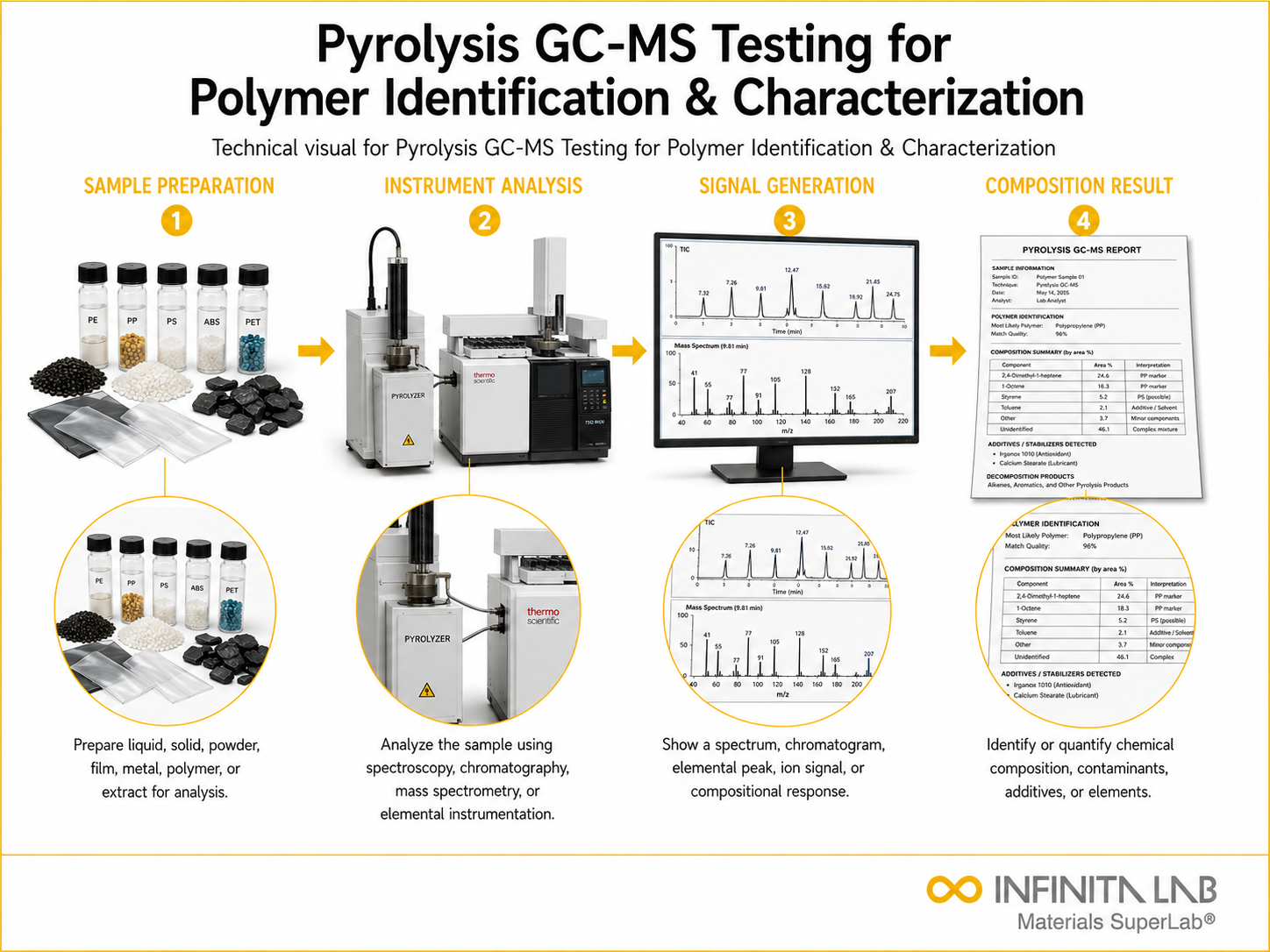
Pyrolysis Gas Chromatography-Mass Spectrometry (Pyro GC-MS) is an advanced analytical technique used to identify and characterize complex organic materials by thermally decomposing them into smaller, volatile fragments. These fragments are then separated by gas chromatography and identified by mass spectrometry, enabling detailed chemical analysis of the materials.
The technique is particularly useful for materials that cannot be analyzed directly using conventional GC-MS, such as polymers, resins, and composites. By rapidly heating samples in an inert environment (typically above 500–1000°C), large molecules break down into characteristic compounds that act as a chemical fingerprint of the original material.

Applications and Benefits of Pyrolysis GC MS Polymer Testing
Scope
Pyro GC-MS testing evaluates:
- Chemical composition of complex materials
- Identification of polymers and additives
- Thermal degradation products
- Presence of contaminants and unknown compounds
- Material fingerprinting and structural analysis
Applications
- Polymers, plastics, and rubber materials
- Paints, coatings, and adhesives
- Microplastics and environmental samples
- Forensic material identification
- Pharmaceuticals and chemical products
Benefits
- Enables analysis of non-volatile and complex materials
- Requires minimal sample preparation
- Provides detailed chemical fingerprinting
- Detects trace-level components (ppm range)
- Supports failure analysis and material identification
Our Testing Procedure
Sample Preparation
Small sample (µg to mg range) is placed in a pyrolysis chamber.
1Pyrolysis
Sample is rapidly heated (typically 500–1000°C) in an inert atmosphere to decompose into volatile fragments.
2GC Separation
Volatile fragments are carried by inert gas and separated in a GC column based on volatility.
3MS Detection
Fragments are ionized and analyzed to generate mass spectra for compound identification.
4Test parameters and requirements
| Parameter | Details |
|---|---|
| Standard | ASTM E1618 (for forensic applications), internal analytical methods |
| Applicable Materials | Polymers, resins, coatings, composites |
| Temperature Range | ~300°C to 1000°C |
| Atmosphere | Inert gas (helium or nitrogen) |
| Sample Size | ~5 µg to few mg |
| Detection Limit | ppm level (component dependent) |
| Measured Outputs | Chemical composition, degradation products |


- Pyrolyzer unit (thermal decomposition system)
- Gas chromatograph (GC)
- Mass spectrometer (MS)
- Carrier gas system (helium/nitrogen)
- Micro-sample introduction system
- Data acquisition and spectral analysis software
Equipment and Instrumentation Used for Testing
What You Receive: Test Report, Data, and Certification
- Chemical composition profile
- Identification of polymers and additives
- Pyrogram (GC-MS chromatogram)
- Mass spectra of individual components
- Contaminant and unknown compound identification
- Test report
Pyrolysis GC MS Polymer FAQs
Pyrolysis GC-MS is a technique used to analyze complex materials by breaking them into smaller fragments through heating and identifying them using gas chromatography and mass spectrometry.
Materials such as plastics, polymers, rubber, coatings, adhesives, and environmental samples like microplastics can be analyzed effectively using this method.
Pyrolysis breaks down large, non-volatile molecules into smaller volatile compounds, enabling their separation and detection using GC-MS techniques.
Typical pyrolysis temperatures range from about 500°C to 1000°C depending on the material and analysis requirements.
It allows direct analysis of complex materials with minimal preparation, provides detailed chemical identification, and is highly sensitive for detecting trace components.
Why Choose Infinita Lab for Pyrolysis GC MS Polymer Testing
At the core of this breadth is our network of 2,000+ accredited laboratories across the USA, offering access to over 10,000 testing methods and analytical services. From advanced materials characterization (SEM, TEM, RBS, XPS) to mechanical, chemical, environmental, biological, and standardized ASTM/ISO-compliant testing, we deliver unmatched flexibility, specialization, and scale. You are never limited by geography, facility, or methodology — Infinita Lab connects you to the right expertise and testing solution, every time.

Looking for an Accredited Partner for Pyrolysis GC MS Polymer Testing?
Send query us at hello@infinitalab.com or call us at (888) 878-3090 to learn more about our services and how we can support you.



Request a Quote
Submit your material details and receive testing procedures, pricing, and turnaround time within 24 hours.
 Quick Turnaround and Hasslefree process
 Confidentiality Guarantee
 Free, No-obligation Consultation
 100% Customer Satisfaction
