


PIXE Particle Induced X Ray Emission Testing Services
Accredited PIXE particle induced x ray emission testing from Infinita Lab, performed to the exact standard requirements - accurate, reproducible results with full documentation for compliance, R&D, and quality control programs.
TRUSTED BY


Get compliant results — request your PIXE particle induced x ray emission testing quote
- Overview
- Scope, Applications, and Benefits
- Test Process
- Specifications
- Instrumentation
- Results and Deliverables
What Is PIXE Particle Induced X Ray Emission?
Particle-Induced X-Ray Emission (PIXE) is a highly sensitive, non-destructive analytical technique used to identify and quantify the elemental composition of a wide range of materials, from ancient artefacts and biological tissues to modern semiconductors and environmental particulates. As part of the broader family of ion beam analysis methods, PIXE is valued by materials scientists, conservators, and quality engineers for its ability to reveal trace and ultra-trace elements without altering or damaging the sample under examination.
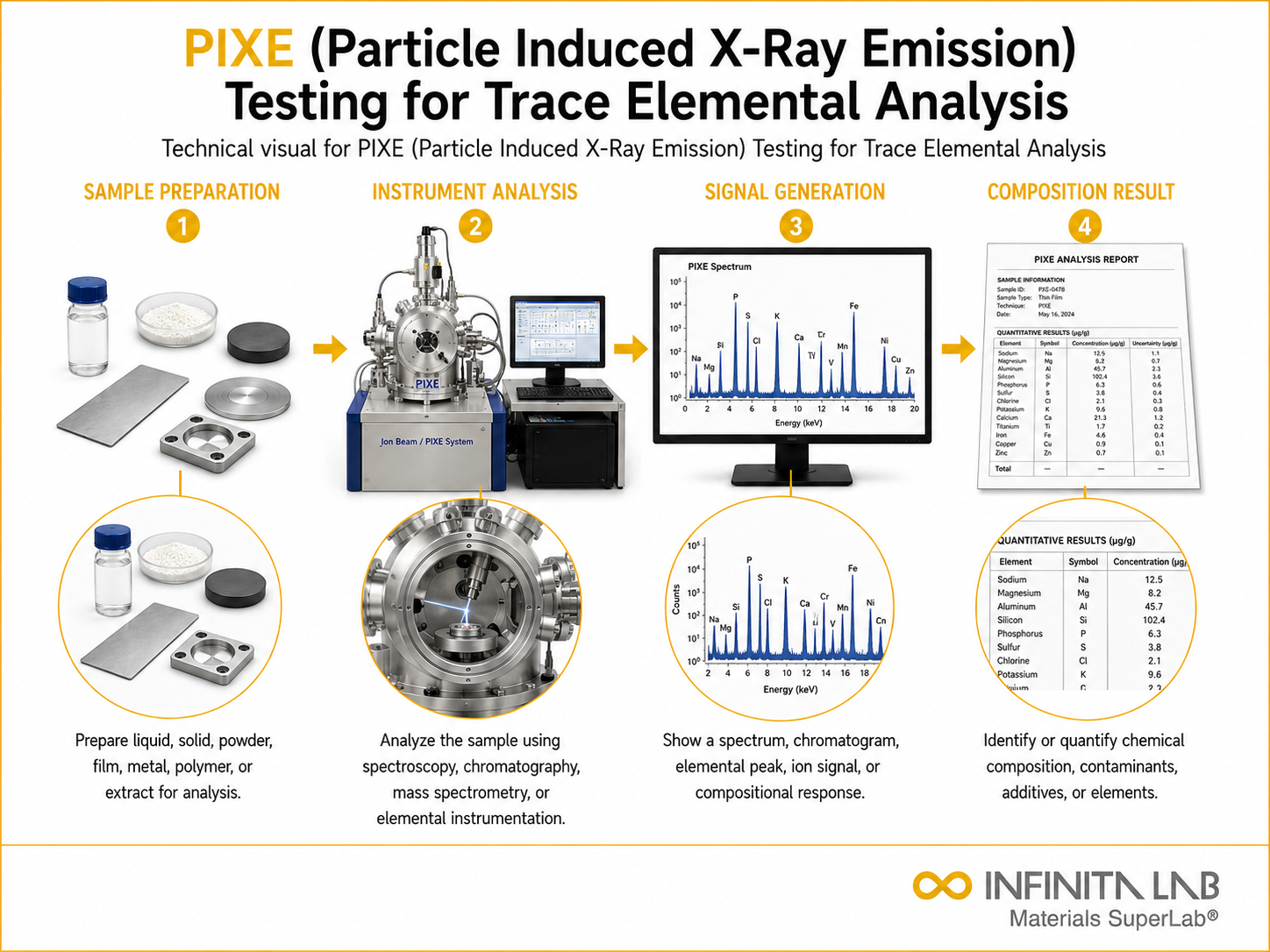
At its core, PIXE testing directs a beam of high-energy charged particles, typically protons accelerated to megaelectronvolt (MeV) energies by a particle accelerator, onto the surface of a target sample. As the incident protons pass through the material, they interact with the electrons orbiting each atom’s nucleus, ejecting inner-shell electrons and leaving behind vacancies. When outer-shell electrons fall into these vacancies, the atom releases energy in the form of characteristic X-rays, each carrying an energy signature unique to a specific element. A high-resolution, energy-dispersive detector captures these emitted X-rays, and supporting electronics sort them into a spectrum that reveals which elements are present and in what concentration.
Because PIXE can simultaneously detect a broad range of elements, from sodium through uranium, in a single measurement, often down to parts-per-million or sub-ppm sensitivity, it delivers a rapid, multi-elemental fingerprint of a sample with minimal preparation. Given its inherently non-destructive nature, PIXE is an indispensable tool for provenance studies, contamination analysis, environmental monitoring, and quality control across industries where preserving sample integrity is as important as the analytical data itself.

Applications and Benefits of PIXE Particle Induced X Ray Emission Testing
Scope
- PIXE testing identifies and quantifies the elemental composition of a sample by measuring the characteristic X-rays emitted when an ion beam strikes its surface.
- The technique reliably detects elements across a broad range of the periodic table, generally from sodium (Z = 11) up through uranium (Z = 92), in a single acquisition.
- Detection sensitivity typically reaches parts-per-million levels, with thin-film or foil samples capable of sub-ppm sensitivity for many elements.
- Samples can be analysed as solids, pressed pellets, thin films, foils, liquids, aerosol filters, or biological and tissue sections, giving the technique broad applicability across sample forms.
- PIXE is fundamentally non-destructive and typically requires little to no chemical sample preparation, allowing analysis of valuable or irreplaceable objects intact.
- The method is inherently surface-sensitive, probing roughly the top micrometre of a sample, which makes it well suited to thin coatings, films, and surface contamination studies.
- Because it excites and detects multiple elements simultaneously, PIXE provides a rapid multi-element fingerprint rather than requiring separate tests for each element of interest.
- Industries and disciplines that rely on PIXE include archaeology and art conservation, environmental science, semiconductor manufacturing, biomedical research, geology, and industrial quality control.
- Typical use cases include provenance and authentication studies of art and archaeological objects, aerosol and airborne particulate characterisation, semiconductor and thin-film contamination screening, and biomedical or forensic elemental profiling.
- PIXE results support material characterisation, contamination and impurity analysis, provenance and authenticity studies, and ongoing quality control programs.
Applications
- Archaeology and cultural heritage, for provenance studies and non-destructive analysis of artefacts, pigments, and archaeological ceramics.
- Art conservation and authentication, for identifying pigments, alloys, and material composition without sampling or damaging the artwork.
- Environmental science, for characterising airborne particulates, aerosol filters, and pollution source profiling.
- Semiconductor and electronics manufacturing, for trace contamination screening of wafers, thin films, and coatings.
- Biomedical and forensic science, for elemental profiling of tissues, hair, and other biological specimens.
- Geology and mineralogy, for elemental characterization of rocks, minerals, and ore samples.
- Industrial quality control, for verifying material composition and identifying sources of contamination in production processes.
Benefits
- Extremely high sensitivity for trace and ultra-trace elements, often reaching ppm or sub-ppm detection levels.
- Non-destructive analysis that preserves the sample, making it ideal for irreplaceable, rare, or evidentiary materials.
- Simultaneous multi-element detection in a single measurement, reducing overall testing time compared with element-by-element methods.
- Minimal sample preparation requirements, which speed up turnaround and reduce the risk of contamination.
- Strong surface sensitivity that makes the technique effective for thin films, coatings, and surface-level contamination.
- Broad applicability across sample types and industries, from cultural heritage objects to modern engineered materials.
Our Testing Procedure
Sample Preparation
The sample is prepared in thin, uniform form to ensure efficient interaction with the incoming charged particle beam.
1Particle Beam Irradiation
A high-energy proton beam is directed onto the sample, causing ionization of inner-shell electrons in atoms.
2X-ray Emission and Detection
Characteristic X-rays emitted from excited atoms are detected using high-resolution X-ray detectors.
3Spectral Analysis
The X-ray spectrum is analyzed to identify and quantify elemental composition based on energy signatures.
4Test parameters and requirements
| Parameter | Details |
|---|---|
| Measurement Principle | Proton-induced characteristic X-ray emission |
| Particle Source | MeV-energy proton beam |
| Detection Range | Sodium (Na) to Uranium (U) typically |
| Detection Limit | ppm to sub-ppm levels |
| Sample Type | Solid, thin film, aerosol, biological specimens |
| Spatial Resolution | Micrometer-scale (beam-dependent) |
| Analysis Mode | Multi-element simultaneous detection |
| Data Output | Elemental concentration spectrum |


- Particle Accelerator – Generates and accelerates the proton beam used to excite characteristic X-ray emission in the sample.
- Beam Focusing and Collimation System – Shapes and directs the ion beam onto a precise, well-defined area of the sample surface.
- Sample Chamber and Mounting Stage – Holds the sample in position within the beam path, whether under vacuum or in an external beam configuration.
- Vacuum System – Maintains the low-pressure environment required for standard in-vacuum PIXE analysis.
- X-Ray Detector (Si(Li) or SDD) – A high-resolution, energy-dispersive detector that captures the characteristic X-rays emitted from the sample.
- Multichannel Analyser and Data Acquisition Electronics – Sorts detected X-ray events by energy to build the elemental spectrum in real time.
- Spectral Analysis Software – Processes the acquired spectrum to identify elements, resolve overlapping peaks, and calculate quantitative concentrations.
Equipment and Instrumentation Used for Testing
What You Receive: Test Report, Data, and Certification
- A detailed elemental composition report listing all elements identified in the sample.
- Quantitative concentration values for each detected element, typically expressed in ppm or weight per cent.
- The full acquired X-ray spectrum, providing a visual elemental fingerprint of the sample.
- Comparison of results against relevant reference standards or certified reference materials where applicable.
- A trace element and contamination summary highlighting elements of particular concern or interest.
- A final analytical report suitable for documentation, quality assurance records, or provenance and research purposes.
PIXE Particle Induced X Ray Emission FAQs
PIXE is based on inner-shell ionization of atoms caused by high-energy proton bombardment, which leads to emission of characteristic X-rays used for elemental identification and quantification.
The technique uses low background X-ray emission and high detector resolution, allowing detection of elements at ppm to sub-ppm concentrations.
PIXE uses proton beams, which produce higher X-ray yield and lower background noise, resulting in better sensitivity for trace element detection compared to electron-based methods.
Different elements can emit X-rays with closely spaced energies, leading to spectral peak overlap. This complicates deconvolution and can cause misidentification or inaccurate quantification if resolution is insufficient.
Beam energy determines ionization depth and excitation efficiency. Too low reduces signal strength, while too high increases background noise and may introduce unwanted secondary interactions.
A proton beam strikes the sample and ejects inner-shell electrons. As atoms return to their stable state, they emit characteristic X-rays that reveal the elemental composition.
The sample is irradiated with a proton beam, emitted X-rays are detected and analyzed, and the resulting spectrum is used to identify and quantify elements.
PIXE spectroscopy measures the energies and intensities of characteristic X-rays emitted from a proton-irradiated sample to determine its elemental composition and concentrations.
Why Choose Infinita Lab for Advanced Materials Testing and Characterization?
At the core of this breadth is our network of 2,000+ accredited laboratories across the USA, offering access to over 10,000 testing methods and analytical services. From advanced materials characterization (SEM, TEM, RBS, XPS) to mechanical, chemical, environmental, biological, and standardized ASTM/ISO-compliant testing, we deliver unmatched flexibility, specialization, and scale. You are never limited by geography, facility, or methodology — Infinita Lab connects you to the right expertise and testing solution, every time.

Looking for an Accredited Partner for PIXE Particle Induced X Ray Emission Testing?
Send query us at hello@infinitalab.com or call us at (888) 878-3090 to learn more about our services and how we can support you.



Request a Quote
Submit your material details and receive testing procedures, pricing, and turnaround time within 24 hours.
 Quick Turnaround and Hasslefree process
 Confidentiality Guarantee
 Free, No-obligation Consultation
 100% Customer Satisfaction
