


Metal Grain Size Determination Guide – ASTM E112 & Image Analysis
Determining the average grain size of metallic materials is important in understanding the microstructure of a material and how it may affect its mechanical properties. The average grain size of metallic materials can be determined using various methods, but one of the most commonly used methods is optical microscopy.
TRUSTED BY


Precision Testing Solutions for Accurate, Reliable, and Standards-Compliant Results
- Overview
- Scope, Applications, and Benefits
- Test Process
- Specifications
- Instrumentation
- Results and Deliverables
Grain Size Determination Test – Overview
Determining the average grain size of metallic materials is a critical metallurgical analysis used to evaluate microstructural characteristics. Grain size significantly influences mechanical properties such as strength, toughness, hardness, and fatigue resistance in metals.
This test is commonly performed using optical microscopy methods as per standardized procedures. It provides quantitative data on grain structure, enabling control of heat treatment processes, material performance, and quality assurance in metal production.

Scope, Applications, and Benefits
Scope
This method defines procedures for measuring average grain size in metallic materials through microscopic examination and standardized comparison techniques such as intercept or planimetric methods. It evaluates microstructural uniformity and grain distribution.
The analysis supports correlation between microstructure and mechanical properties.
- Measurement of average grain size using microscopic techniques
- Evaluation of grain distribution and uniformity
- Assessment of metallurgical processing effects
- Correlation with mechanical properties
- Comparison of materials and heat treatments
- Standardized microstructural characterization
Applications
- Metallurgical quality control and inspection
- Heat treatment process validation
- Steel and alloy development
- Failure analysis and investigation
- Aerospace and automotive material testing
- Welding and casting evaluation
- Research and development in materials science
Benefits
- Provides insight into mechanical property behavior
- Supports optimization of heat treatment processes
- Enables control of strength and toughness
- Helps detect abnormal grain growth
- Improves consistency in material performance
- Essential for metallurgical quality assurance
Grain Size Determination Test – Test Process
Sample Preparation
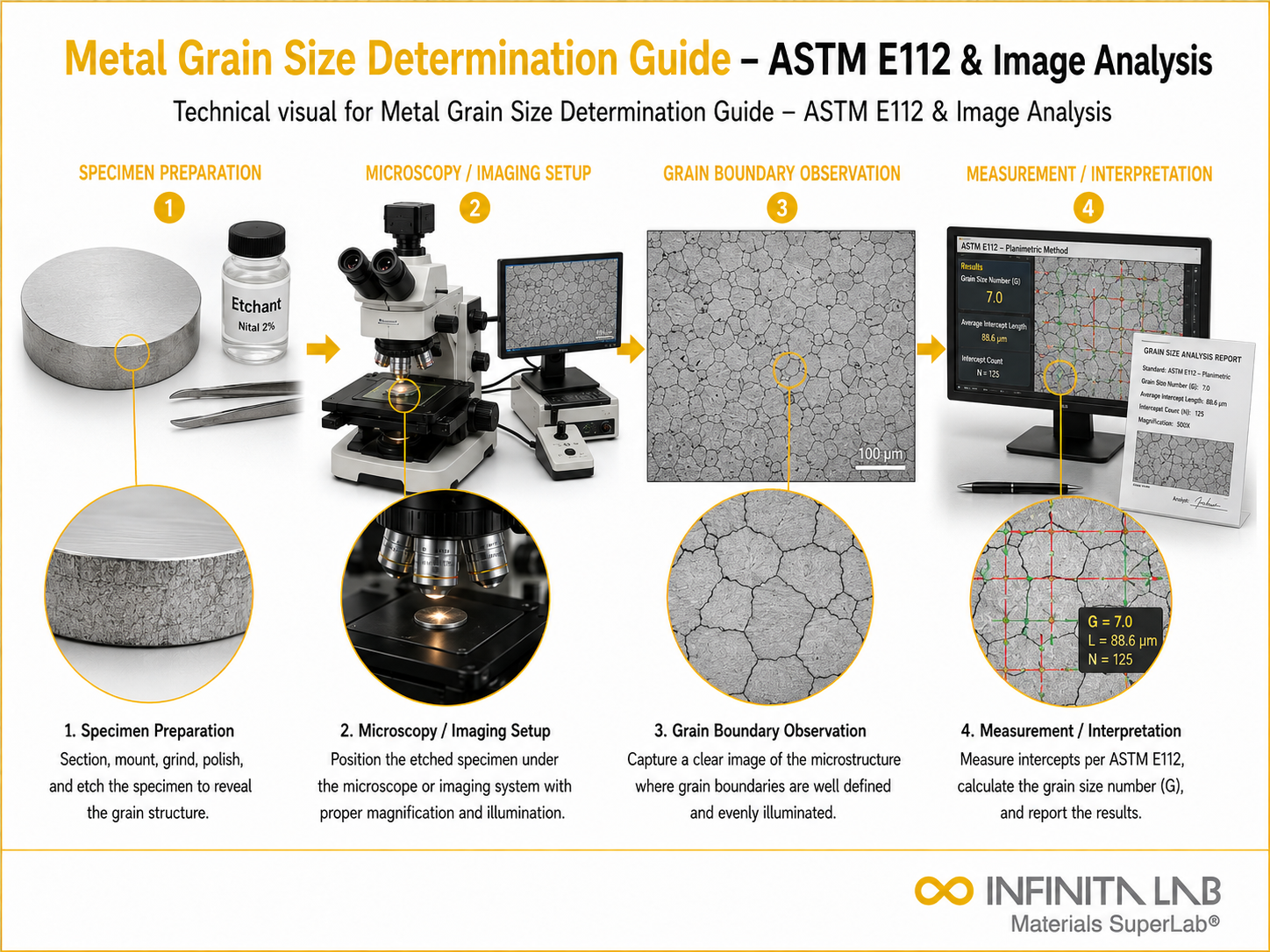
The metal sample is sectioned, mounted, polished, and etched to reveal grain boundaries clearly under a microscope.
1Microscopic Examination
The prepared specimen is observed using optical microscopy at specified magnifications to visualize grain structure.
2Measurement Method Selection
Grain size is determined using comparison charts, intercept method, or planimetric counting techniques.
3Data Calculation & Reporting
Grain size number or average grain diameter is calculated and reported as per standard requirements.
4Grain Size Determination Test – Technical Specification
| Parameter | Details |
|---|---|
| Sample Condition | Properly polished and etched metallographic specimen |
| Sample Type | Metallic materials (ferrous and non-ferrous alloys) |
| Measurement Method | Comparison, intercept, or planimetric techniques |
| Magnification Range | Typically 50× to 500× depending on grain size |
| Environmental Conditions | Controlled lighting and stable laboratory conditions |
| Measurement Units | ASTM grain size number (G) or micrometers (µm) |


Instrumentation Used for Testing
- Optical microscope
- Metallographic sample preparation equipment
- Grinding and polishing machines
- Etching chemicals
- Image analysis software
- Measuring grids or reticles
- Sample mounting press
- Illumination system
Results and Deliverables
- Average grain size value
- ASTM grain size number (G)
- Microstructure images
- Grain distribution analysis
- Metallurgical test report
- Quality control documentation
- Compliance with standards
- Recommendations for process optimization
Frequently Asked Questions
Grain boundaries impede dislocation motion; finer grains increase boundary density, enhancing strength via the Hall–Petch mechanism, while coarse grains reduce resistance to deformation and lower yield strength under applied stress conditions.
It establishes that yield strength increases inversely with the square root of grain diameter, demonstrating that smaller grains provide greater resistance to dislocation movement and improve overall mechanical performance.
Elevated temperatures increase atomic mobility, promoting grain boundary migration and growth, while controlled cooling or deformation processes can refine grains and improve mechanical properties.
Intercept methods measure boundary intersections along lines, offering speed and simplicity, while planimetric methods count grains within an area, providing higher statistical accuracy.
Cold deformation introduces dislocations and strain energy, which later drives recrystallization, forming new refined grains during heat treatment.
Why Choose Infinita Lab for Advanced Materials Testing and Characterization?
At the core of this breadth is our network of 2,000+ accredited laboratories across the USA, offering access to over 10,000 testing methods and analytical services. From advanced materials characterization (SEM, TEM, RBS, XPS) to mechanical, chemical, environmental, biological, and standardized ASTM/ISO-compliant testing, we deliver unmatched flexibility, specialization, and scale. You are never limited by geography, facility, or methodology — Infinita Lab connects you to the right expertise and testing solution, every time.

Looking for a Trusted Partner for Accurate and Reliable Testing Services?
Send query us at hello@infinitlab.com or call us at (888) 878-3090 to learn more about our services and how we can support you.



Request a Quote
Submit your material details and receive testing procedures, pricing, and turnaround time within 24 hours.
 Quick Turnaround and Hasslefree process
 Confidentiality Guarantee
 Free, No-obligation Consultation
 100% Customer Satisfaction
