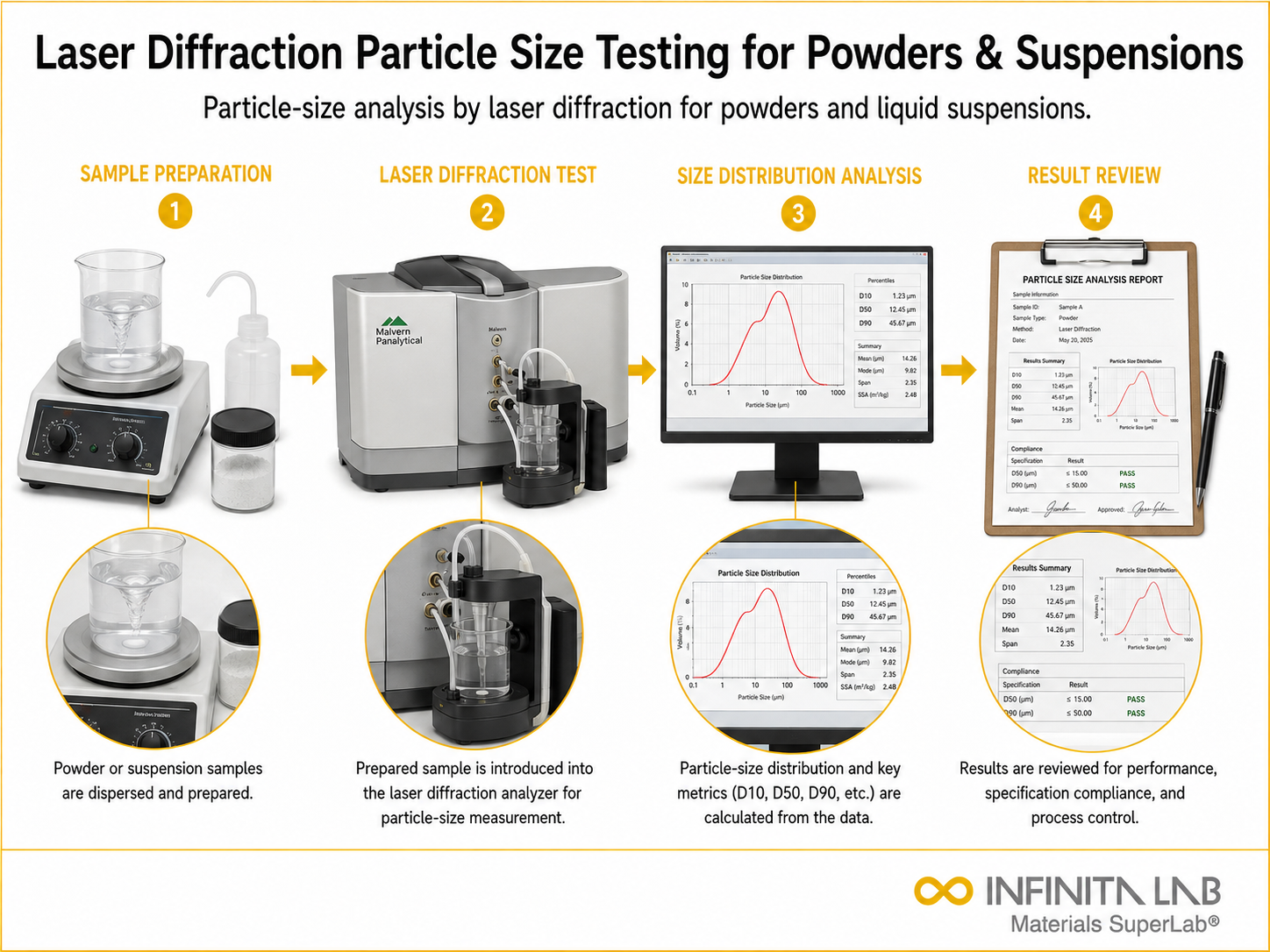


What Is Laser Diffraction Particle Size?
Laser diffraction, also known as laser diffractometry, is a widely used particle size analysis technique that determines the size distribution of particles based on the scattering pattern produced when a laser beam passes through a dispersed sample. The angle and intensity of scattered light are measured to calculate particle size using optical models.
This technique is applicable to powders, suspensions, and emulsions across a broad size range from nanometers to millimeters. It provides rapid, repeatable, and high-resolution particle size distribution data, making it essential for quality control, research, and process optimization in industries such as pharmaceuticals, chemicals, food, and materials engineering.

Applications and Benefits of Laser Diffraction Particle Size Testing
Scope
Laser diffraction is used to measure particle size distribution in solid and liquid systems with high accuracy and repeatability. It is suitable for both dry and wet dispersion methods depending on the sample characteristics.
- Applicable to powders, suspensions, emulsions, and aerosols
- Covers wide particle size range from nanometers to millimeters
- Supports both wet and dry dispersion techniques
- Measures volume-based particle size distribution
- Used for quality control and research applications
- Enables analysis of homogeneous and heterogeneous samples
- Suitable for real-time and offline particle size measurement
- Helps evaluate agglomeration and dispersion behavior
Applications
- Pharmaceutical powder characterization
- Food and beverage particle analysis
- Chemical and pigment size distribution measurement
- Cement and construction material evaluation
- Environmental and aerosol particle studies
Benefits
- Wide dynamic measurement range
- Rapid and repeatable results
- Minimal sample preparation required
- High accuracy for particle size distribution
- Suitable for both dry and wet samples
Our Testing Procedure
Sample Dispersion
Sample is dispersed in air or liquid to ensure individual particle separation.
1Laser Illumination
Laser beam passes through the dispersed particles generating scattering patterns.
2Signal Detection
Detectors measure intensity and angle of scattered light.
3Data Analysis
Software calculates particle size distribution using scattering models.
4Test parameters and requirements
| Parameter | Details |
|---|---|
| Method | Light scattering measurement using laser beam interaction with particles |
| Measurement Type | Particle size distribution based on scattering intensity |
| Sample Type | Powders, suspensions, emulsions, and aerosols |
| Loading Type | Optical interaction via laser illumination |
| Units | µm, nm, volume %, D10, D50, D90 |
| Size Range | Typically ~0.01 µm to 3500 µm (instrument dependent) |


- Laser diffraction particle size analyzer
- Wet dispersion unit (liquid medium system)
- Dry powder feeder and dispersion unit
- Optical detection system with multiple detectors
- Data processing and analysis software
Equipment and Instrumentation Used for Testing
What You Receive: Test Report, Data, and Certification
- Particle size distribution curve
- D10, D50, D90 values
- Volume and number-based distribution data
- Repeatability and statistical analysis report
- Complete particle characterization report
Laser Diffraction Particle Size FAQs
Laser diffraction is used to determine particle size distribution by measuring how particles scatter light. It provides rapid, accurate data across a wide size range, making it essential for quality control and material characterization in industrial and research applications.
These values represent particle size percentiles. D10 indicates 10% of particles are smaller than that size, D50 is the median size, and D90 indicates 90% are smaller, providing a complete distribution profile.
Wet dispersion uses liquid to suspend particles, suitable for fine materials, while dry dispersion uses air for powders. The choice depends on sample properties and measurement requirements.
These are mathematical models used to interpret scattering data. Mie theory considers optical properties and is more accurate for small particles, while Fraunhofer is simpler and used for larger particles.
Refractive index directly influences scattering calculations, especially for small particles analyzed using Mie theory. Incorrect values can distort particle size results, making accurate input of optical properties essential for precise and reproducible measurements.
Why Choose Infinita Lab for Laser Diffraction Particle Size Testing?
At the core of this breadth is our network of 2,000+ accredited laboratories across the USA, offering access to over 10,000 testing methods and analytical services. From advanced materials characterization (SEM, TEM, RBS, XPS) to mechanical, chemical, environmental, biological, and standardized ASTM/ISO-compliant testing, we deliver unmatched flexibility, specialization, and scale. You are never limited by geography, facility, or methodology — Infinita Lab connects you to the right expertise and testing solution, every time.

Looking for an Accredited Partner for Laser Diffraction Particle Size Testing?
Send query us at hello@infinitalab.com or call us at (888) 878-3090 to learn more about our services and how we can support you.





