


IEC Accreditation Guide Testing Services
Learn how ISO/IEC 17025 helps various companies get global recognition, consistent operations, and a competitive advantage.
TRUSTED BY


Get compliant results — request your IEC accreditation guide testing quote
- Overview
- Scope, Applications, and Benefits
- Test Process
- Specifications
- Instrumentation
- Results and Deliverables
What Is IEC Accreditation Guide?
ISO/IEC 17025 is the internationally recognized standard that defines the requirements for competence, impartiality, and consistent operation of testing and calibration laboratories. It ensures that laboratories produce accurate, reliable, and scientifically valid results across various industries.
Accreditation to ISO/IEC 17025 is granted by authorized accreditation bodies after a thorough assessment of a laboratory’s technical capabilities, quality systems, and operational processes. It demonstrates that a laboratory is technically competent and capable of generating globally accepted results, reducing the need for repeat testing.

Applications and Benefits of IEC Accreditation Guide Testing
Scope
ISO/IEC 17025 accreditation evaluates:
- Laboratory technical competence and capability
- Accuracy, precision, and traceability of measurements
- Validation of test and calibration methods
- Equipment calibration and maintenance
- Quality management and documentation systems
Applications
- Testing laboratories (chemical, mechanical, environmental)
- Calibration laboratories (metrology, instrumentation)
- Pharmaceutical and food testing labs
- Research and development laboratories
- Government and regulatory laboratories
Benefits
- Ensures accurate and reliable test results
- Enables global acceptance of laboratory reports
- Improves operational consistency and efficiency
- Enhances credibility with clients and regulators
- Reduces the need for duplicate testing
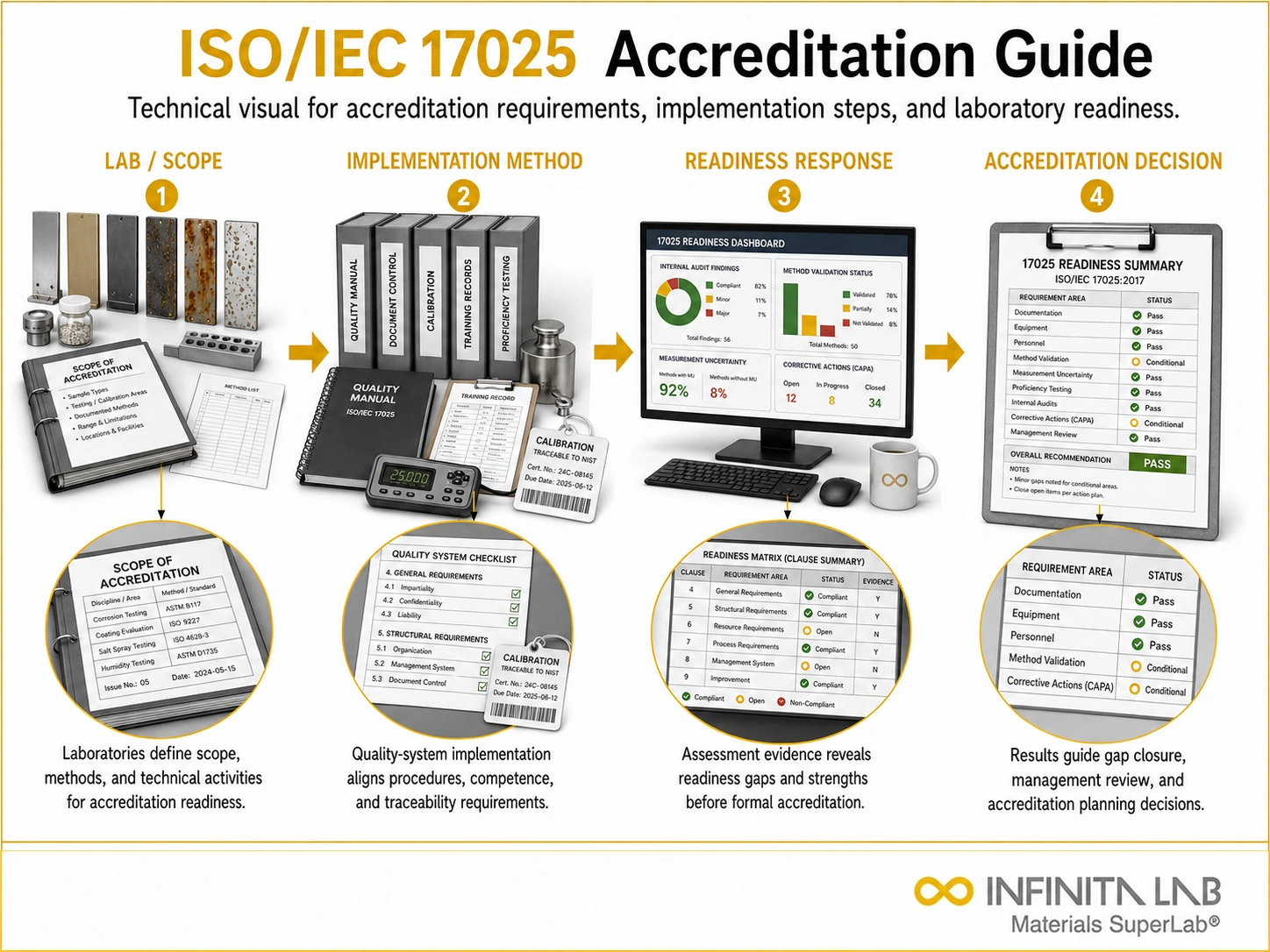
Our Testing Procedure
Gap Assessment
Laboratory systems and procedures are evaluated against ISO 17025 requirements.
1Implementation
Quality management system and technical procedures are developed and documented.
2Internal Audit
Internal audits and corrective actions are conducted to ensure readiness.
3Accreditation Audit
External assessment by accreditation body verifies compliance and grants accreditation.
4Test parameters and requirements
| Parameter | Details |
|---|---|
| Standard | ISO/IEC 17025:2017 |
| Test Principle | Evaluation of technical competence and quality system |
| Applicable Organizations | Testing and calibration laboratories |
| Core Requirements | General, structural, resource, process, management |
| Key Focus | Accuracy, reliability, traceability |
| Audit Frequency | Periodic surveillance audits (typically annual) |
| Output | Accredited scope of testing/calibration |


- Quality management software (QMS systems)
- Document control systems
- Internal audit tools
- Performance monitoring dashboards
- Risk management tools
- Training and competency systems
Equipment and Instrumentation Used for Testing
What You Receive: Test Report, Data, and Certification
- QMS implementation and compliance report
- Process performance and efficiency evaluation
- Customer satisfaction analysis
- Risk and improvement action plans
- Continuous improvement roadmap
IEC Accreditation Guide FAQs
ISO 9001 is used to establish a quality management system that ensures consistent delivery of products and services while improving efficiency, customer satisfaction, and overall business performance.
ISO 9001 is not mandatory, but many organizations adopt it to improve quality systems and meet customer or regulatory requirements, especially when competing for contracts or entering global markets.
ISO 9001 is based on principles such as customer focus, leadership, engagement of people, process approach, improvement, evidence-based decision-making, and relationship management.
ISO 9001 certification is typically valid for three years, with annual surveillance audits conducted to ensure continued compliance and system effectiveness.
ISO 9001 helps organizations improve efficiency, reduce errors, and enhance customer satisfaction while building credibility and competitiveness in the global market.
Why Choose Infinita Lab for IEC Accreditation Guide Testing?
At the core of this breadth is our network of 2,000+ accredited laboratories across the USA, offering access to over 10,000 testing methods and analytical services. From advanced materials characterization (SEM, TEM, RBS, XPS) to mechanical, chemical, environmental, biological, and standardized ASTM/ISO-compliant testing, we deliver unmatched flexibility, specialization, and scale. You are never limited by geography, facility, or methodology — Infinita Lab connects you to the right expertise and testing solution, every time.

Looking for an Accredited Partner for IEC Accreditation Guide Testing?
Send query us at hello@infinitalab.com or call us at (888) 878-3090 to learn more about our services and how we can support you.



Request a Quote
Submit your material details and receive testing procedures, pricing, and turnaround time within 24 hours.
 Quick Turnaround and Hasslefree process
 Confidentiality Guarantee
 Free, No-obligation Consultation
 100% Customer Satisfaction
