


ASTM E136: Non Combustibility Testing Services
The International Organization for Standardization (ISO) sets high standards for industrial process quality and safety. Many industry leaders rely on the ISO 1182 (ASTM E136 Method B) test to deliver fast, accurate results when it comes to maximizing fire safety for structure components.
TRUSTED BY


Get ASTM E136 compliant results — request your non combustibility testing quote
- Overview
- Scope, Applications, and Benefits
- Test Process
- Specifications
- Instrumentation
- Results and Deliverables
What Is ASTM E136 Non Combustibility?
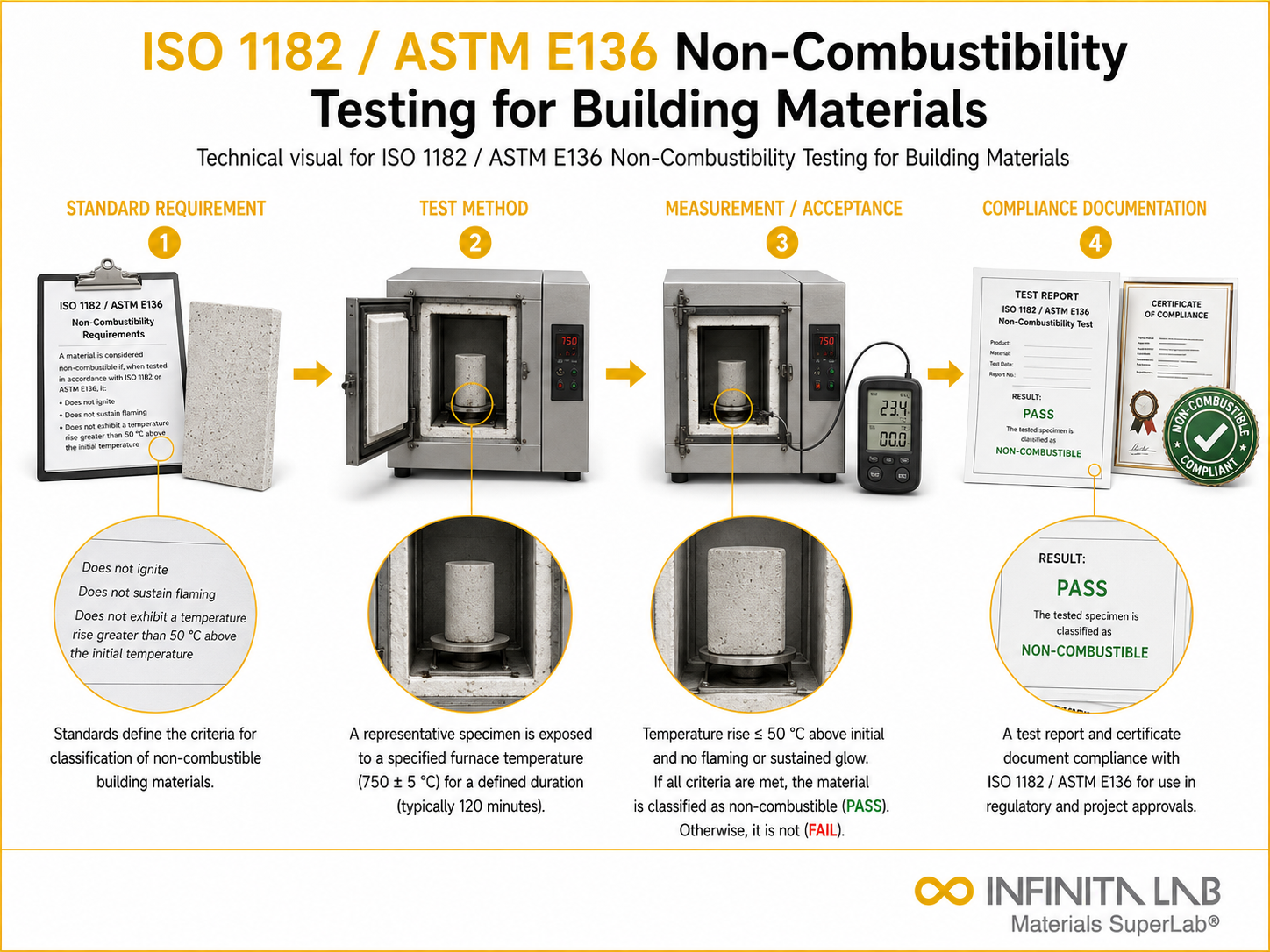
ISO 1182 and ASTM E136 Method B are standardized test methods used to determine whether building materials are non-combustible when exposed to high temperatures. These tests assess whether a material contributes to fire growth, flame propagation, or heat release under controlled furnace conditions.
Both methods use a vertical tube furnace operating at ~750°C, exposing specimens for a defined duration to evaluate combustion behavior. Materials that pass are classified as non-combustible, meaning they do not ignite, sustain flames, or significantly increase temperature during testing.

Applications and Benefits of ASTM E136 Non Combustibility Testing
Scope
Non-combustibility testing evaluates:
- Combustibility behavior under high Temperature (~750°C)
- Flame presence and duration
- Temperature rise (surface and core, typically ≤30°C increase)
- Weight loss during exposure (%)
- Contribution to heat release and fire propagation
Applications
- Building and construction materials (cement, concrete, gypsum)
- Insulation materials (mineral wool, fiberglass)
- Cladding and façade systems
- Marine and offshore materials
- Fire-safe industrial components
Benefits
- Determines true non-combustibility classification
- Supports fire safety compliance in buildings
- Reduces fire propagation risks
- Enables safe material selection for critical applications
- Provides standardized pass/fail evaluation
Our ASTM E136 Testing Procedure
Sample Conditioning
Specimens are dried at ~60°C for 24 hours to remove moisture before testing.
1Furnace Exposure
Samples are placed in a vertical tube furnace maintained at ~750°C.
2Monitoring
Temperature rise (surface & core), flaming behavior, and duration are recorded.
3Data Analysis
Results are evaluated against criteria such as temperature rise ≤30°C and no sustained flaming.
4ASTM E136 Test Parameters and Requirements
| Parameter | Details |
|---|---|
| Test Principle | Vertical tube furnace non-combustibility evaluation |
| Furnace Temperature | ~750°C (1382°F) |
| Exposure Duration | ≥30 minutes |
| Sample Size | ~38 × 38 × 50 mm (typical) |
| Measured Outputs | Temperature rise, flaming, weight loss |
| Acceptance Criteria | No sustained flaming, minimal temperature riseInstrumentation Used for Testing |


- Vertical tube furnace (~750°C capability)
- Thermocouples (surface and core measurement)
- Sample holder and insertion system
- Temperature control unit
- Data acquisition system
- Conditioning oven
Equipment and Instrumentation Used for ASTM E136 Testing
What You Receive: Test Report, Data, and Certification
- Pass/Fail non-combustibility classification
- Temperature rise data (surface and core)
- Flaming duration and observation records
- Weight loss and physical changes
- Material suitability for fire-safe applications
- Test report
ASTM E136 Non Combustibility FAQs
These tests determine whether a material is non-combustible under high-temperature conditions. They are widely used in construction and engineering to ensure materials do not contribute to fire growth or spread.
The test is conducted at approximately 750°C, where the sample is exposed in a controlled furnace environment for at least 30 minutes to evaluate combustion behavior.
Materials must not exhibit sustained flaming and must show minimal temperature rise, typically not exceeding 30°C. Any significant combustion behavior leads to failure.
Materials such as concrete, cement, mineral wool, and glass-based products typically pass, while organic materials and most polymers fail due to their combustible nature.
It ensures materials used in buildings and industrial applications do not contribute to fire hazards, improving safety, compliance, and structural performance during fire exposure.
Why Choose Infinita Lab for Non Combustibility Testing
At the core of this breadth is our network of 2,000+ accredited laboratories across the USA, offering access to over 10,000 testing methods and analytical services. From advanced materials characterization (SEM, TEM, RBS, XPS) to mechanical, chemical, environmental, biological, and standardized ASTM/ISO-compliant testing, we deliver unmatched flexibility, specialization, and scale. You are never limited by geography, facility, or methodology — Infinita Lab connects you to the right expertise and testing solution, every time.

Need ASTM E136 Non Combustibility Testing You Can Rely On?
Send query us at hello@infinitalab.com or call us at (888) 878-3090 to learn more about our services and how we can support you.



Request a Quote
Submit your material details and receive testing procedures, pricing, and turnaround time within 24 hours.
 Quick Turnaround and Hasslefree process
 Confidentiality Guarantee
 Free, No-obligation Consultation
 100% Customer Satisfaction
