


Integrated Circuit Leak Testing Services
This article highlights the necessity of evaluating the packaging integrity of electronic components and introduces the concept of leak detection, which uses techniques like keeping an eye out for bubbles or utilizing helium and a mass spectrometer to spot breaches. There are several leak testing techniques addressed, including fine and gross leak testing.
TRUSTED BY


Get compliant results — request your integrated circuit leak testing quote
- Overview
- Scope, Applications, and Benefits
- Test Process
- Specifications
- Instrumentation
- Results and Deliverables
What Is Integrated Circuit Leak?
Leak testing for integrated circuits (ICs) is a critical reliability evaluation method used to detect hermetic seal failures or package integrity issues that may allow moisture, gases, or contaminants to enter or escape. It ensures long-term performance and protection of sensitive semiconductor components.
This testing is especially important for hermetically sealed devices used in aerospace, defense, and high-reliability electronics. Techniques such as helium leak detection and gross leak testing are used to identify both fine and large leaks. The process helps prevent corrosion, electrical failure, and degradation of internal circuitry over time.

Applications and Benefits of Integrated Circuit Leak Testing
Scope
Leak testing for integrated circuits focuses on evaluating the sealing integrity of semiconductor packages to ensure protection against environmental exposure and maintain long-term reliability.
- Applicable to hermetic and non-hermetic IC packages
- Detects fine and gross leaks in sealed components
- Uses helium, fluorocarbon, or pressure-based methods
- Ensures protection against moisture and contamination ingress
- Supports high-reliability electronics in critical applications
- Applicable to ceramic, metal, and glass-sealed packages
- Used in quality control and reliability testing
- Helps identify manufacturing defects in sealing processes
- Suitable for aerospace, defense, and medical electronics
Applications
- Aerospace and defense electronics validation
- Semiconductor packaging quality assurance
- Medical implantable device reliability testing
- High-reliability electronic component screening
- Failure analysis and root cause investigation
Benefits
- Ensures hermetic seal integrity
- Prevents moisture and contaminant ingress
- Improves long-term reliability of ICs
- Detects manufacturing defects early
- Supports compliance with industry standards
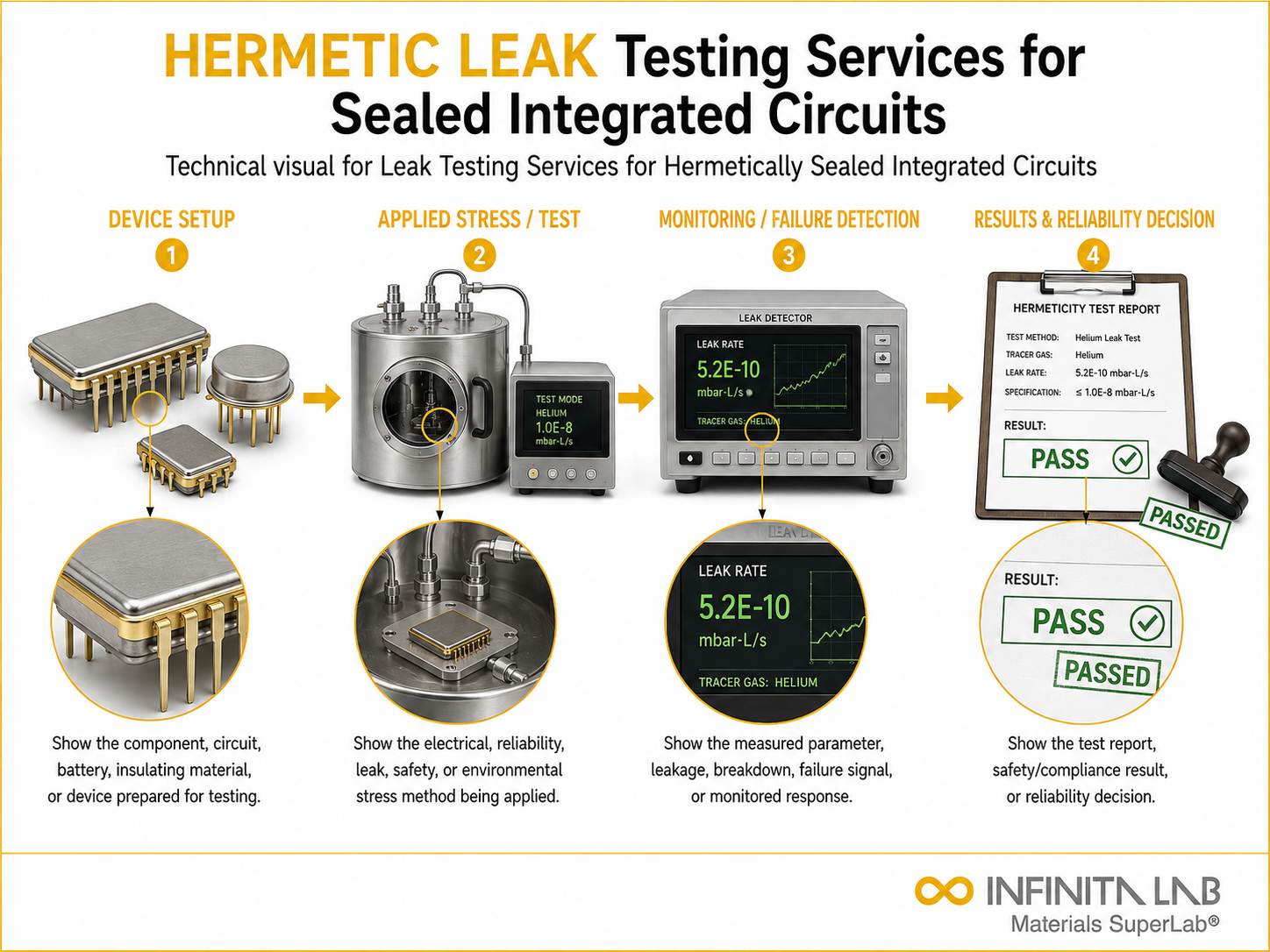
Leak Testing for ICs Process
Sample Conditioning
ICs are prepared and, if required, pressurized with tracer gas.
1Leak Detection Setup
Devices are placed in a vacuum chamber or detection system.
2Measurement Execution
Helium or other tracer gas leakage is measured using sensitive detectors.
3Result Evaluation
Leak rates are analyzed against acceptance criteria for compliance.
4Leak Testing for ICs Technical Specification
| Parameter | Details |
|---|---|
| Method | Helium mass spectrometry and gross leak detection techniques |
| Measurement Type | Leak rate and seal integrity assessment |
| Sample Type | Integrated circuits and hermetically sealed semiconductor packages |
| Loading Type | Pressurization with tracer gas or vacuum exposure |
| Units | atm·cc/s (leak rate) |
| Detection Range | Fine leaks (~10⁻⁹ atm·cc/s) to gross leaks |


- Helium mass spectrometer leak detector
- Vacuum chamber system
- Pressure bombing chamber
- Gross leak detection equipment (bubble or fluorocarbon systems)
- Data acquisition and control system
Equipment and Instrumentation Used for Testing
What You Receive: Test Report, Data, and Certification
- Measured leak rate values
- Pass/fail evaluation based on standards
- Fine and gross leak classification report
- Hermeticity compliance documentation
- Failure analysis and defect identification report
Integrated Circuit Leak FAQs
Helium mass spectrometry detects extremely small leak rates by measuring helium ions passing through defects under vacuum conditions. Its high sensitivity enables detection of micro-leaks that could lead to long-term reliability issues in hermetically sealed devices.
Fine leak testing detects microscopic leaks using tracer gases like helium, while gross leak testing identifies larger leaks using bubble or fluorocarbon methods. Both are complementary to ensure complete hermeticity verification.
Helium is inert, non-toxic, and has very small atomic size, allowing it to penetrate tiny defects. Its low natural presence in air also minimizes background interference, improving detection accuracy.
In the bombing method, devices are exposed to high-pressure helium, allowing gas to enter through leaks. The sample is then tested in a vacuum system to measure the escaping helium and determine leak rates.
Higher leak rates indicate greater risk of moisture ingress and contamination, leading to corrosion or electrical failure over time. Lower leak rates ensure better long-term reliability.
Why Choose Infinita Lab for Integrated Circuit Leak Testing
At the core of this breadth is our network of 2,000+ accredited laboratories across the USA, offering access to over 10,000 testing methods and analytical services. From advanced materials characterization (SEM, TEM, RBS, XPS) to mechanical, chemical, environmental, biological, and standardized ASTM/ISO-compliant testing, we deliver unmatched flexibility, specialization, and scale. You are never limited by geography, facility, or methodology — Infinita Lab connects you to the right expertise and testing solution, every time.

Looking for an Accredited Partner for Integrated Circuit Leak Testing?
Send query us at hello@infinitalab.com or call us at (888) 878-3090 to learn more about our services and how we can support you.



Request a Quote
Submit your material details and receive testing procedures, pricing, and turnaround time within 24 hours.
 Quick Turnaround and Hasslefree process
 Confidentiality Guarantee
 Free, No-obligation Consultation
 100% Customer Satisfaction
