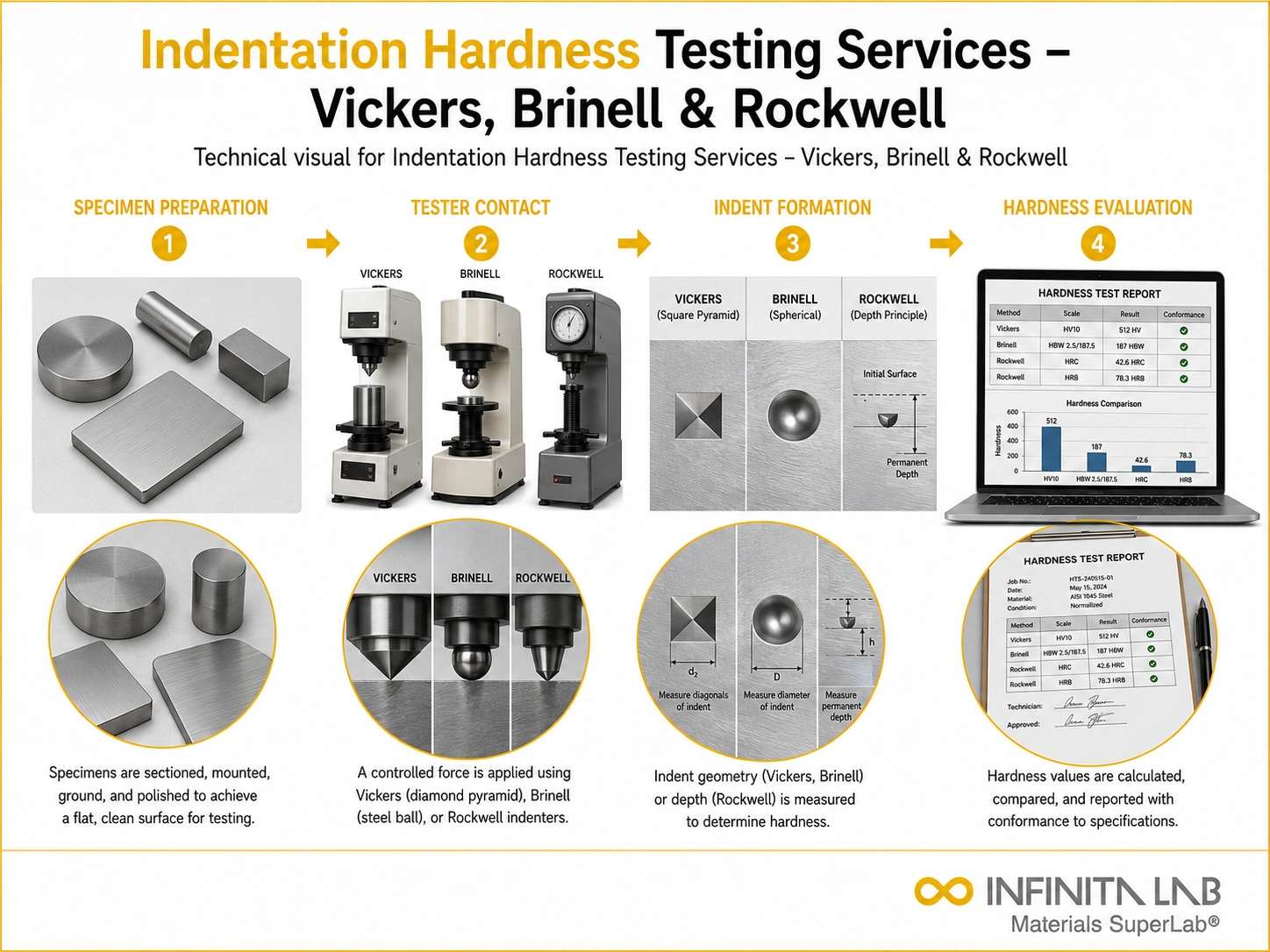


What Is Indentation Hardness?
Indentation Hardness refers to the resistance of a material to permanent deformation when a specific indenter is pressed into its surface under controlled load. It is a key mechanical property used to evaluate strength, wear resistance, and surface durability.
This property is widely measured in the materials, metals, polymers, and manufacturing industry to assess product quality and performance. Indentation hardness testing helps in material selection, process control, and ensuring components meet mechanical and durability requirements for various applications.

Applications and Benefits of Indentation Hardness Testing
Scope
Indentation hardness testing evaluates the resistance of materials to localized plastic deformation under applied force.
It provides insight into mechanical strength, wear resistance, and surface properties.
- Hardness measurement
- Surface deformation analysis
- Material strength evaluation
- Wear resistance assessment
- Quality control testing
- Comparative material analysis
- Compliance verification
Applications
- Metal and alloy testing
- Polymer and plastic evaluation
- Coatings and surface treatments
- Manufacturing quality control
- Research and development
Benefits
- Determines material strength
- Evaluates wear resistance
- Supports material selection
- Ensures product consistency
- Improves process control
- Enhances durability assessment
- Meets industry standards
Our Testing Procedure
Sample Preparation
Material surface is prepared smooth and clean to ensure accurate indentation measurement.
1Indentation Application
A defined indenter is pressed into the material under controlled load and time.
2Measurement
Size or depth of the indentation is measured using optical or depth-sensing methods.
3Calculation
Hardness value is calculated based on applied load and indentation geometry.
4Test parameters and requirements
| Parameter | Details |
|---|---|
| Material Type | Metals, polymers, ceramics, and composites. |
| Indenter Type | Ball, diamond cone, or pyramid. |
| Load Range | Defined load depending on method. |
| Result Unit | HB, HR, HV, or similar hardness scales. |
| Surface Condition | Smooth and polished surface. |
| Test Duration | Controlled dwell time. |
| Environment Condition | Ambient or controlled conditions. |


- Hardness tester (Brinell, Rockwell, Vickers)
- Indenters (ball or diamond)
- Optical microscope
- Digital measurement system
- Sample preparation tools
- Calibration blocks
Equipment and Instrumentation Used for Testing
What You Receive: Test Report, Data, and Certification
- Hardness values (HB, HR, HV)
- Indentation measurement data
- Material strength assessment
- Comparative analysis results
- Compliance with standards
- Test documentation
- Final test report
Indentation Hardness FAQs
Indentation hardness measures a material’s resistance to localized plastic deformation under an applied load. It is important because it provides insight into strength, wear resistance, and durability, helping engineers select suitable materials for various industrial and structural applications.
Common methods include Brinell, Rockwell, and Vickers hardness tests, each using different indenters and load conditions to measure hardness based on indentation size or depth, depending on material type and application requirements.
Hardness is often correlated with strength, especially in metals, as harder materials generally exhibit higher resistance to deformation and wear, although it may not directly indicate all mechanical properties like toughness or ductility.
Factors such as surface preparation, load applied, indenter type, material homogeneity, and testing conditions can influence the accuracy and consistency of hardness measurements.
While useful, hardness testing provides localized measurements and may not represent overall material behavior, requiring additional tests for comprehensive mechanical characterization.
An indentation test measures a material’s resistance to localized deformation. A hard indenter is pressed into the specimen under a controlled load, and the resulting indentation’s depth or size is measured to determine hardness. Common methods include Rockwell, Brinell, and Vickers testing.
Hardness is a material’s resistance to localized permanent deformation caused by pressing, scratching, or penetrating its surface. In indentation testing, harder materials generally produce smaller or shallower indentations under the same test conditions.
Indentation is a depression or impression formed when an object presses into a material’s surface. In materials testing, indentation is used to evaluate hardness and, with specialized methods, properties such as elastic modulus and resistance to deformation.
Why Choose Infinita Lab for Indentation Hardness Testing
When your Indentation Hardness results have to hold up - for compliance, a customer audit, or an engineering decision - accuracy and an unbiased third-party report matter more than price. Infinita Lab routes your indentation hardness testing to ISO/IEC 17025-accredited U.S. partner labs with hands-on method experience, so you get defensible data, transparent reporting, and turnaround times built around your project deadline - not ours.

Looking for an Accredited Partner for Indentation Hardness Testing?
Send query us at hello@infinitalab.com or call us at (888) 878-3090 to learn more about our services and how we can support you.





