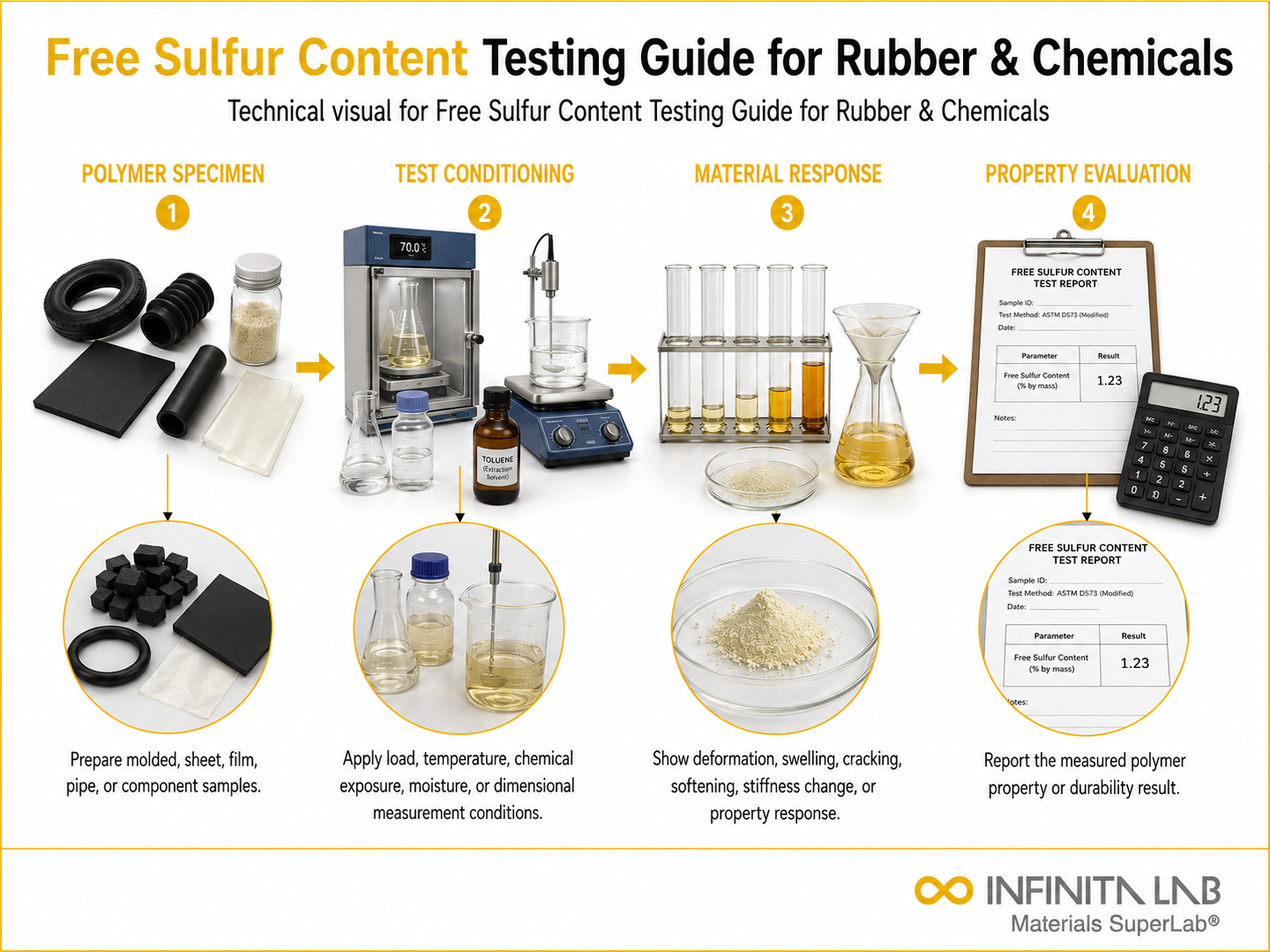


What Is Free Sulfur Content?
Free sulfur content testing is an analytical method used to determine the amount of unbound or elemental sulfur present in materials, particularly polymers, rubber compounds, fuels, and chemicals. Free sulfur differs from chemically bound sulfur, as it exists independently and can significantly influence material behavior and stability.
This testing is critical in applications such as vulcanized rubber systems, where sulfur acts as a cross-linking agent. The amount of free sulfur directly affects properties such as strength, elasticity, aging resistance, and chemical stability. Accurate measurement helps in understanding curing mechanisms and ensuring optimal formulation performance.

Applications and Benefits of Free Sulfur Content Testing
Scope
Free sulfur content testing evaluates:
- Free (unbound) sulfur content (%)
- Total sulfur vs extractable sulfur
- Influence of sulfur on cross-link density
- Residual sulfur after curing
- Material composition and formulation quality
Applications
- Rubber and elastomer compounds
- Vulcanized thermosets and polymers
- Petrochemical and fuel analysis
- Chemical and pharmaceutical materials
- Quality control in polymer processing
Benefits
- Determines curing efficiency in rubber systems
- Helps optimize material formulation
- Detects excess or residual sulfur
- Improves mechanical and aging performance
- Supports process control and consistency
Our Testing Procedure
Sample Preparation
A known quantity of material (~1–2 g) is finely ground and prepared for extraction.
1Extraction
Free sulfur is extracted using solvents such as carbon disulfide or similar reagents.
2Conversion / Detection
Extracted sulfur may be converted to measurable form (e.g., SO₂ via combustion or chemical reaction).
3Data Analysis
Sulfur content is quantified and reported as % or mg/kg of the original sample.
4Test parameters and requirements
| Parameter | Details |
|---|---|
| Standard | ASTM D297 (rubber), other ASTM/ISO methods |
| Applicable Materials | Rubber, polymers, fuels, chemicals |
| Detection Range | ppm to % levels |
| Techniques Used | Extraction, UV fluorescence, XRF, combustion analysis |
| Sample Size | ~1–2 g |
| Measured Outputs | Free sulfur content (%) or mg/kg |


- Sulfur analyzer (e.g., combustion/UV fluorescence systems)
- Solvent extraction apparatus
- X-ray fluorescence (XRF) spectrometer
- Analytical balance (±0.1 mg)
- Furnace or combustion unit
- Data acquisition system
Equipment and Instrumentation Used for Testing
What You Receive: Test Report, Data, and Certification
- Free sulfur content (% or mg/kg)
- Total vs free sulfur comparison
- Material composition insights
- Curing system evaluation
- Comparative analysis across samples
Free Sulfur Content FAQs
Free sulfur content refers to the amount of unbound elemental sulfur present in a material. It is not chemically bonded and can influence material properties such as curing behavior and stability.
Free sulfur affects cross-linking in rubber systems. Excess free sulfur can lead to blooming or degradation, while insufficient sulfur may result in poor mechanical properties.
Common methods include solvent extraction, combustion analysis, UV fluorescence, and X-ray fluorescence, depending on material type and required detection sensitivity.
Free sulfur is unbound sulfur present in the material, while total sulfur includes both free and chemically bound sulfur within compounds or additives.
Industries such as rubber manufacturing, petrochemicals, plastics, and pharmaceuticals use this testing to ensure product quality, optimize formulations, and control material performance.
Why Choose Infinita Lab for Free Sulfur Content Testing?
At the core of this breadth is our network of 2,000+ accredited laboratories across the USA, offering access to over 10,000 testing methods and analytical services. From advanced materials characterization (SEM, TEM, RBS, XPS) to mechanical, chemical, environmental, biological, and standardized ASTM/ISO-compliant testing, we deliver unmatched flexibility, specialization, and scale. You are never limited by geography, facility, or methodology — Infinita Lab connects you to the right expertise and testing solution, every time.

Looking for an Accredited Partner for Free Sulfur Content Testing?
Send query us at hello@infinitalab.com or call us at (888) 878-3090 to learn more about our services and how we can support you.





