


Differential Hall Effect Metrology DHEM Testing Services
Accredited differential hall effect metrology DHEM testing from Infinita Lab, performed to the exact standard requirements - accurate, reproducible results with full documentation for compliance, R&D, and quality control programs.
TRUSTED BY


Get compliant results - request your differential hall effect metrology DHEM testing quote
- Overview
- Scope, Applications, and Benefits
- Test Process
- Specifications
- Instrumentation
- Results and Deliverables
What Is Differential Hall Effect Metrology DHEM?
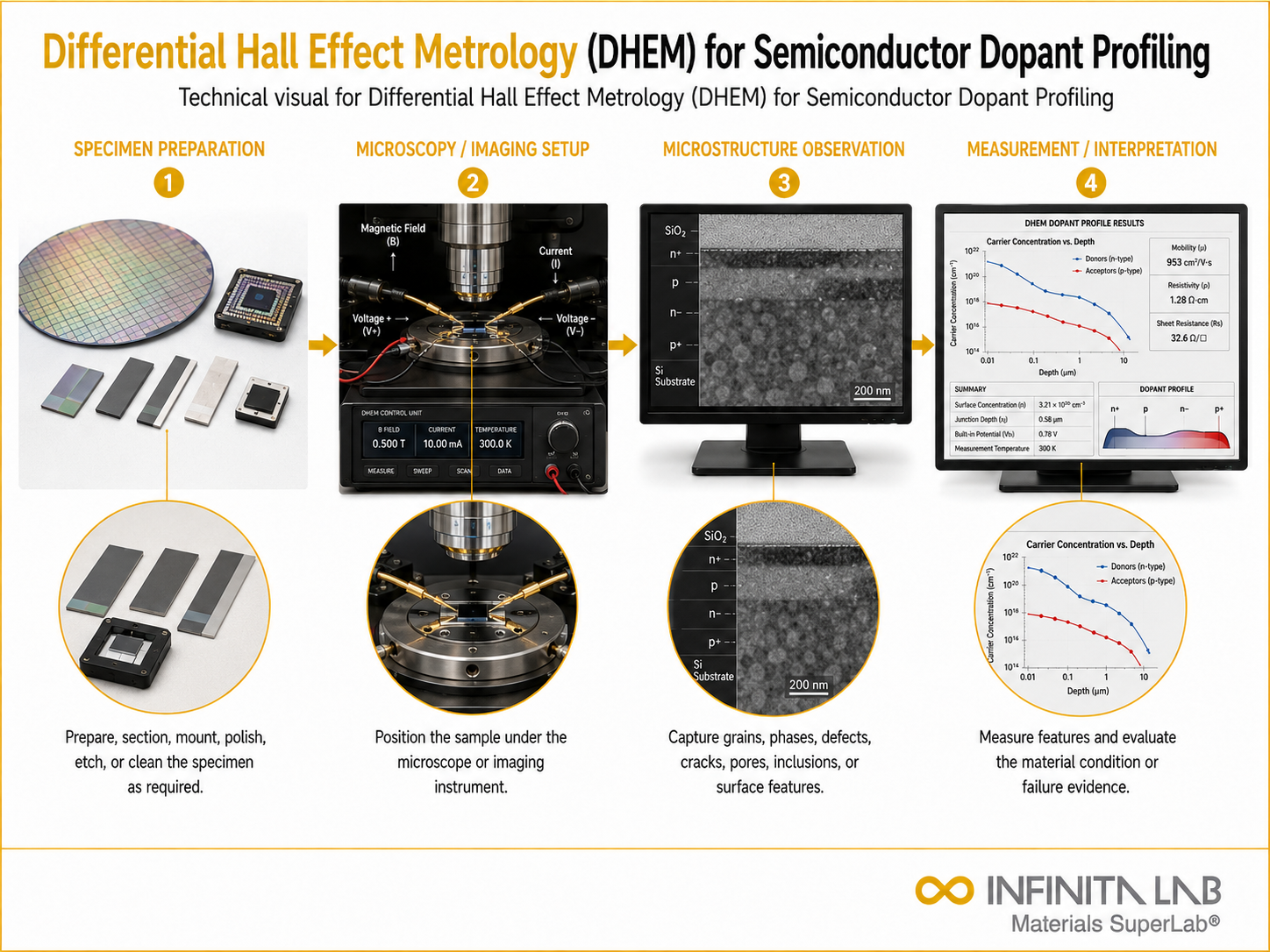
Differential Hall Effect Metrology (DHEM) is an electrical depth-profiling technique that reconstructs how carrier concentration, mobility, and resistivity change with depth in a doped semiconductor layer by repeating Hall effect and sheet resistance measurements. In contrast, the layer is thinned in small, controlled steps. It’s a measurement technique, not a published ASTM test method, and no ASTM designation governs it. The sample gets patterned into a van der Pauw structure, commonly a Greek cross on an isolated mesa. Four electrical contacts stay clear of the thinned region. At each step, a thin slice of material comes off, either by growing an anodic or chemical oxide and stripping it, or by controlled electrochemical or wet etching. Then the remaining conductive layer is measured again. Sheet resistance and sheet Hall coefficient are recorded along with the thickness removed, which is often confirmed independently by spectroscopic ellipsometry rather than assumed from a constant removal rate. Every step removes a known thickness, so the change in sheet conductance and Hall dose between consecutive steps is attributed to the slice just removed. Differential calculation then yields local resistivity, active carrier concentration, and Hall mobility at that depth. Isolation matters. The layer under study must be separated from the substrate by a p-n junction, an insulating buried layer, or a semi-insulating substrate. Because the output is the electrically active dopant profile, DHEM complements chemical profiling methods such as secondary ion mass spectrometry and is valuable for assessing dopant activation in ultra-shallow junctions, implants, epitaxial layers, and strained alloys. Silicon, germanium, and silicon-germanium are the best-established materials, while III-V layers generally need additional recipe development. The measurement is destructive.

Applications and Benefits of Differential Hall Effect Metrology DHEM Testing
Scope
DHEM enables detailed electrical characterization of semiconductor materials by separating layer-specific properties and improving measurement accuracy.
It supports advanced material analysis, process optimization, and quality control in semiconductor device fabrication.
- DHEM is a technique, not a published ASTM test method, so testing is performed against a documented laboratory procedure agreed with the customer.
- Depth profiles of active carrier concentration, Hall mobility, and resistivity come out of the method, together with the sheet resistance of the remaining layer at each removal step.
- Testing relies on a van der Pauw-compatible test structure, typically a Greek cross defined on an electrically isolated mesa.
- Substrate isolation is a must. The layer being profiled needs a p-n junction, an insulating layer such as a buried oxide, or a semi-insulating substrate to separate it.
- Silicon, germanium, and silicon-germanium layers are the most established materials; III-V compound layers can be profiled after dedicated removal-recipe development.
- Layers come off by oxidation and oxide stripping or by controlled etching. Each new material system generally needs its own validated recipe.
- To keep the differential calculation from depending on an assumed removal rate, removed thickness is verified at each step, commonly by spectroscopic ellipsometry.
- Corrections for surface depletion, backside depletion near a buried interface, and native oxide effects may be needed. That’s particularly true for very thin or lightly doped layers.
- It’s destructive: the profiled region of the test structure is consumed as the measurement proceeds.
- Related published methods, such as ASTM F76 for resistivity, Hall coefficient, and Hall mobility in single-crystal semiconductors, address bulk or single-layer Hall measurements. They can support a depth-resolved DHEM study but don’t replace it.
Applications
- Dopant activation in ultra-shallow junctions formed by ion implantation followed by rapid thermal, spike, or laser annealing.
- Profiling doped epitaxial layers and strained silicon-germanium or germanium films used in advanced transistor structures.
- Thin silicon-on-insulator and germanium-on-insulator layers, where substrate leakage would otherwise distort the measurement.
- Electrically active profiles can be compared against chemical dopant profiles from secondary ion mass spectrometry to quantify the inactive fraction.
- It supports process development and failure investigation for implant, anneal, and epitaxy steps in CMOS, RF, and power device manufacturing.
- III-V and other compound semiconductor layers can be characterized too, when a suitable removal recipe is available.
Benefits
- You get true electrical depth profiles of carrier concentration and mobility, not an inference from total atomic dopant content.
- Near-surface behavior is resolved with removal steps that published work has demonstrated to be below one nanometer in silicon and germanium systems.
- Mobility and resistivity are reported alongside concentration, which supports analysis of scattering, damage, and strain effects.
- The profile integrates into a sheet resistance value. Independent four-point probe measurements can cross-check it.
- It complements secondary ion mass spectrometry by separating electrically active dopants from the total chemical dopant population.
- Engineers can tune annealing and activation conditions using direct electrical evidence from the layer itself.
Our Testing Procedure
Sample Preparation
Sample is prepared with proper geometry and electrical contacts for accurate Hall measurements.
1Measurement Setup
Magnetic field and current are applied to generate Hall voltage across the sample.
2Differential Measurement
Multiple measurements are taken under varying conditions to isolate layer-specific properties.
3Data Analysis
Electrical parameters like carrier concentration and mobility are calculated from measured data.
4Test parameters and requirements
| Parameter | Details |
|---|---|
| Material Type | Semiconductor wafers, thin films, and multilayer structures. |
| Measurement Mode | Differential Hall voltage measurement under varying magnetic fields. |
| Magnetic Field Range | Typically low to moderate fields depending on system design. |
| Temperature Control | Measurements performed at controlled or variable temperatures. |
| Sample Geometry | Defined shapes such as van der Pauw or Hall bar structures. |
| Measured Parameters | Carrier concentration, mobility, resistivity. |


- Hall Effect Measurement System – Applies a magnetic field and switches the current and voltage across the van der Pauw contacts to determine sheet resistance and sheet Hall coefficient at every step.
- Electrochemical Anodization or Etching Cell – Controlled oxidation or etching reaches a defined test region, so material comes off in small, repeatable increments.
- Spectroscopic Ellipsometer – Measures the thickness removed at each step, which means the differential calculation uses actual rather than assumed values.
- Photolithography and Mesa Etch Tools – These define the isolated van der Pauw test structure on the sample before profiling begins.
- Four-Point Probe – Gives independent sheet resistance values for cross-checking the integrated DHEM profile.
- Secondary Ion Mass Spectrometry (SIMS) – Supplies complementary chemical dopant profiles to compare against the electrically active profile.
Equipment and Instrumentation Used for Testing
What You Receive: Test Report, Data, and Certification
- Depth profiles of active carrier concentration for each analyzed layer.
- Hall mobility and resistivity profiles too, with sheet resistance reported at each removal step.
- A summary of the test structure, layer stack, removal method, and thickness determination approach used.
- Notes cover any depletion or isolation corrections applied, plus the limits of the valid profile range.
- Plots, tabulated raw and processed data, and a written interpretation, with optional comparison to SIMS or four-point probe data.
Differential Hall Effect Metrology DHEM FAQs
DHEM is a technique used to measure electrical properties of semiconductor materials using differential Hall effect measurements, enabling accurate characterization of carrier concentration, mobility, and resistivity in complex structures.
DHEM uses differential measurements to separate contributions from multiple layers, providing more detailed and accurate analysis compared to conventional Hall effect methods.
DHEM helps in precise material characterization, improving device performance, process optimization, and quality control in semiconductor fabrication.
A magnetic field is applied to generate Hall voltage, which is used to calculate electrical properties of the material.
Yes, DHEM is specifically useful for analyzing multilayer semiconductor structures by separating layer-specific electrical properties.
Why Choose Infinita Lab for Differential Hall Effect Metrology DHEM Testing
When your Differential Hall Effect Metrology DHEM results have to hold up - for compliance, a customer audit, or an engineering decision - accuracy and an unbiased third-party report matter more than price. Infinita Lab routes your differential hall effect metrology DHEM testing to ISO/IEC 17025-accredited U.S. partner labs with hands-on method experience, so you get defensible data, transparent reporting, and turnaround times built around your project deadline - not ours.

Looking for an Accredited Partner for Differential Hall Effect Metrology DHEM Testing?
Send query us at hello@infinitalab.com or call us at (888) 878-3090 to learn more about our services and how we can support you.



Request a Quote
Submit your material details and receive testing procedures, pricing, and turnaround time within 24 hours.
 Quick Turnaround and Hasslefree process
 Confidentiality Guarantee
 Free, No-obligation Consultation
 100% Customer Satisfaction
