

What Is Atomic Layer Deposition ALD?
Atomic Layer Deposition (ALD) represents the gold standard in thin-film engineering, offering a level of control that conventional coating methods simply cannot match. At its core, ALD is a specialized vapor phase deposition technique based on sequential, self-limiting surface reactions. By pulsing precursor gases into a vacuum chamber one at a time, material is deposited one atomic layer per cycle.

Applications and Benefits of Atomic Layer Deposition ALD Testing
Scope
Atomic Layer Deposition (ALD) is a thin-film deposition technique that uses sequential, self-limiting surface reactions to deposit highly uniform, conformal films at the atomic scale. It enables precise control over film thickness, composition, and uniformity, even on complex 3D and high-aspect-ratio structures. ALD is widely used in advanced manufacturing and research where nanoscale precision, excellent step coverage, and repeatability are critical.
Applications
- Semiconductor devices (gate dielectrics, high-k layers, barrier and passivation films)
- Microelectronics and nanoelectronics fabrication
- Energy devices (batteries, supercapacitors, fuel cells, solar cells)
- MEMS and NEMS devices
- Optoelectronics (LEDs, displays, photonic devices)
- Protective and corrosion-resistant coatings
- Medical devices and biomedical coatings
- Catalysts and catalyst supports
- Sensors and functional surface coatings
Benefits
- Atomic-level thickness control
- Excellent conformality on complex and high-aspect-ratio structures
- High film uniformity and repeatability
- Dense, pinhole-free, and high-quality films
- Precise composition and stoichiometry control
- Low deposition temperatures are possible
- Improved device performance and reliability
Our Testing Procedure
Substrate Cleaning
Clean and prepare the substrate.
1Chamber Loading
Load substrate and evacuate the chamber.
2Temperature Stabilization
Stabilize the deposition temperature.
3Cooling & Unloading
Cool, unload, and evaluate the deposited film.
4Test parameters and requirements
| Parameter | Details |
|---|---|
| Deposition Mode | Thermal ALD / Plasma-Enhanced ALD (PEALD) |
| Deposition Temperature | ~50 °C to 400 °C |
| Substrate Types | Silicon, glass, metals, polymers |
| Typical Film Types | Oxides, nitrides, sulfides, metals |
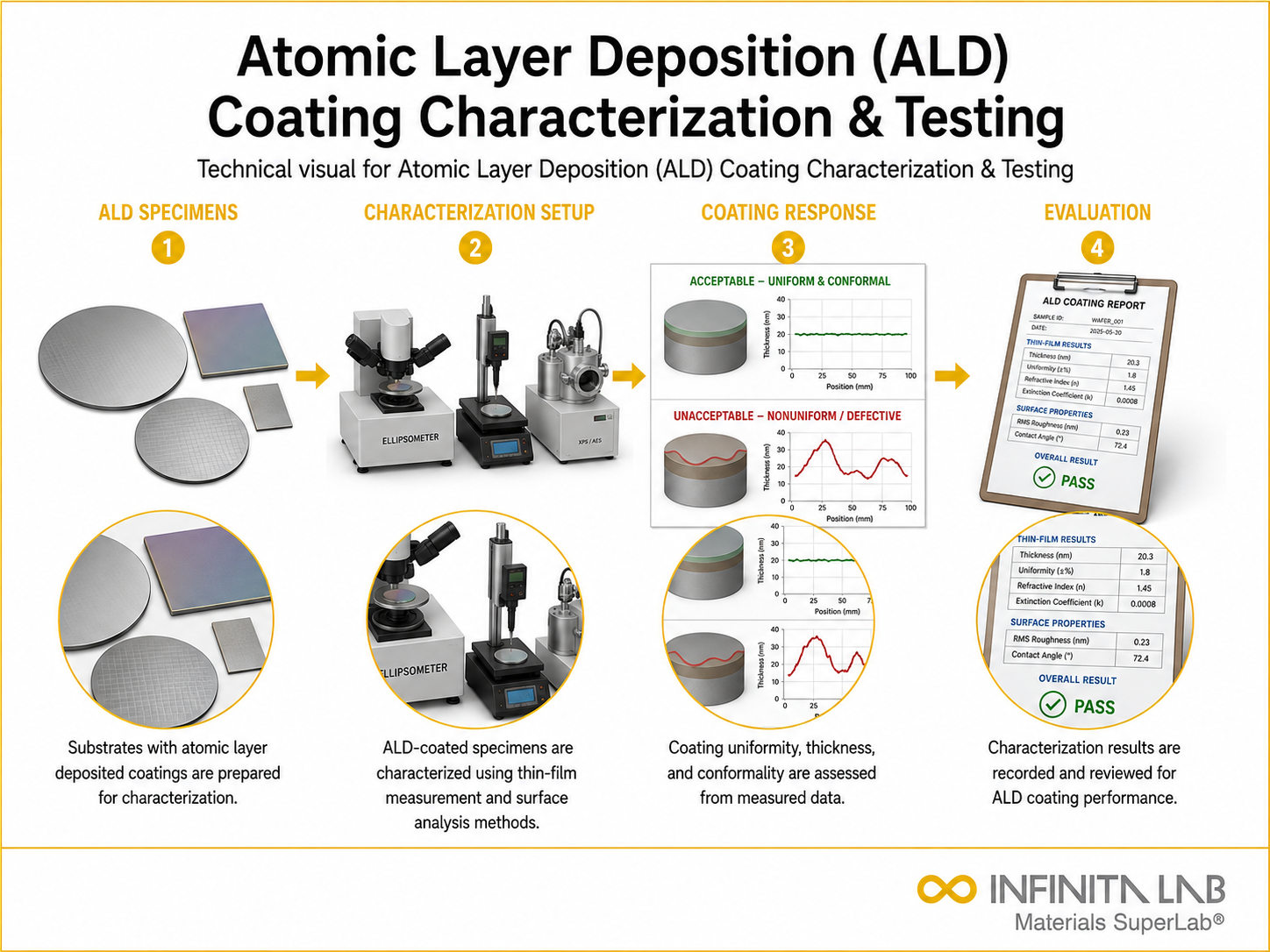
| Thickness Measurement | Ellipsometry, XRR, SEM/TEM |
| Process Control | Number of ALD cycles |


- Atomic Layer Deposition (ALD) reactor system
- Precursor delivery and dosing system
- Reaction chamber with controlled heating
- Vacuum pumping and pressure control system
- Inert carrier and purge gas supply
- Substrate holder and temperature controller
- Process monitoring and control software
Equipment and Instrumentation Used for Testing
What You Receive: Test Report, Data, and Certification
- Uniform and conformal thin film deposited on the substrate
- Film thickness achieved as per the number of ALD cycles
- Dense and pinhole-free coating observed
- Excellent step coverage on complex and high-aspect-ratio structures
- Consistent film composition and stoichiometry
- Good adhesion between film and substrate
- Reproducible and repeatable deposition results
Atomic Layer Deposition ALD FAQs
Atomic Layer Deposition is a film deposition technique in which materials are deposited one atomic layer at a time through successive chemical reactions, enabling control of film thickness and uniform coating of complex surfaces.
Atomic Layer Deposition is a method of producing ultra-uniform and conformal thin films with precise thickness control, an important characteristic for semiconductor devices, nanotechnology, and other coatings requiring high performance and reliability.
Atomic Layer Deposition can deposit materials such as metal oxides, metal nitrides, metal sulfides, and metals, which are used in semiconductor devices, energy storage devices, sensors, protective coatings, and various electronic devices.
Atomic Layer Deposition is widely used across industries such as semiconductor manufacturing, electronics, aerospace, energy storage, optics, and nanotechnology. In all of these sectors, thin film coatings play a crucial role.
Atomic Layer Deposition techniques may be slower than other deposition methods because layers are deposited one at a time, and specialized chemicals may be required, which can increase equipment costs.
Why Choose Infinita Lab for Atomic Layer Deposition ALD Testing?
At the core of this breadth is our network of 2,000+ accredited laboratories across the USA, offering access to over 10,000 testing methods and analytical services. From advanced materials characterization (SEM, TEM, RBS, XPS) to mechanical, chemical, environmental, biological, and standardized ASTM/ISO-compliant testing, we deliver unmatched flexibility, specialization, and scale. You are never limited by geography, facility, or methodology — Infinita Lab connects you to the right expertise and testing solution, every time.

Looking for an Accredited Partner for Atomic Layer Deposition ALD Testing?
Send query us at hello@infinitalab.com or call us at (888) 878-3090 to learn more about our services and how we can support you.





