


ASTM E517: Plastic Strain Ratio R Value Testing Services
ASTM E 517 – 00 applies to specific stress testing of sheet metal designed for deep-drawing applications to determine the plastic strain ratio, r. The values are considered as a standard when expressed in SI units.
TRUSTED BY


Get ASTM E517 compliant results — request your plastic strain ratio r value testing quote
- Overview
- Scope, Applications, and Benefits
- Test Process
- Specifications
- Instrumentation
- Results and Deliverables
What Is ASTM E517 Plastic Strain Ratio R Value?
ASTM E517 provides a standard test method for determining the plastic strain ratio (r-value) of sheet metals — a measure of the anisotropic flow behavior that governs deep drawability and forming behavior. The r-value is the ratio of true width strain to true thickness strain during tensile testing in the plane of the sheet.
High r-values indicate superior deep drawing capability — the ability to draw metal into cup or can shapes without thinning and rupture — making r-value measurement fundamental to sheet metal characterization for automotive, appliance, and packaging applications.

Applications and Benefits of ASTM E517 Plastic Strain Ratio R Value Testing
Scope
ASTM E517 evaluates:
- Plastic strain ratio (r) at defined orientations (0°, 45°, 90° to rolling direction)
- Normal anisotropy (r̄) — average r-value for deep drawing prediction
- Planar anisotropy (Δr) — earing tendency in drawn cups
- Effect of temper, processing, and composition on r-values
Applications
- Automotive body panel steel qualification (deep draw steel, BH steel)
- Aluminum alloy sheet formability characterization
- Appliance housing and can body steel evaluation
- Stainless steel deep-draw component material selection
- Sheet metal forming process development
Benefits
- Predicts deep drawing capability before tool investment
- Quantifies sheet anisotropy for forming simulation input data
- Enables material selection and specification compliance verification
- Applicable to all sheet metal alloys (steel, aluminum, copper alloys)
- Standard test widely specified by automotive OEMs
Our ASTM E517 Testing Procedure
Specimen Preparation
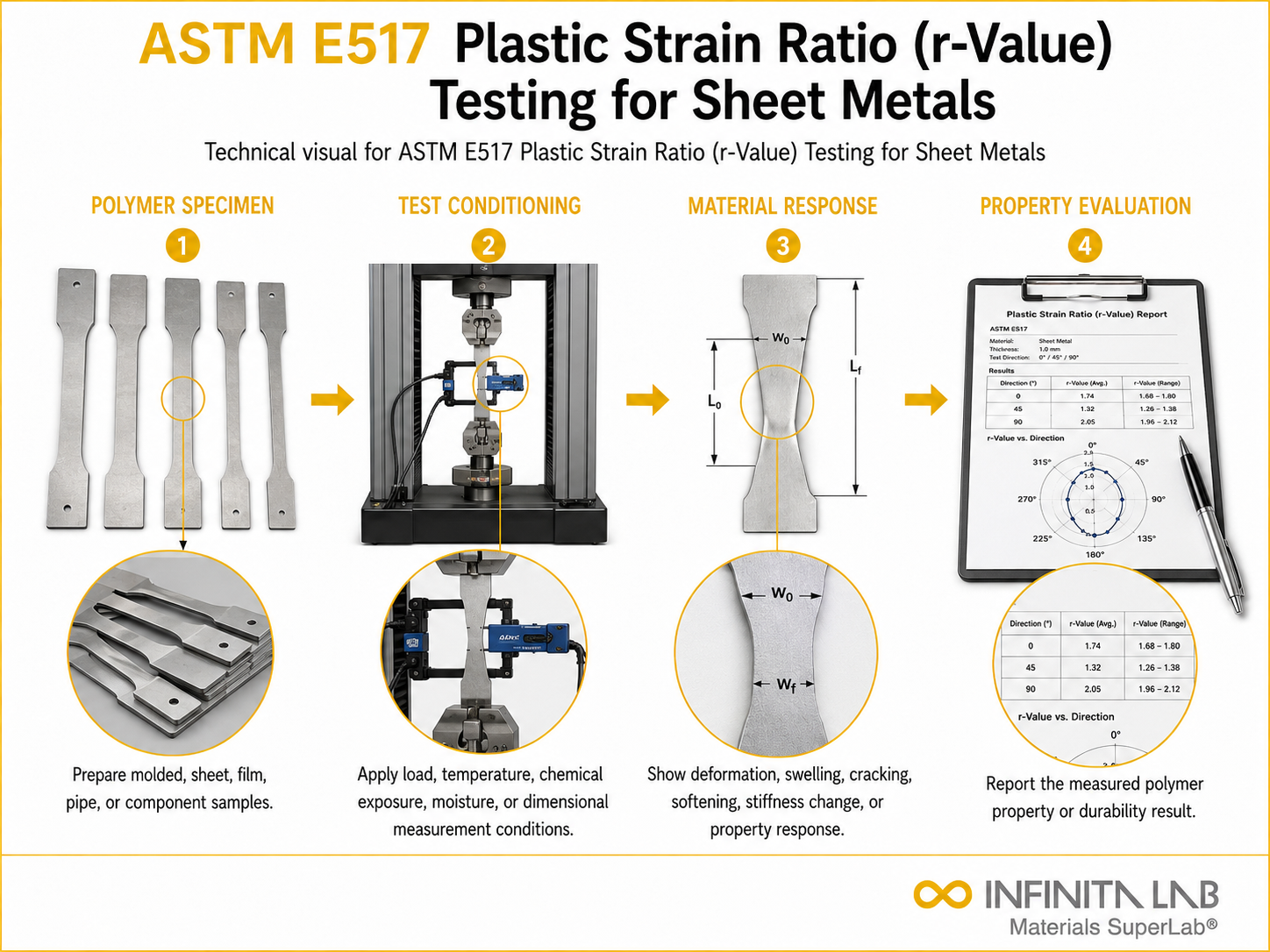
Tensile specimens are cut from the sheet at 0°, 45°, and 90° to the rolling direction per ASTM E517 geometry; initial width and gauge length are measured precisely.
1Tensile Testing
Specimens are tensile tested to a defined prestrain (typically 15–20% engineering strain); width and length are measured at the start and end of the prestrain increment.
2Strain Calculation
True width strain (εw) and true length strain (εl) are calculated from width and gauge length measurements; true thickness strain (εt) is derived from volume constancy (εw + εl + εt = 0).
3r-Value Reporting
r = εw / εt for each orientation; r̄ = (r₀ + 2r₄₅ + r₉₀) / 4; Δr = (r₀ − 2r₄₅ + r₉₀) / 2 are calculated and reported.
4ASTM E517 Test Parameters and Requirements
| Parameter | Details |
|---|---|
| Measured Property | Plastic strain ratio (r-value) |
| Test Orientations | 0°, 45°, 90° to rolling direction |
| Prestrain Level | 15–20% engineering strain (typical) |
| Measurement Method | Width/length measurement or extensometry |
| Applicable Materials | Sheet metals (steel, aluminum, copper, titanium) |


- Universal testing machine (UTM) with grip fixtures
- Precision micrometer (width measurement)
- An extensometer or a strain gauge for length measurement
- Video extensometer (for non-contact width and length strain)
- Specimen cutting die (dog-bone geometry)
Equipment and Instrumentation Used for ASTM E517 Testing
What You Receive: Test Report, Data, and Certification
- r-values at 0°, 45°, and 90° orientations
- Normal anisotropy (r̄) and planar anisotropy (Δr)
- Tensile stress–strain data at each orientation
- Specification compliance statement
- Full r-value test report per ASTM E517
ASTM E517 Plastic Strain Ratio R Value FAQs
A high r-value (r̄ > 1.5) indicates good resistance to thinning during deep drawing — the sheet prefers to flow in its plane rather than thin. Very high r̄ values (>2.0) are characteristic of interstitial-free (IF) deep draw steels used in automotive body panels.
Δr reflects the variation in r-value with direction in the sheet plane. High Δr leads to earing — the formation of ears (irregular peaks) around the rim of deep-drawn cups. Δr near zero is desirable for uniform cup height in deep drawing and ironing operations.
At minimum, 3 specimens at 0°, 3 at 45°, and 3 at 90° are needed (9 total) for a complete r̄ and Δr determination with statistical reliability. Additional specimens improve confidence in the mean values.
Yes. Digital image correlation enables full-field strain measurement during tensile testing, providing continuous r-value measurement as a function of strain without physical contact width measurement. DIC offers higher accuracy and additional flow curve information compared to manual width measurements.
Low carbon steel: r̄ ≈ 1.0–1.2; Drawing quality steel (DQ): r̄ ≈ 1.4–1.8; IF steel (deep drawing): r̄ ≈ 1.8–2.5; Aluminum alloy 3xxx/5xxx: r̄ ≈ 0.6–0.8; Stainless steel 304: r̄ ≈ 1.0. Aluminum alloys have lower r-values than steel but compensate through higher ductility.
Why Choose Infinita Lab for Plastic Strain Ratio R Value Testing
At the core of this breadth is our network of 2,000+ accredited laboratories across the USA, offering access to over 10,000 testing methods and analytical services. From advanced materials characterization (SEM, TEM, RBS, XPS) to mechanical, chemical, environmental, biological, and standardized ASTM/ISO-compliant testing, we deliver unmatched flexibility, specialization, and scale. You are never limited by geography, facility, or methodology — Infinita Lab connects you to the right expertise and testing solution, every time.

Need ASTM E517 Plastic Strain Ratio R Value Testing You Can Rely On?
Send query us at hello@infinitalab.com or call us at (888) 878-3090 to learn more about our services and how we can support you.



Request a Quote
Submit your material details and receive testing procedures, pricing, and turnaround time within 24 hours.
 Quick Turnaround and Hasslefree process
 Confidentiality Guarantee
 Free, No-obligation Consultation
 100% Customer Satisfaction
