


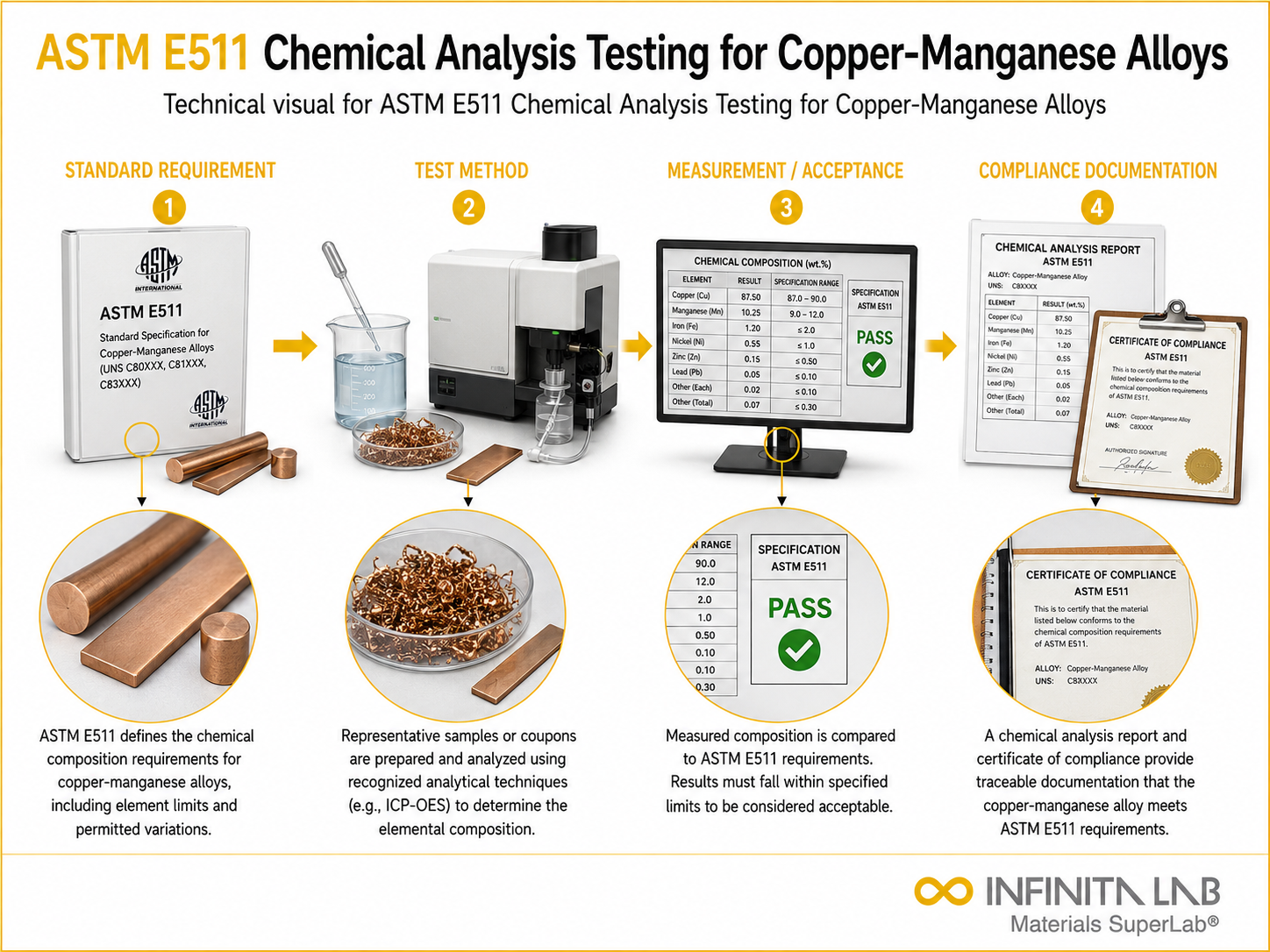
ASTM E511 Chemical Analysis Testing for Copper-Manganese Alloys
ASTM E511 – 07 describes the measuring of radiative heat flux with a transducer whose sensing element is a thin circular metal foil. Gardon Gauges are a common name for these sensors. The values are considered as a standard when expressed in SI units.
TRUSTED BY


Precision Testing Solutions for Accurate, Reliable, and Standards-Compliant Results
- Overview
- Scope, Applications, and Benefits
- Test Process
- Specifications
- Instrumentation
- Results and Deliverables
ASTM E511 Heat Flux Measurement – Overview
ASTM E511 – 07 describes a method for measuring heat flux using a copper-constantan circular foil heat-flux transducer. The technique is based on thermoelectric principles, where temperature differences across the foil generate a voltage proportional to the heat flux passing through it.
This method is widely used in thermal testing applications requiring accurate measurement of radiant and convective heat transfer. It provides reliable data for evaluating material performance, fire exposure conditions, and thermal system behavior under controlled laboratory environments.

Scope, Applications, and Benefits
Scope
ASTM E511 establishes a procedure for measuring heat flux using a circular foil transducer under controlled thermal exposure. It ensures accurate conversion of thermal energy flow into measurable electrical signals.
- Applicable to radiant and convective heat flux measurements
- Suitable for laboratory and controlled testing environments
- Based on thermoelectric transducer principles
- Enables precise heat flux quantification
Applications
- Fire testing and material evaluation
- Thermal insulation performance analysis
- Heat transfer studies
- Calibration of heat flux sensors
- Research and laboratory testing
Benefits
- Direct and accurate heat flux measurement
- High sensitivity to thermal changes
- Suitable for both radiant and convective conditions
- Reliable and reproducible results
- Supports thermal system analysis
ASTM E511 Heat Flux Measurement – Test Process
Sensor Preparation
Install and calibrate the copper-constantan foil transducer for accurate heat flux measurement.
1Exposure Setup
Position the transducer in the test environment under controlled thermal conditions.
2Signal Measurement
Record thermoelectric voltage generated due to temperature difference across the foil.
3Heat Flux Calculation
Convert voltage signal into heat flux using calibration constants.
4ASTM E511 Heat Flux Measurement – Technical Specification
| Parameter | Details |
|---|---|
| Standard | ASTM E511 – 07 |
| Method | Copper-constantan circular foil heat-flux transducer |
| Sensor Type | Thermoelectric foil transducer |
| Measurement Principle | Voltage generated proportional to heat flux |
| Heat Flux Range | Application-dependent thermal exposure levels |
| Applicable Materials | Thermal systems, surfaces, and test environments |
| Units | kW/m² or W/m² |


- Copper-constantan circular foil heat flux transducer
- Data acquisition system
- Temperature measurement devices
- Calibration equipment
- Mounting and positioning fixtures
Instrumentation Used for Testing
Results and Deliverables
- Heat flux values (kW/m² or W/m²)
- Voltage output data
- Calibration constants and conversion factors
- Test conditions and setup details
- Final thermal analysis report
Frequently Asked Question
The transducer operates on the thermoelectric effect, where a temperature gradient across the foil generates a voltage. This voltage is proportional to heat flow and is converted into heat flux using calibration constants.
Copper-constantan provides stable thermoelectric properties and high sensitivity, making it suitable for accurate measurement of small temperature differences associated with heat flux.
Calibration establishes the relationship between voltage output and heat flux. Accurate calibration ensures reliable conversion of electrical signals into precise heat flux values.
Accuracy depends on sensor calibration, positioning, environmental conditions, and minimization of heat losses such as radiation or conduction through mounting structures.
Temperature measures thermal state, while heat flux quantifies the rate of heat transfer per unit area, providing more detailed insight into energy flow in thermal systems.
Why Choose Infinita Lab for Advanced Materials Testing and Characterization?
At the core of this breadth is our network of 2,000+ accredited laboratories across the USA, offering access to over 10,000 testing methods and analytical services. From advanced materials characterization (SEM, TEM, RBS, XPS) to mechanical, chemical, environmental, biological, and standardized ASTM/ISO-compliant testing, we deliver unmatched flexibility, specialization, and scale. You are never limited by geography, facility, or methodology — Infinita Lab connects you to the right expertise and testing solution, every time.

Looking for a Trusted Partner for Accurate and Reliable Testing Services?
Send query us at hello@infinitalab.com or call us at (888) 878-3090 to learn more about our services and how we can support you.



Request a Quote
Submit your material details and receive testing procedures, pricing, and turnaround time within 24 hours.
 Quick Turnaround and Hasslefree process
 Confidentiality Guarantee
 Free, No-obligation Consultation
 100% Customer Satisfaction
