


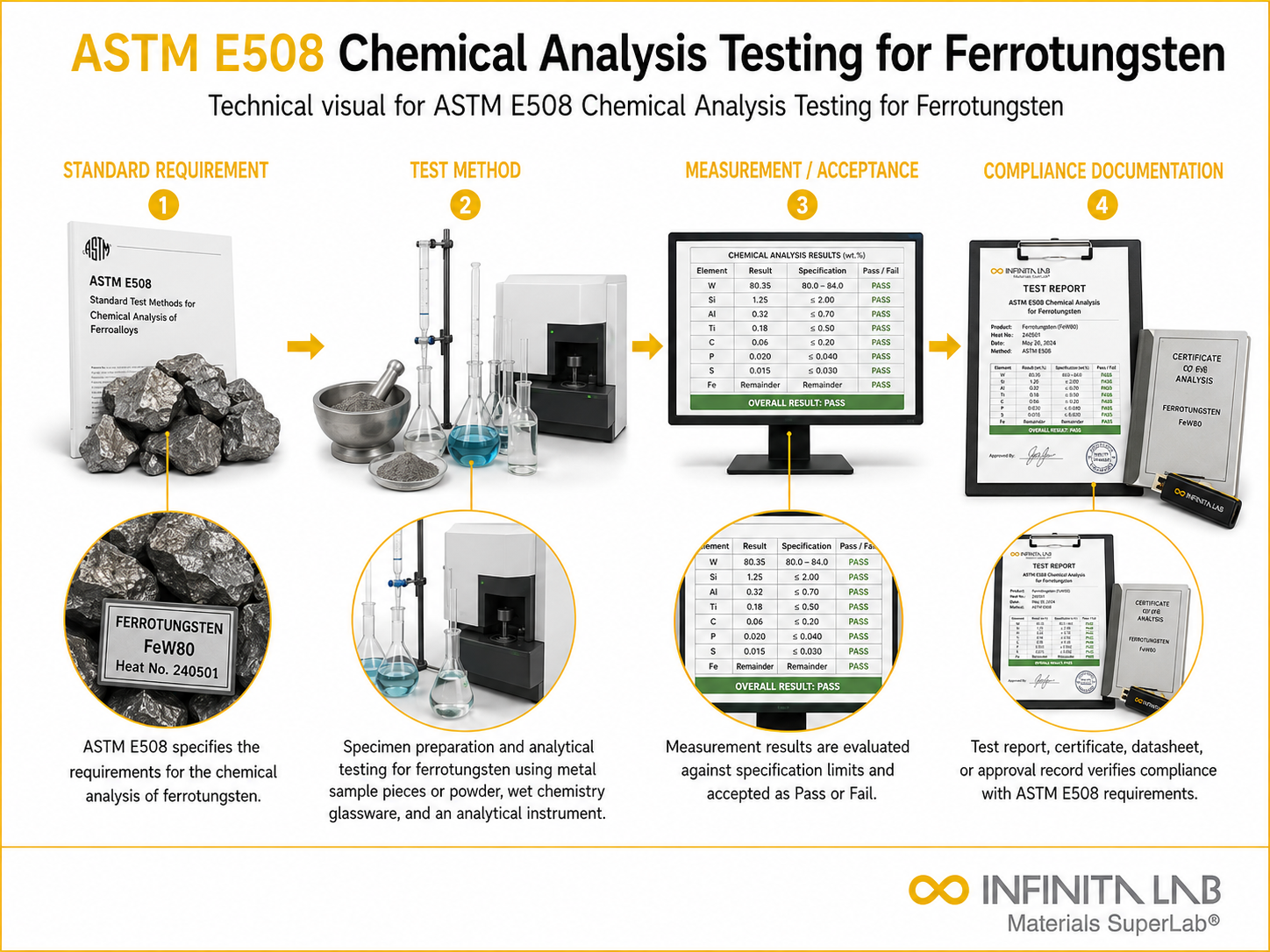
ASTM E508 Chemical Analysis Testing for Ferrotungsten
ASTM E508 determines calcium and magnesium in iron ores, concentrates, and agglomerates in the mass fraction range from 0.05 % to 5 % of calcium and 0.05 % to 3 % of magnesium. The values are considered as a standard when expressed in SI units.
TRUSTED BY


Precision Testing Solutions for Accurate, Reliable, and Standards-Compliant Results
- Overview
- Scope, Applications, and Benefits
- Test Process
- Specifications
- Instrumentation
- Results and Deliverables
ASTM E508 Determination of Calcium & Magnesium – Overview
ASTM E508 – 13 specifies a flame atomic absorption spectrometric (FAAS) method for determining calcium and magnesium in iron ores. The method involves acid digestion of the sample followed by atomization in a flame, where element-specific light absorption is measured for quantitative analysis.
This standard is essential for evaluating fluxing behavior and metallurgical performance of iron ores. Calcium and magnesium significantly influence slag formation, furnace efficiency, and impurity control, making their accurate determination critical for process optimization and quality assurance.

Scope, Applications, and Benefits
Scope
ASTM E508 provides a quantitative method for determining calcium and magnesium in iron ores using FAAS. It ensures reliable analysis under controlled laboratory conditions.
- Applicable to iron ores and related mineral materials
- Suitable for Ca and Mg determination across concentration ranges
- Based on atomic absorption spectrometric principles
- Enables simultaneous evaluation of multiple elements
Applications
- Iron ore quality assessment
- Metallurgical process optimization
- Slag chemistry control
- Mining and beneficiation studies
- Laboratory elemental analysis
Benefits
- High sensitivity for Ca and Mg detection
- Accurate and reproducible measurements
- Faster than conventional wet chemistry methods
- Suitable for routine laboratory use
- Supports efficient furnace operation
ASTM E508 Determination of Ca & Mg – Test Process
Sample Dissolution
Digest iron ore using suitable acids to bring calcium and magnesium into solution.
1Solution Conditioning
Dilute and treat the solution with releasing agents to minimize chemical interferences.
2Atomic Absorption Measurement
Aspirate sample into flame and measure Ca and Mg absorbance at specific wavelengths.
3Concentration Calculation
Determine element concentrations using calibration curves with interference corrections.
4ASTM E508 Determination of Ca & Mg – Technical Specification
| Parameter | Details |
|---|---|
| Standard | ASTM E508 – 13 |
| Method | Flame atomic absorption spectrometry (FAAS) |
| Analytes | Calcium (Ca) and Magnesium (Mg) |
| Sample Type | Iron ore and mineral samples |
| Extraction Type | Acid digestion of solid sample |
| Wavelengths | Ca (~422.7 nm), Mg (~285.2 nm) |
| Measurement Basis | Absorbance proportional to concentration |
| Units | Percentage (%) or ppm |


- Atomic absorption spectrometer (flame type)
- Air-acetylene flame system
- Analytical balance
- Volumetric glassware
- Digestion apparatus (hot plate or microwave system)
Instrumentation Used for Testing
Results and Deliverables
- Calcium and magnesium concentrations (% or ppm)
- Calibration curves and absorbance data
- Test conditions and instrumental parameters
- Interference correction details
- Final analytical report
Frequently Asked Question
ASTM E508 measures Ca and Mg sequentially using element-specific wavelengths under optimized flame conditions. Proper calibration and instrument settings allow accurate detection of both elements from the same prepared sample solution.
Iron ores contain Ca and Mg in mineral-bound forms. Acid digestion breaks down these structures, ensuring complete dissolution and availability of elements for accurate spectrometric measurement.
Elements like phosphate or aluminum can form stable compounds with Ca and Mg, reducing atomization efficiency. ASTM E508 uses releasing agents to prevent such interference and ensure accurate readings.
Each element absorbs light at a unique wavelength, allowing selective detection. Using characteristic wavelengths ensures accurate differentiation and quantification of Ca and Mg in complex matrices.
Flame composition affects atomization efficiency. Air-acetylene flames are commonly used for Ca and Mg due to their adequate temperature and stable performance for these elements.
Why Choose Infinita Lab for Advanced Materials Testing and Characterization?
At the core of this breadth is our network of 2,000+ accredited laboratories across the USA, offering access to over 10,000 testing methods and analytical services. From advanced materials characterization (SEM, TEM, RBS, XPS) to mechanical, chemical, environmental, biological, and standardized ASTM/ISO-compliant testing, we deliver unmatched flexibility, specialization, and scale. You are never limited by geography, facility, or methodology — Infinita Lab connects you to the right expertise and testing solution, every time.

Looking for a Trusted Partner for Accurate and Reliable Testing Services?
Send query us at hello@infinitalab.com or call us at (888) 878-3090 to learn more about our services and how we can support you.



Request a Quote
Submit your material details and receive testing procedures, pricing, and turnaround time within 24 hours.
 Quick Turnaround and Hasslefree process
 Confidentiality Guarantee
 Free, No-obligation Consultation
 100% Customer Satisfaction
