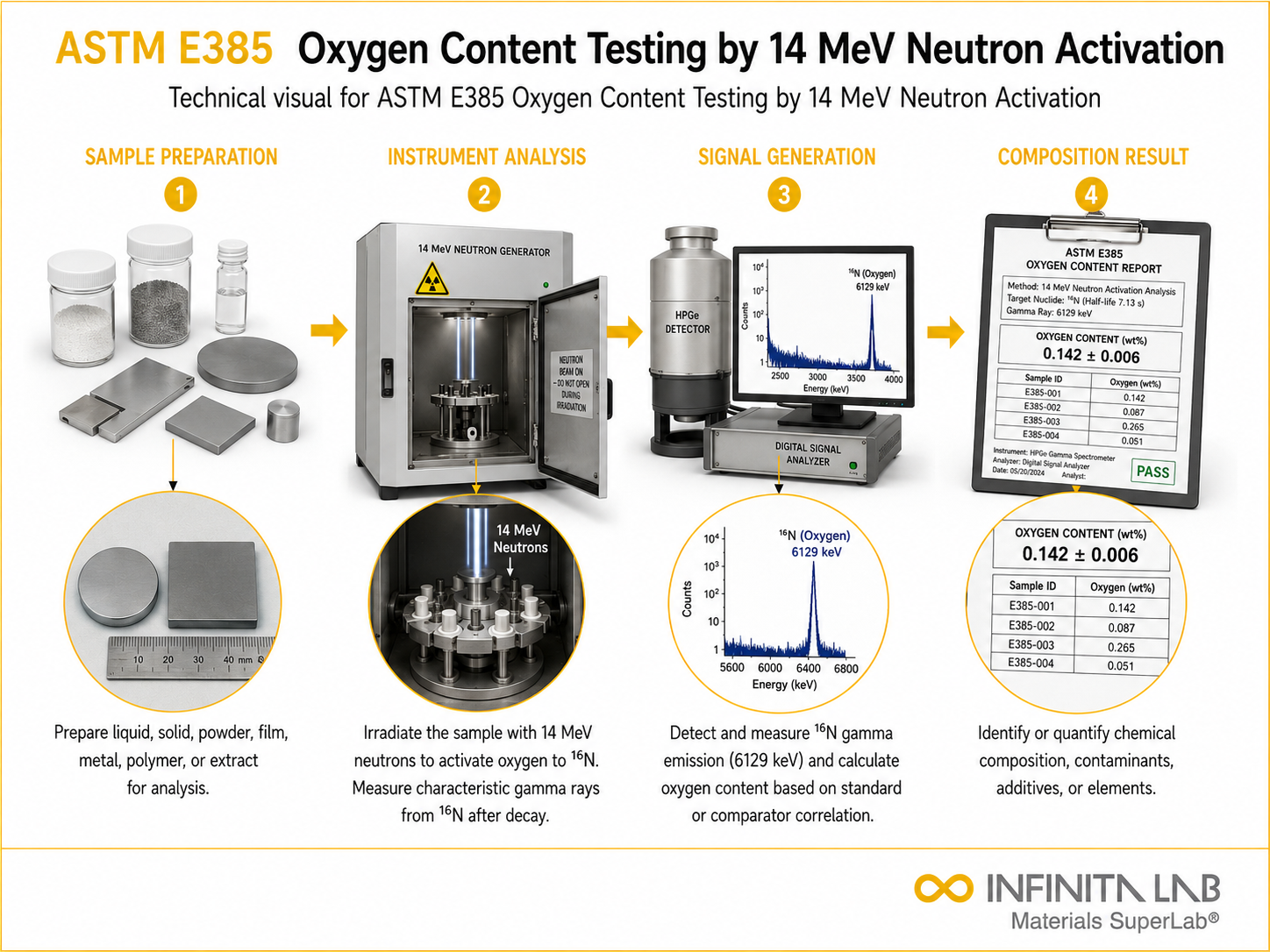


What Is ASTM E385 Oxygen Content Neutron Activation?
ASTM E385 describes a standard test method for determining the oxygen content of materials using a 14-MeV neutron activation analysis and direct-counting technique. This method is particularly useful for analyzing oxygen in metals where conventional chemical methods may be difficult or less accurate.
The technique involves irradiating the sample with high-energy neutrons, causing nuclear reactions that produce measurable radiation. The emitted radiation is then directly counted to determine oxygen concentration with high sensitivity and precision.

Applications and Benefits of ASTM E385 Oxygen Content Neutron Activation Testing
Scope
ASTM E385 outlines procedures for the quantitative determination of oxygen content using neutron activation analysis. It evaluates:
- Oxygen content (ppm or %)
- Trace oxygen levels in metals
- Material purity and cleanliness
- Internal oxygen distribution
Applications
- Aerospace and high-performance alloys
- Nuclear and energy industries
- Metallurgical quality control
- Research and advanced materials development
- Semiconductor and specialty materials
Benefits
- High sensitivity for trace oxygen detection
- Non-destructive or minimal sample preparation
- Accurate and rapid measurement
- Suitable for difficult-to-analyze materials
- Supports advanced material characterization
Our ASTM E385 Testing Procedure
Sample Preparation
The specimen is cleaned and prepared to avoid contamination prior to irradiation.
1The sample is exposed to 14-MeV neutrons, inducing nuclear reactions with oxygen atoms.
The sample is exposed to 14-MeV neutrons, inducing nuclear reactions with oxygen atoms.
2Radiation Detection
Emitted radiation from activated oxygen isotopes is directly measured using detectors.
3Calculation & Reporting
Oxygen content is calculated based on radiation counts and reported quantitatively.
4ASTM E385 Test Parameters and Requirements
| Parameter | Details |
|---|---|
| Applicable Materials | Metals and selected non-metallic materials |
| Sample Type | Solid samples with minimal preparation |
| Measured Output | Oxygen content (ppm or %) |
| Detection Range | Trace levels (ppm) to higher concentrations |
| Radiation Source | 14-MeV neutron generator |


- 14-MeV neutron generator
- Radiation detection system (gamma-ray detectors)
- Sample handling and shielding equipment
- Calibration standards
- Data acquisition and counting system
Equipment and Instrumentation Used for ASTM E385 Testing
What You Receive: Test Report, Data, and Certification
- Oxygen content (ppm or %)
- Material purity evaluation
- Trace element analysis data
- Quality control assessment
- Compliance reports
ASTM E385 Oxygen Content Neutron Activation FAQs
It determines the oxygen content in materials using neutron activation and radiation counting, providing highly sensitive and accurate measurement of oxygen levels, especially in metals where trace oxygen significantly affects material properties and performance.
The sample is irradiated with high-energy neutrons, causing nuclear reactions with oxygen atoms that emit detectable radiation, which is measured and correlated to oxygen concentration using calibration standards and counting techniques.
Oxygen affects mechanical properties, brittleness, and overall material performance, making accurate measurement essential for ensuring quality, reliability, and suitability of metals used in aerospace, nuclear, and high-performance engineering applications.
Solid metallic and certain non-metallic samples can be tested with minimal preparation, making the method suitable for analyzing materials where conventional chemical techniques may be challenging or less effective.
Industries such as aerospace, nuclear energy, metallurgy, and advanced materials use ASTM E385 to measure oxygen content, ensure material purity, and maintain performance standards in critical and high-reliability applications.
Why Choose Infinita Lab for Oxygen Content Neutron Activation Testing
At the core of this breadth is our network of 2,000+ accredited laboratories across the USA, offering access to over 10,000 testing methods and analytical services. From advanced materials characterization (SEM, TEM, RBS, XPS) to mechanical, chemical, environmental, biological, and standardized ASTM/ISO-compliant testing, we deliver unmatched flexibility, specialization, and scale. You are never limited by geography, facility, or methodology — Infinita Lab connects you to the right expertise and testing solution, every time.

Looking for an Accredited Partner for ASTM E385 Oxygen Content Neutron Activation Testing?
Send query us at hello@infinitalab.com or call us at (888) 878-3090 to learn more about our services and how we can support you.





