


ASTM E307 Normal Spectral Emittance Testing at Elevated Temperatures
This Test method ASTM 307-72 elaborates techniques for electrically conducting materials or material with electrically conducting substrates for measuring the normal spectral emittance in the range of 326 to 1126 ºC and at a wavelength from 1 to 35 μm.
TRUSTED BY


Precision Testing Solutions for Accurate, Reliable, and Standards-Compliant Results
- Overview
- Scope, Applications, and Benefits
- Test Process
- Specifications
- Instrumentation
- Results and Deliverables
ASTM E307-72 Normal Spectral Emittance Overview
ASTM E307-72 describes a standard test method for determining the normal spectral emittance of materials at elevated temperatures. Spectral emittance is a critical thermal property that indicates how efficiently a material emits radiant energy at a specific wavelength.
This test is essential for materials used in high-temperature environments such as furnaces, turbines, and thermal protection systems. Accurate emittance data helps in heat transfer analysis, thermal design, and performance optimization.

Scope, Applications, and Benefits
Scope
ASTM E307-72 outlines procedures for measuring spectral emittance at normal incidence under elevated temperature conditions. It evaluates:
- Normal spectral emittance
- Radiative heat emission characteristics
- Temperature-dependent emissivity behavior
- Surface radiation properties
Applications
- Furnace and refractory materials
- Aerospace thermal protection systems
- Power generation components
- Heat exchangers and thermal coatings
- Research and thermal analysis laboratories
Benefits
- Provides accurate emissivity data at high temperatures
- Supports thermal system design and modeling
- Enhances energy efficiency analysis
- Enables material comparison and selection
- Ensures compliance with thermal performance standards
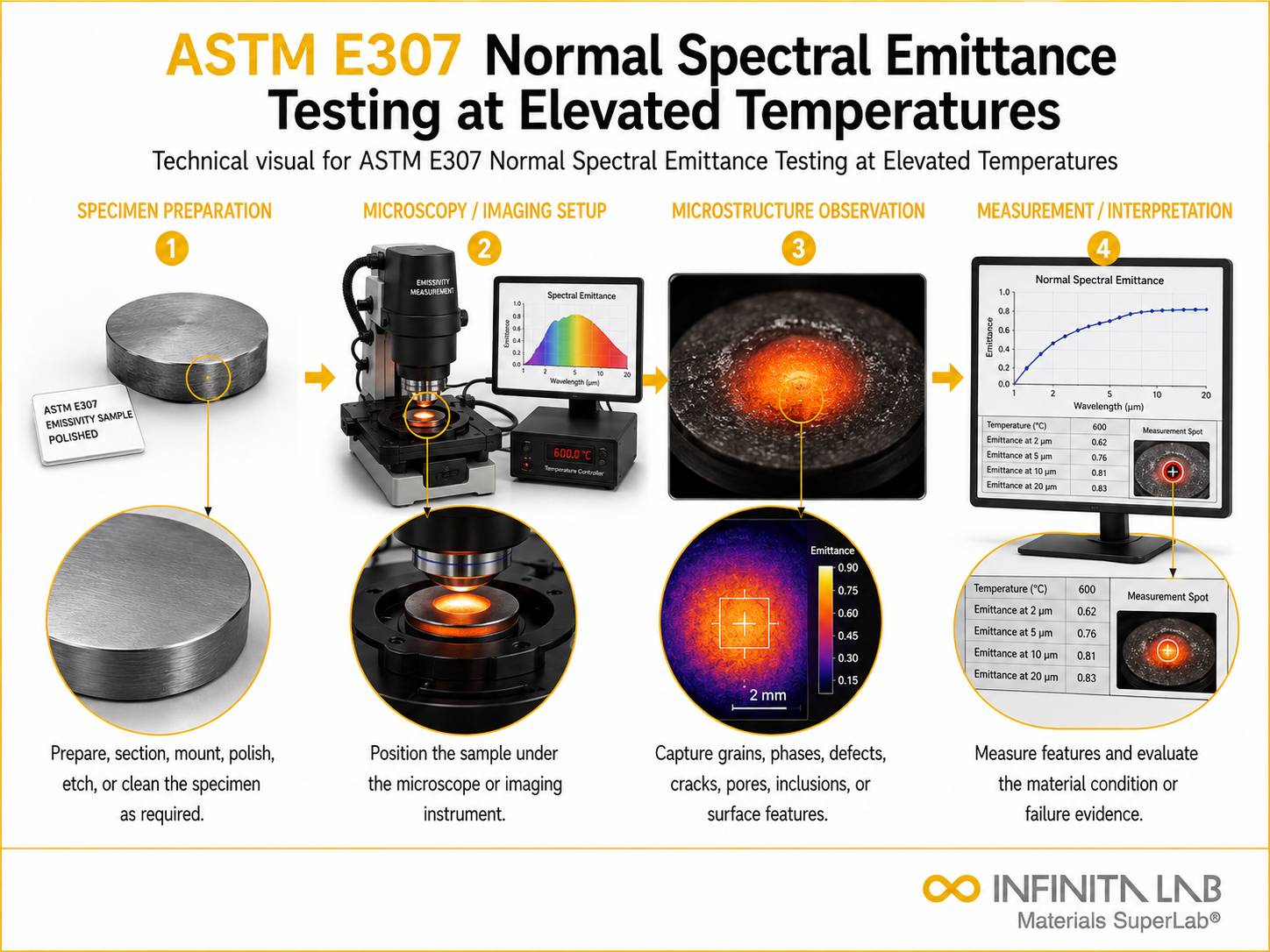
ASTM E307-72 Emittance Test Process
Sample Preparation
The specimen surface is cleaned and prepared to ensure uniform emissivity conditions.
1Heating
The sample is heated to the required elevated temperature in a controlled environment.
2Radiation Measurement
Emitted radiation at a specific wavelength is measured using appropriate detectors.
3Calculation & Reporting
Normal spectral emittance is calculated by comparing emitted radiation to a reference blackbody.
4ASTM E307-72 Emittance Technical Specifications
| Parameter | Details |
|---|---|
| Applicable Materials | Metals, ceramics, coatings, and high-temperature materials |
| Temperature Range | Typically 300°C to 1000°C or higher (depending on setup) |
| Wavelength Range | Infrared region (commonly 1–15 µm depending on instrument) |
| Measurement Type | Normal spectral emittance (at specific wavelength) |
| Reference | Blackbody radiation standard |


- High-temperature furnace
- Spectrometer or radiometer
- Blackbody reference source
- Optical system (lenses, mirrors)
- Temperature measurement devices (thermocouples/pyrometers)
- Data acquisition system
Instrumentation Used for Testing
Results and Deliverables
- Normal spectral emittance values
- Temperature vs emissivity data
- Radiative heat transfer characteristics
- Material performance evaluation reports
- Comparative analysis data
- Compliance reports
Frequently Asked Question
ASTM E307-72 is a standard test method used to determine normal spectral emittance of materials at elevated temperatures, evaluating their ability to emit thermal radiation under controlled conditions.
ASTM E307-72 is important because thermal radiation properties affect heat transfer, making it essential for designing materials used in high-temperature environments like furnaces and aerospace systems.
ASTM E307-72 measures emitted radiation from a heated specimen at specific wavelengths and compares it with a reference to determine spectral emittance.
ASTM E307-72 requires a high-temperature furnace, radiometric detectors, optical system, and calibration standards for accurate measurement.
ASTM E307-72 results are reported as spectral emittance values at given wavelengths and temperatures, indicating radiative properties of the material.
Why Choose Infinita Lab for Advanced Materials Testing and Characterization?
At the core of this breadth is our network of 2,000+ accredited laboratories across the USA, offering access to over 10,000 testing methods and analytical services. From advanced materials characterization (SEM, TEM, RBS, XPS) to mechanical, chemical, environmental, biological, and standardized ASTM/ISO-compliant testing, we deliver unmatched flexibility, specialization, and scale. You are never limited by geography, facility, or methodology — Infinita Lab connects you to the right expertise and testing solution, every time.

Looking for a Trusted Partner for Accurate and Reliable Testing Services?
Send query us at hello@infinitalab.com or call us at (888) 878-3090 to learn more about our services and how we can support you.



Request a Quote
Submit your material details and receive testing procedures, pricing, and turnaround time within 24 hours.
 Quick Turnaround and Hasslefree process
 Confidentiality Guarantee
 Free, No-obligation Consultation
 100% Customer Satisfaction
