


ASTM E1228: Peroxy Ester Iodometric Assay Testing Services
ASTM E1228 test method determines properties of the assay of organic peroxides of the peroxy ester type. The information related to toxicity, first aid, procedures, and safety precautions is included. The final results of this method are displayed keeping in view the international standards and inch-pound units.
TRUSTED BY


Get ASTM E1228 compliant results — request your peroxy ester iodometric assay testing quote
- Overview
- Scope, Applications, and Benefits
- Test Process
- Specifications
- Instrumentation
- Results and Deliverables
What Is ASTM E1228 Peroxy Ester Iodometric Assay?
ASTM E1228 specifies a quantitative analytical method for determining the active oxygen content of peroxy esters using a catalyzed iodometric titration procedure. Peroxy esters are reactive compounds widely used as polymerization initiators, making accurate assay essential for safety, quality control, and process consistency.
The method is based on the oxidation of iodide ions by peroxy esters in the presence of a catalyst, liberating iodine that is subsequently titrated. ASTM E1228 provides precise and reproducible measurement of peroxide concentration, supporting formulation control, storage stability assessment, and compliance with product specifications.

Applications and Benefits of ASTM E1228 Peroxy Ester Iodometric Assay Testing
Scope
ASTM E1228 establishes procedures for determining peroxy ester concentration by measuring active oxygen through a catalyzed iodometric reaction. It ensures accurate titration and reliable quantification under controlled analytical conditions.
- Determines active oxygen content in peroxy esters
- Uses catalyzed iodometric titration method
- Applicable to liquid and solution-phase peroxy esters
- Requires controlled reaction and titration conditions
- Ensures reproducible and accurate analytical results
Applications
ASTM E1228 establishes procedures for determining peroxy ester concentration by measuring active oxygen through a catalyzed iodometric reaction. It ensures accurate titration and reliable quantification under controlled analytical conditions.
- Determines active oxygen content in peroxy esters
- Uses catalyzed iodometric titration method
- Applicable to liquid and solution-phase peroxy esters
- Requires controlled reaction and titration conditions
- Ensures reproducible and accurate analytical results
Benefits
- Quality control of peroxy ester formulations
- Polymerization initiator concentration verification
- Chemical manufacturing process monitoring
- Stability and shelf-life evaluation
- Research and analytical chemistry studies
- Safety assessment of reactive peroxide compounds
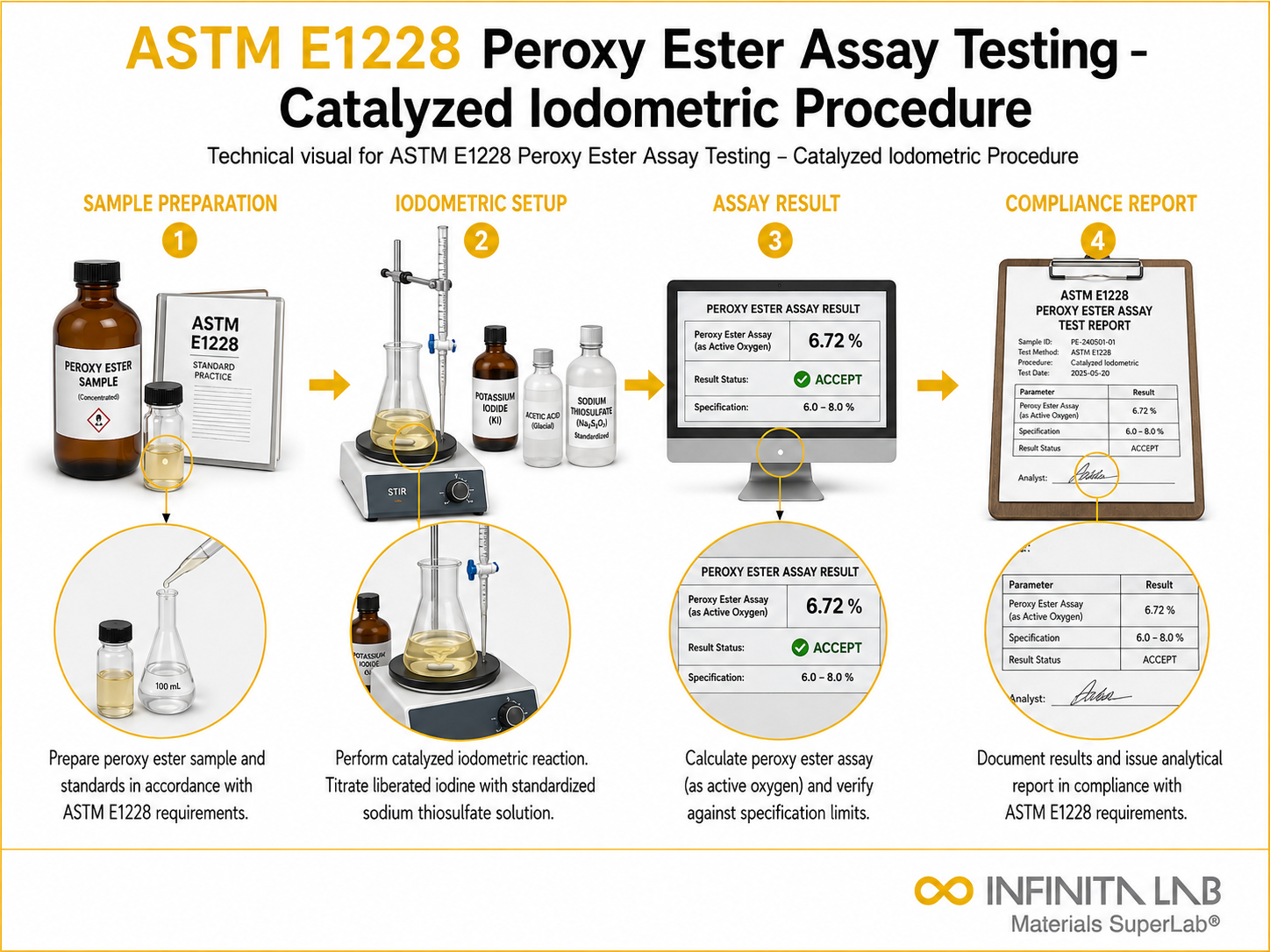
Our ASTM E1228 Testing Procedure
Sample Preparation
The peroxy ester sample is dissolved in a suitable solvent under controlled conditions.
1Reaction Initiation
Iodide is added with a catalyst to react with peroxy ester, liberating iodine.
2Titration
Released iodine is titrated with standardized sodium thiosulfate solution.
3Calculation
Active oxygen content is calculated from titration volume and concentration.
4ASTM E1228 Test Parameters and Requirements
| Parameter | Details |
|---|---|
| Standard | ASTM E1228 |
| Test Principle | Catalyzed iodometric titration based on oxidation of iodide to iodine |
| Applicable Materials | Peroxy esters in liquid or solution form |
| Measurement Output | Active oxygen content (%) or concentration |
| Reaction Mechanism | Peroxide oxidizes iodide ions to iodine in presence of catalyst |
| Titrant | Standardized sodium thiosulfate solution |
| Indicator | Starch solution for endpoint detection |
| Catalyst Used | Suitable catalyst to accelerate iodometric reaction |


- Burette and titration setup
- Analytical balance
- Volumetric flasks and pipettes
- Magnetic stirrer
- Reaction vessels (glassware)
- Standard sodium thiosulfate solution
- Starch indicator solution
- Laboratory safety equipment
Equipment and Instrumentation Used for ASTM E1228 Testing
What You Receive: Test Report, Data, and Certification
- Active oxygen content (%) of peroxy ester
- Titration data and calculations
- Quality control and batch verification results
- Test report with methodology and conditions
- Compliance verification with ASTM E1228
- Stability and formulation assessment data
ASTM E1228 Peroxy Ester Iodometric Assay FAQs
Active oxygen directly reflects the oxidizing capability of peroxy esters, correlating with their reactivity and effectiveness as initiators, making it a more meaningful parameter than total concentration for performance evaluation.
The catalyst accelerates the oxidation of iodide by peroxy esters, ensuring complete and rapid iodine liberation, which is critical for achieving accurate and reproducible titration results.
Interference from other oxidizing or reducing agents, instability of peroxy esters, and improper endpoint detection can affect accuracy, requiring careful control of reaction conditions and sample purity.
Sodium thiosulfate reacts quantitatively with iodine, reducing it back to iodide, allowing precise determination of the amount of iodine released and thus the active oxygen content.
Incomplete reaction, degradation of peroxy esters, improper catalyst concentration, or delayed titration can lead to lower measured iodine release, underestimating active oxygen content.
Why Choose Infinita Lab for Peroxy Ester Iodometric Assay Testing?
At the core of this breadth is our network of 2,000+ accredited laboratories across the USA, offering access to over 10,000 testing methods and analytical services. From advanced materials characterization (SEM, TEM, RBS, XPS) to mechanical, chemical, environmental, biological, and standardized ASTM/ISO-compliant testing, we deliver unmatched flexibility, specialization, and scale. You are never limited by geography, facility, or methodology — Infinita Lab connects you to the right expertise and testing solution, every time.

Looking for an Accredited Partner for ASTM E1228 Peroxy Ester Iodometric Assay Testing?
Send query us at hello@infinitalab.com or call us at (888) 878-3090 to learn more about our services and how we can support you.



Request a Quote
Submit your material details and receive testing procedures, pricing, and turnaround time within 24 hours.
 Quick Turnaround and Hasslefree process
 Confidentiality Guarantee
 Free, No-obligation Consultation
 100% Customer Satisfaction
