


ASTM E1174: Healthcare Handwash Efficacy Testing Services
Accredited ASTM E1174 healthcare handwash efficacy testing from Infinita Lab, performed to the exact standard requirements - accurate, reproducible results with full documentation for compliance, R&D, and quality control programs.
TRUSTED BY


Get ASTM E1174 compliant results - request your healthcare handwash efficacy testing quote
- Overview
- Scope, Applications, and Benefits
- Test Process
- Specifications
- Instrumentation
- Results and Deliverables
What Is ASTM E1174 Healthcare Handwash Efficacy?
ASTM E1174 – officially the Standard Test Method for Evaluation of the Effectiveness of Healthcare Personnel Handwash Formulations – spells out exactly how to run an in vivo efficacy study on human volunteers’ hands. Not a suspension test, not a surface panel. The standard puts a real formulation directly onto real hands and measures what happens to a controlled bacterial population before and after a wash.
Here’s how it works mechanically. Volunteers’ hands get contaminated with a standardized, non-pathogenic marker organism first – that’s the baseline bioburden the whole test hinges on. Researchers then recover bacteria using the “glove juice” technique: a sterile glove filled with recovery solution goes over the hand and gets massaged until residual organisms dislodge into solution, ready for dilution and plate counting. That recovery happens right after contamination, to set the baseline, and again after the subject washes with the test product.
From those counts, the standard specifies how to calculate log10 reduction – the core efficacy metric E1174 is built around. Depending on the study design, that reduction is measured immediately after a single wash or tracked across repeated wash cycles over several days to capture persistent, cumulative antimicrobial activity rather than a one-time effect.
It’s worth being precise about what E1174 is not. It’s a distinct, independently active standard from ASTM E1115, which governs surgical hand scrub formulations – a different product category entirely, with its own use conditions and performance expectations. Neither standard replaces or supersedes the other; they test different things for different purposes. The current edition, E1174-21, remains active today, and its data regularly show up in FDA OTC healthcare antiseptic submissions, since the glove juice method is one of the few ways to give regulators standardized, human-subject efficacy evidence rather than in vitro approximations alone.

Applications and Benefits of ASTM E1174 Healthcare Handwash Efficacy Testing
Scope
ASTM E1174 establishes procedures to assess the effectiveness of healthcare handwash formulations by measuring microbial reduction on human hands after artificial contamination and washing. It ensures controlled testing conditions for reliable and repeatable results.
- ASTM E1174 lays out a standardized in vivo procedure for evaluating antimicrobial handwash and antiseptic formulations meant for routine use by healthcare personnel.
- It applies to products marketed for frequent hand hygiene in clinical settings – not to surgical scrub products, which fall under separate standards.
- Human subjects are the test vehicle here. Their hands get experimentally contaminated with a defined, non-pathogenic marker organism to simulate transient microbial flora.
- Recovery relies on the “glove juice” sampling technique, used to pull bacteria off the hand surface both before and after product use.
- Converting bacterial recovery counts into log10 reduction values is how the data ends up expressing just how effectively a product lowered the contaminating population.
- Depending on study design, the standard can assess an immediate reduction after a single wash, a sustained or cumulative effect across repeated washes over multiple days, or both.
- ASTM Subcommittee E35.15 on Antimicrobial Agents maintains E1174; the current active edition dates to 2021, with earlier versions issued in 2000, 2006, and 2013.
- Controlled inoculation with a marker organism is what sets this method apart methodologically from standards that rely on a subject’s natural resident flora.
- Regulatory submissions reference the test often, including those supporting FDA review of healthcare personnel handwash and antiseptic products.
- Results get statistically evaluated across a representative subject panel – not pulled from a single demonstration wash.
Applications
- Antimicrobial handwash, antiseptic soap, and sanitizing cleanser formulations marketed to nurses, physicians, and other clinical staff.
- Healthcare facility hand hygiene products going through efficacy substantiation before a market launch or a label claim update.
- FDA OTC healthcare antiseptic submissions that need standardized clinical efficacy data.
- Reformulation work – comparing a revised formula against a prior version, or against a competitor’s benchmark.
- Hospital and institutional procurement evaluations, where buyers want independent efficacy verification before they’ll adopt a product.
- R&D programs screening new active ingredients or surfactant systems for clinical hand hygiene use.
- Quality and regulatory affairs teams assembling a defensible data package alongside stability, safety, and skin compatibility studies.
Benefits
- Clinically relevant, human-subject efficacy data – not just in vitro or surrogate-surface results.
- Backs regulatory submissions with a method FDA reviewers already recognize for healthcare personnel handwash products.
- Sets a formulation’s real-world performance apart from competitors’ through standardized, comparable log reduction data.
- Helps manufacturers confirm both the immediate and the sustained antimicrobial benefit of a product across a realistic use pattern.
- Produces documentation that supports marketing and label claims with traceable, reproducible test evidence.
- Builds confidence among healthcare purchasers that a product does what it’s supposed to under actual hand hygiene conditions.
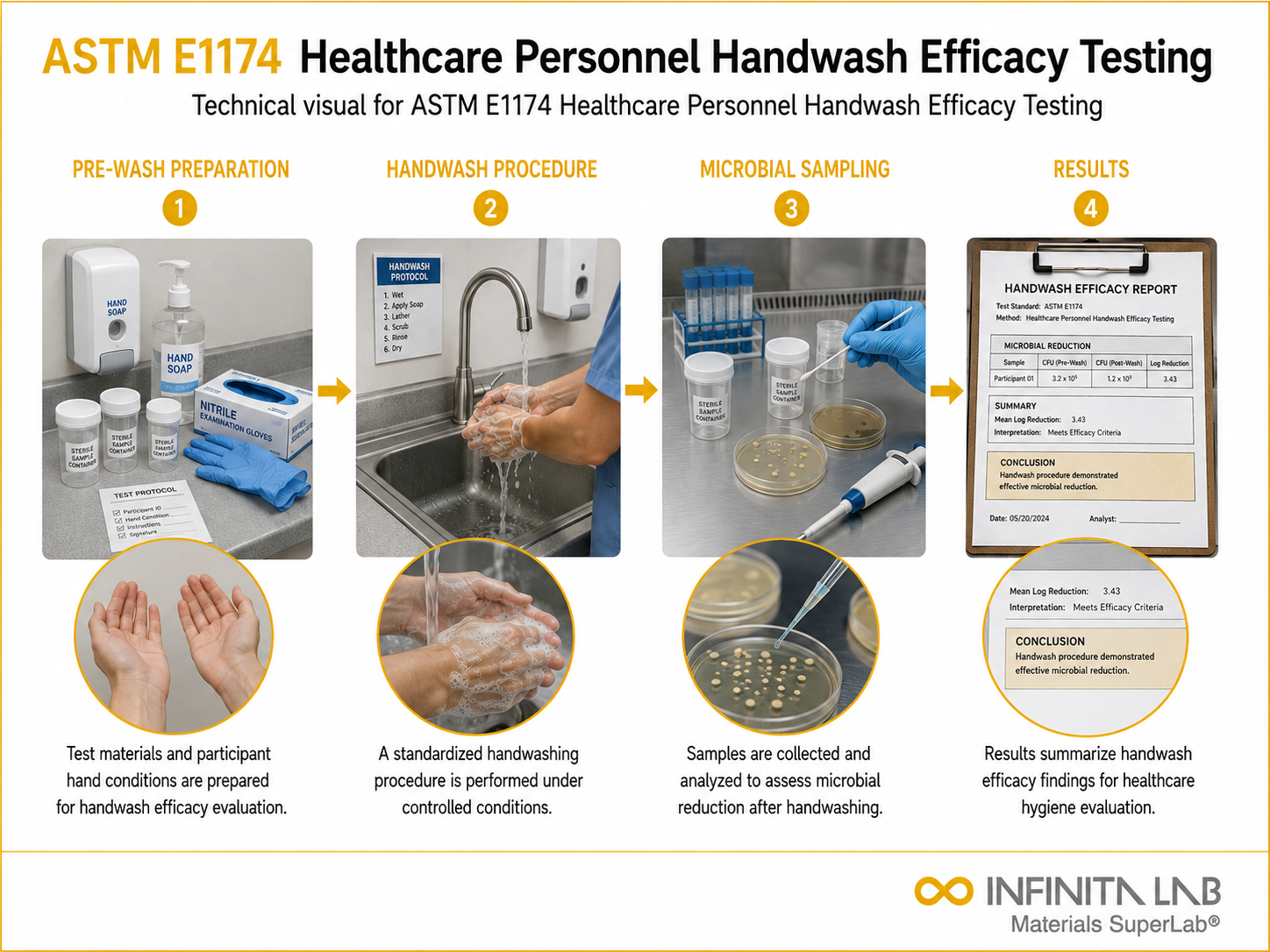
Our ASTM E1174 Testing Procedure
Hand Contamination
Subjects’ hands are artificially contaminated with a known concentration of test microorganisms.
1Product Application
The handwash formulation is applied under defined conditions and washing procedure.
2Microbial Recovery
Surviving microorganisms are recovered using standardized sampling methods.
3Enumeration and Analysis
Microbial counts are determined to calculate log reduction achieved by the product.
4ASTM E1174 Test Parameters and Requirements
| Parameter | Details |
|---|---|
| Standard | ASTM E1174 |
| Test Principle | In vivo measurement of microbial reduction after handwashing following artificial contamination |
| Applicable Products | Healthcare handwash and antiseptic formulations |
| Test Type | Human subject-based microbiological efficacy test |
| Measurement Output | Log₁₀ reduction in transient microbial population |
| Test Organism | Typically Serratia marcescens or equivalent indicator organism |
| Inoculum Level | High microbial load (typically ≥10⁸ CFU/mL contamination suspension) |


- Biosafety cabinet – a controlled, contamination-free space for preparing inoculum suspensions and handling recovered samples.
- Incubator – holds the temperature conditions organisms need to grow, both during culture prep and post-test colony development.
- Calibrated pipettes and dilution equipment – for accurate, reproducible serial dilutions of recovery fluid before plate counting.
- Sterile sampling gloves and recovery solution – the core tools of the glove juice technique, used to collect viable organisms off subjects’ hands.
- Colony counter – enumerates bacterial colonies on agar plates after incubation, producing the raw counts behind every log reduction calculation.
- Vortex mixer – agitates recovery fluid so dislodged organisms suspend uniformly before dilution and plating.
- Analytical balance and media preparation equipment – supports accurate prep of culture media, neutralizing solutions, and inoculum suspensions.
Equipment and Instrumentation Used for ASTM E1174 Testing
What You Receive: Test Report, Data, and Certification
- A complete test report covering study design, subject panel characteristics, and the methodology used.
- Baseline and post-wash colony count data, broken out by subject and by sampling interval.
- Log10 reduction values – immediate and, where tested, sustained antimicrobial performance.
- A statistical summary across the full subject panel, variability and confidence measures included.
- Pass/fail or performance assessment, measured against the efficacy criteria tied to the intended regulatory pathway.
- Documentation formatted for FDA OTC healthcare antiseptic submissions or internal product substantiation files.
ASTM E1174 Healthcare Handwash Efficacy FAQs
The method uses controlled artificial contamination with high microbial loads to mimic worst-case exposure scenarios, ensuring that handwash formulations are evaluated under rigorous conditions representative of healthcare environments.
Serratia marcescens is easily distinguishable, non-pathogenic under test conditions, and provides consistent recovery, making it suitable for evaluating handwash effectiveness without compromising subject safety.
The method primarily measures reduction in recoverable organisms, which includes both physical removal and antimicrobial action. Additional studies may be required to distinguish between these mechanisms.
High microbial loads create a stringent challenge, ensuring that only effective formulations demonstrate significant reduction, thereby validating product performance under demanding conditions.
The glove juice technique ensures thorough recovery of microorganisms from the entire hand surface by mechanical agitation, reducing variability and improving reliability of microbial counts.
Hand wash efficacy testing evaluates how effectively a hand-wash product reduces microorganisms on the hands. Test subjects use the product under controlled conditions, and microbial counts before and after washing are compared to determine the reduction in microorganisms.
Why Choose Infinita Lab for Healthcare Handwash Efficacy Testing
When your Healthcare Handwash Efficacy results have to hold up - for compliance, a customer audit, or an engineering decision - ASTM E1174 accuracy and an unbiased third-party report matter more than price. Infinita Lab routes your ASTM E1174 healthcare handwash efficacy testing to ISO/IEC 17025-accredited U.S. partner labs with hands-on method experience, so you get defensible data, transparent reporting, and turnaround times built around your project deadline - not ours.

Need ASTM E1174 Healthcare Handwash Efficacy Testing You Can Rely On?
Send query us at hello@infinitalab.com or call us at (888) 878-3090 to learn more about our services and how we can support you.



Request a Quote
Submit your material details and receive testing procedures, pricing, and turnaround time within 24 hours.
 Quick Turnaround and Hasslefree process
 Confidentiality Guarantee
 Free, No-obligation Consultation
 100% Customer Satisfaction
