


ASTM D6736: Latex Paint Burnish Resistance Testing Services
ASTM D6736 is a standardized test that describes a method for measuring the resistance of latex paints to burnishing under dry conditions. This test method permits a more quantitative and accurate estimate of burnishing resistance than other techniques. The values are to be stated in SI units.
TRUSTED BY


Get ASTM D6736 compliant results — request your latex paint burnish resistance testing quote
- Overview
- Scope, Applications, and Benefits
- Test Process
- Specifications
- Instrumentation
- Results and Deliverables
What Is ASTM D6736 Latex Paint Burnish Resistance?
ASTM D6736 is a standard test method for evaluating the burnish resistance of latex paint films. Burnishing refers to the undesirable increase in gloss that occurs when a painted surface is rubbed or scrubbed, particularly common with flat and low-sheen interior latex paints. This aesthetic defect reduces the visual uniformity of painted surfaces in areas of frequent contact.
Burnish resistance is a key performance criterion for interior architectural latex paints used in high-traffic areas such as corridors, kitchens, and commercial spaces. ASTM D6736 provides a controlled, reproducible method to evaluate and compare paint formulations for their resistance to gloss increase under mechanical rubbing.

Applications and Benefits of ASTM D6736 Latex Paint Burnish Resistance Testing
Scope
ASTM D6736 evaluates:
- Gloss increase (burnish) of applied latex paint films after mechanical rubbing
- Comparison of burnish resistance between paint formulations
- Performance at defined film thickness and substrate conditions
- Applicability to flat, eggshell, and low-sheen interior latex paints
Applications
- Interior architectural latex paint development
- Paint quality control for flat and low-sheen products
- Comparative evaluation of competitive paint brands
- OEM specification compliance for commercial coatings
- High-traffic and institutional building paint qualification
Benefits
- Provides a standardized, reproducible burnish evaluation
- Enables differentiation between burnish-resistant formulations
- Supports marketing claims for scrub and burnish resistance
- Identifies formulation weaknesses early in development
- Reduces field complaints and repainting costs
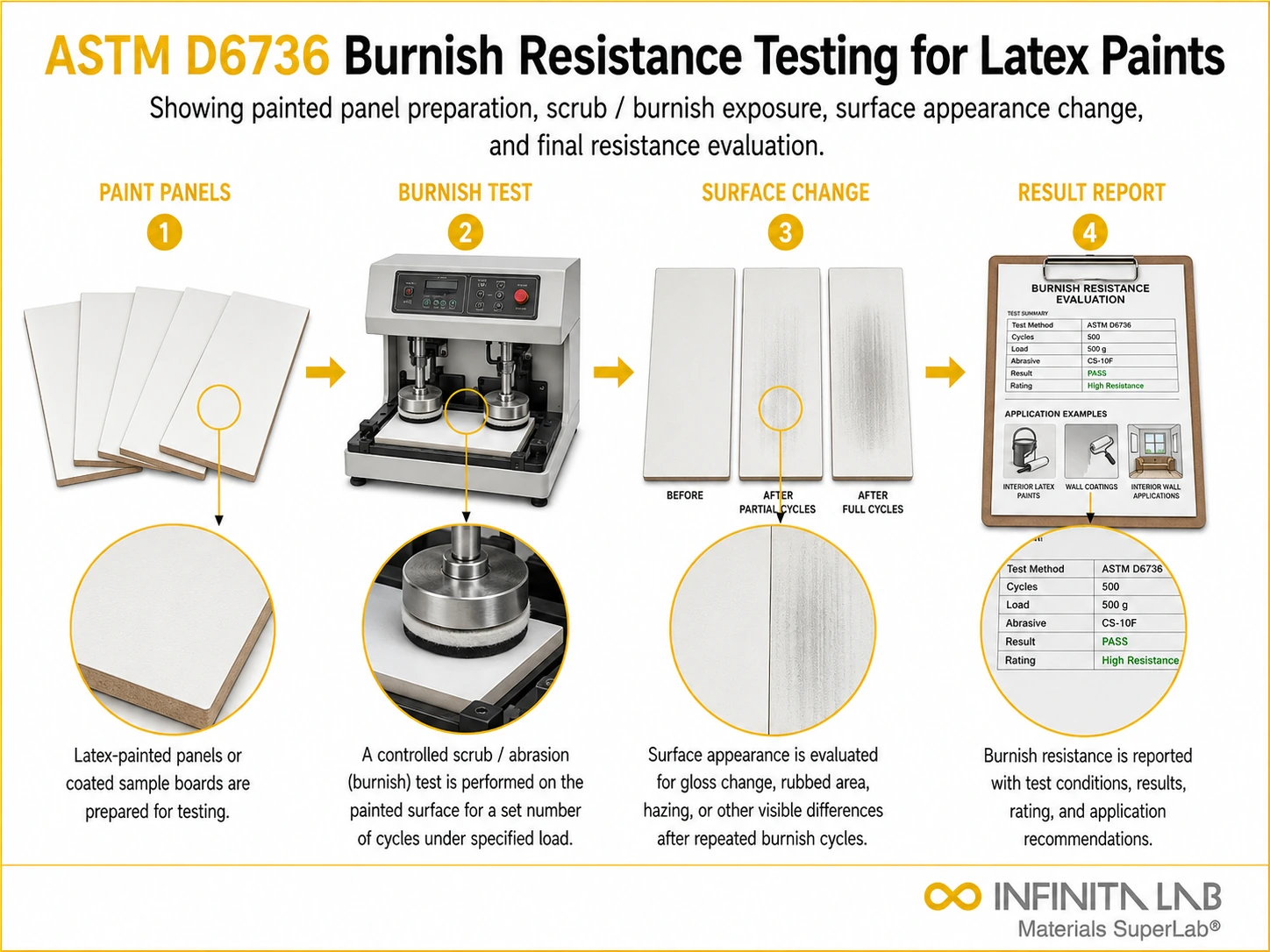
Our ASTM D6736 Testing Procedure
Panel Preparation
Latex paint is applied at specified wet film thickness to a standard substrate and allowed to cure under controlled conditions.
1Initial Gloss Measurement
Gloss of the cured paint film is measured at 60° and 85° geometry using a calibrated glossmeter before rubbing.
2Mechanical Rubbing
The cured panel is scrubbed with a standard abrasive pad under set load and strokes in a washability tester.
3Post-Rub Gloss Measurement
Gloss is re-measured in the rubbed area; burnish value is calculated as the gloss increase (ΔGloss) compared to the unrubbed area.
4ASTM D6736 Test Parameters and Requirements
| Parameter | Details |
|---|---|
| Standard | ASTM D6736 |
| Applicable Materials | Interior latex paint films (flat, eggshell, low-sheen) |
| Measurement | Specular gloss at 60° and 85° |
| Rubbing Apparatus | Washability scrub machine with defined pad and load |
| Burnish Index | ΔGloss units (rubbed minus unrubbed) |


- Calibrated specular glossmeter (60° and 85° geometry)
- Washability/scrub machine with defined stroke and load parameters
- Standard abrasive or burnishing pad
- Film applicator (bird applicator or drawdown bar)
- Standard test substrate panels
- Conditioning chamber for paint film cure
Equipment and Instrumentation Used for ASTM D6736 Testing
What You Receive: Test Report, Data, and Certification
- Initial gloss (60° and 85°) values
- Post-rub gloss values in burnished area
- Burnish index (ΔGloss)
- Comparative burnish resistance ranking of formulations
- Quality control and product development documentation
ASTM D6736 Latex Paint Burnish Resistance FAQs
Burnishing occurs when mechanical rubbing compresses and partially smooths the microscopic surface texture of a flat paint film, locally increasing specular reflectance and making the rubbed area appear glossier than surrounding areas.
In high-traffic areas where walls are frequently touched, wiped, or rubbed, burnishing creates visible glossy marks that compromise the uniform appearance of flat and matte finish paints.
Both 60° and 85° (near-grazing) angles are used. The 85° measurement is particularly sensitive to texture and surface roughness changes and is more representative of the visual burnish effect as seen from typical viewing angles.
Optimizing pigment volume concentration (PVC), selecting appropriate binders, using flatting agents, and incorporating specific matting pigments can improve burnish resistance while maintaining low sheen appearance.
No. Scrub resistance measures how well a paint withstands film erosion or removal under wet abrasion, while burnish resistance measures resistance to gloss increase under dry or semi-dry rubbing. Both are important performance attributes for interior paints.
Why Choose Infinita Lab for Latex Paint Burnish Resistance Testing
At the core of this breadth is our network of 2,000+ accredited laboratories across the USA, offering access to over 10,000 testing methods and analytical services. From advanced materials characterization (SEM, TEM, RBS, XPS) to mechanical, chemical, environmental, biological, and standardized ASTM/ISO-compliant testing, we deliver unmatched flexibility, specialization, and scale. You are never limited by geography, facility, or methodology — Infinita Lab connects you to the right expertise and testing solution, every time.

Looking for an Accredited Partner for ASTM D6736 Latex Paint Burnish Resistance Testing?
Send query us at hello@infinitalab.com or call us at (888) 878-3090 to learn more about our services and how we can support you.



Request a Quote
Submit your material details and receive testing procedures, pricing, and turnaround time within 24 hours.
 Quick Turnaround and Hasslefree process
 Confidentiality Guarantee
 Free, No-obligation Consultation
 100% Customer Satisfaction
