


ASTM D6646 Hydrogen Sulfide Breakthrough Capacity Testing for Activated Carbon
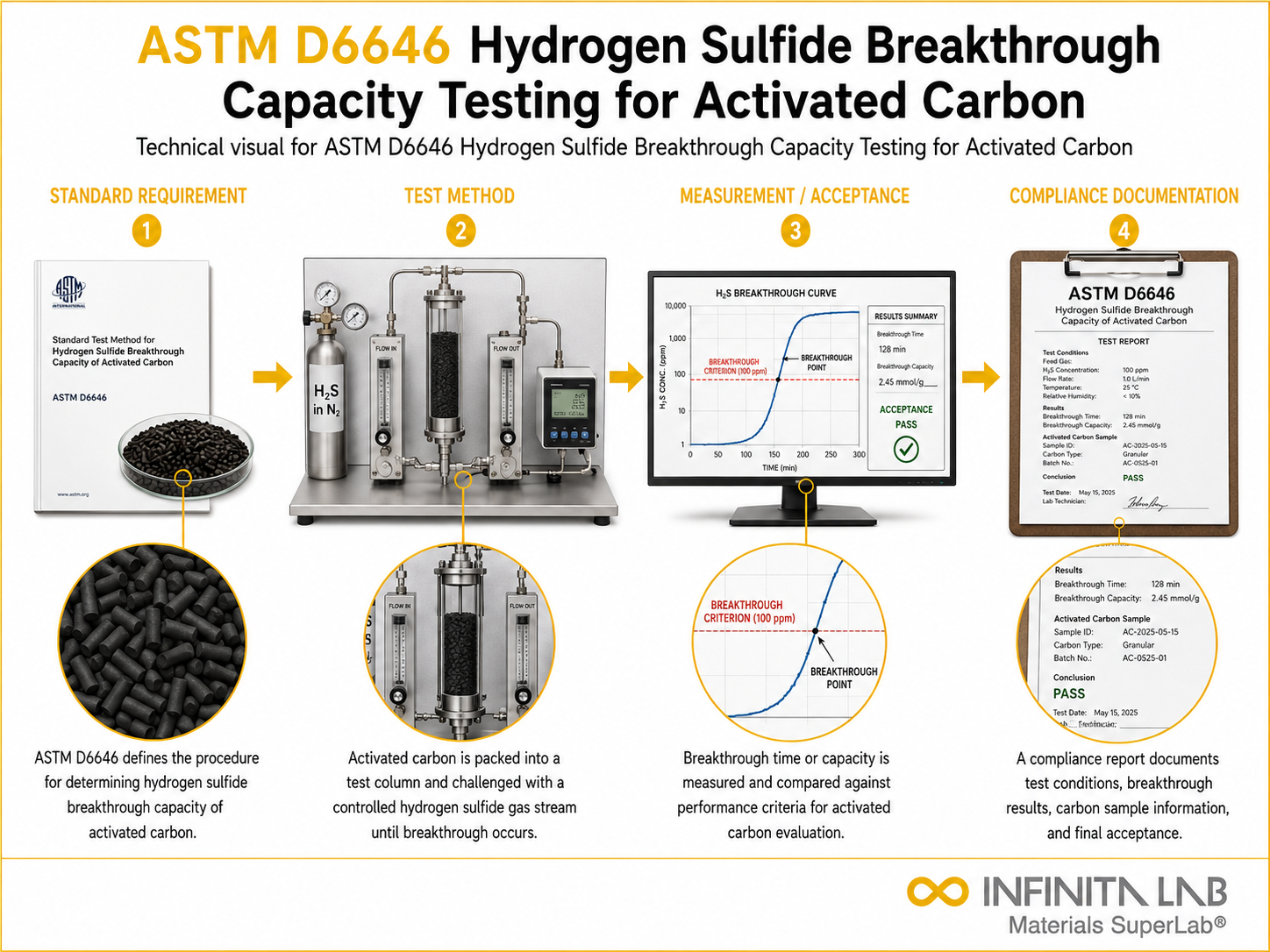
ASTM D6646 is a standard method for assessing the efficacy of granular or pelletized activated carbon in eliminating hydrogen sulfide from an airstream. The evaluation involves passing a moistened airstream containing hydrogen sulfide through a bed of activated carbon until there is a detection of a 50 ppm H2S breakthrough. This method is utilized to measure the performance of activated carbon in removing hydrogen sulfide from an air stream.
TRUSTED BY


Precision-driven testing for dimensional accuracy and compliance
- Overview
- Scope, Applications, and Benefits
- Test Process
- Specifications
- Instrumentation
- Results and Deliverables
Overview
ASTM D6646 is a standard test method for determining the hydrogen sulfide (H₂S) breakthrough capacity of granular and pelletized activated carbon. This method measures the amount of H₂S that a carbon bed can remove from a gas stream before breakthrough—the point at which H₂S begins to pass through the bed at unacceptable concentrations.
Activated carbon is widely used for H₂S removal in air purification, odor control, biogas treatment, and industrial gas processing. This test is critical for sizing carbon beds, comparing sorbent products, and ensuring compliance with emission and odor control standards.

Scope, Applications, and Benefits
Scope
ASTM D6646 evaluates:
- H₂S breakthrough capacity (mg H₂S per gram of carbon)
- Breakthrough time under controlled test conditions
- Performance comparison of different activated carbon grades
- Effect of moisture, temperature, and impregnation on capacity
Applications
- Air pollution control and odor treatment systems
- Biogas and landfill gas H₂S removal
- Industrial gas purification processes
- Wastewater treatment facility odor control
- Natural gas conditioning and sweetening
Benefits
- Enables accurate sizing of H₂S adsorption systems
- Provides standardized comparison between carbon products
- Supports procurement and supplier qualification
- Predicts carbon service life in real-world applications
- Assists in process design and operational optimization
Test Process
Carbon Bed Preparation
A measured mass of activated carbon is packed into a test column at specified bed dimensions and conditioned per the test protocol.
1Gas Flow Initiation
A calibrated H₂S/air stream at controlled concentration, flow, humidity, and temperature is passed through the carbon bed.
2Breakthrough Monitoring
The effluent gas is continuously monitored until the H₂S concentration reaches the specified breakthrough level.
3Capacity Calculation
H₂S breakthrough capacity is calculated from the mass of H₂S adsorbed up to breakthrough, normalized to the mass of carbon used.
4Technical Specifications
| Parameter | Details |
|---|---|
| Standard | ASTM D6646 |
| Test Principle | Fixed-bed adsorption with continuous effluent monitoring |
| Applicable Materials | Granular and pelletized activated carbon |
| Measured Output | H₂S breakthrough capacity (mg/g carbon) |
| Challenge Gas | H₂S in air at specified concentration |
| Breakthrough Definition | Specified outlet H₂S concentration |


Instrumentation Used for Testing
- Fixed-bed test column (specified dimensions)
- Certified H₂S/air calibration gas cylinders
- Mass flow controllers for gas delivery
- H₂S analyzer (electrochemical or UV/IR detection)
- Temperature and humidity measurement instruments
- Data logging system
Results and Deliverables
- H₂S breakthrough capacity (mg H₂S/g carbon)
- Breakthrough curve (effluent H₂S concentration vs. time)
- Bed service life estimate under test conditions
- Comparative carbon performance data
- System design and sizing support data
Frequently Asked Questions
Breakthrough is the point at which H₂S begins to exit the carbon bed at a defined unacceptable concentration, indicating that the carbon's adsorption capacity has been substantially consumed.
Yes, moisture significantly affects H₂S removal. Impregnated carbons often require a minimum moisture level to catalyze H₂S oxidation, while excess moisture can reduce capacity in physisorption-based carbons.
Impregnated activated carbons—particularly those treated with caustic (KOH or NaOH) or potassium iodide—generally offer much higher H₂S capacity than untreated carbons.
The test uses controlled H₂S concentration, humidity, flow rate, and temperature to simulate conditions encountered in actual air treatment applications, though real installations may vary.
Yes. By scaling laboratory breakthrough capacity data to actual system flow rates, concentrations, and carbon volumes, engineers can estimate the carbon service life and replacement frequency in full-scale systems.
Why Choose Infinita Lab for Advanced Materials Testing and Characterization?
At the core of this breadth is our network of 2,000+ accredited laboratories across the USA, offering access to over 10,000 testing methods and analytical services. From advanced materials characterization (SEM, TEM, RBS, XPS) to mechanical, chemical, environmental, biological, and standardized ASTM/ISO-compliant testing, we deliver unmatched flexibility, specialization, and scale. You are never limited by geography, facility, or methodology — Infinita Lab connects you to the right expertise and testing solution, every time.

Looking for a Trusted Partner for Accurate and Reliable Testing Services?
Send query us at hello@infinitlab.com or call us at (888) 878-3090 to learn more about our services and how we can support you.



Request a Quote
Submit your material details and receive testing procedures, pricing, and turnaround time within 24 hours.
 Quick Turnaround and Hasslefree process
 Confidentiality Guarantee
 Free, No-obligation Consultation
 100% Customer Satisfaction
