

What Is ASTM D6645 Polyethylene Methyl Comonomer IR?
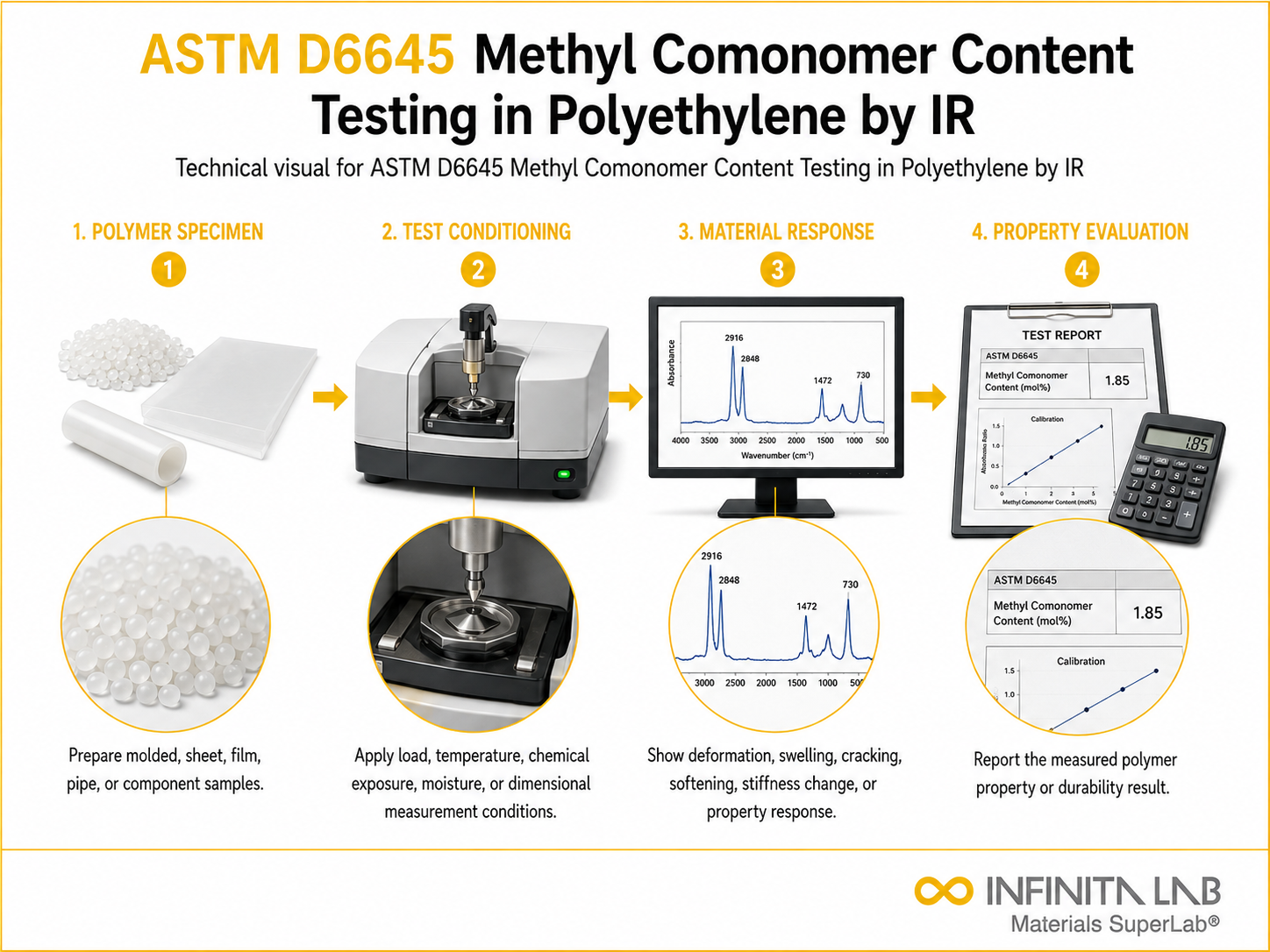
ASTM D6645 is a standard test method for determining the methyl comonomer content in polyethylene (PE) resins using infrared spectrophotometry. Comonomers such as 1-butene, 1-hexene, and 1-octene introduce short-chain branches into the polyethylene backbone, and the methyl group concentration is a direct measure of branching density.
Branching content significantly influences the mechanical, thermal, and processing properties of polyethylene, including density, crystallinity, impact resistance, and environmental stress crack resistance (ESCR). This method enables manufacturers and researchers to accurately characterize PE copolymers for quality control and product development.

Applications and Benefits of ASTM D6645 Polyethylene Methyl Comonomer IR Testing
Scope
ASTM D6645 evaluates:
- Methyl group concentration as a measure of short-chain branching
- Comonomer content in LLDPE, HDPE, MDPE, and VLDPE resins
- Relationship between branching and polymer structure
- Compliance with resin specifications for film, pipe, and molding grades
Applications
- Polyethylene film and packaging resin quality control
- Pipe and wire/cable grade PE characterization
- LLDPE and VLDPE product development
- Catalyst and polymerization process research
- Raw material qualification for converters
Benefits
- Rapid and non-destructive sample analysis
- Directly correlates with key PE performance properties
- Supports precise resin specification compliance
- Enables comparison of resins from different producers
- Complements other PE characterization techniques (DSC, GPC)
Our ASTM D6645 Testing Procedure
Film Specimen Preparation
Polyethylene resin is compression-molded into a film of specified thickness for infrared analysis.
1Baseline Spectrum Acquisition
A reference (blank) spectrum is recorded to establish the baseline for absorption measurements.
2Infrared Analysis
The PE film is analyzed by IR spectroscopy, measuring absorbance at ~1378 cm⁻¹ relative to a reference band.
3Comonomer Content Calculation
Methyl group content (per 1000 carbon atoms) is calculated from the absorbance ratio using calibration data and reported.
4ASTM D6645 Test Parameters and Requirements
| Parameter | Details |
|---|---|
| Standard | ASTM D6645 |
| Applicable Materials | Polyethylene homopolymers and copolymers |
| Measured Output | Methyl groups per 1000 carbon atoms |
| Key Absorption Band | ~1378 cm⁻¹ (methyl C–H deformation) |
| Film Thickness | As specified for accurate absorbance |


- Fourier transform infrared (FTIR) spectrometer
- Compression molding press with heated platens
- Film thickness gauge (micrometer)
- Calibration standards for methyl content
- Spectral data analysis software
Equipment and Instrumentation Used for ASTM D6645 Testing
What You Receive: Test Report, Data, and Certification
- Methyl group content (per 1000 carbon atoms)
- Infrared spectra with peak assignments
- Comonomer content estimate for known comonomer types
- Comparison against resin specification limits
- Quality control and product certification reports
ASTM D6645 Polyethylene Methyl Comonomer IR FAQs
Methyl groups from short-chain branching disrupt crystallinity and affect density, flexibility, toughness, and ESCR. Controlling comonomer content is key to meeting end-use performance specifications.
The method measures methyl groups regardless of their origin, detecting branching from comonomers such as 1-butene (1 methyl/branch), 1-hexene (1 methyl/branch), and propylene, but cannot distinguish between comonomer types.
Yes, FTIR spectrophotometry is sensitive enough to measure the low methyl content present in HDPE, though precision is lower at very low comonomer levels.
Specimens are compression-molded to a defined thickness and measured with a micrometer. Absorbance values are normalized to film thickness to ensure accurate and comparable results.
Differential scanning calorimetry (DSC) for crystallinity, gel permeation chromatography (GPC) for molecular weight distribution, and C-13 NMR for detailed comonomer sequence analysis are common complementary methods.
Why Choose Infinita Lab for Polyethylene Methyl Comonomer IR Testing?
At the core of this breadth is our network of 2,000+ accredited laboratories across the USA, offering access to over 10,000 testing methods and analytical services. From advanced materials characterization (SEM, TEM, RBS, XPS) to mechanical, chemical, environmental, biological, and standardized ASTM/ISO-compliant testing, we deliver unmatched flexibility, specialization, and scale. You are never limited by geography, facility, or methodology — Infinita Lab connects you to the right expertise and testing solution, every time.

Looking for an Accredited Partner for ASTM D6645 Polyethylene Methyl Comonomer IR Testing?
Send query us at hello@infinitalab.com or call us at (888) 878-3090 to learn more about our services and how we can support you.





