


ASTM D6395: Flatwise Flexural Impact Testing Services
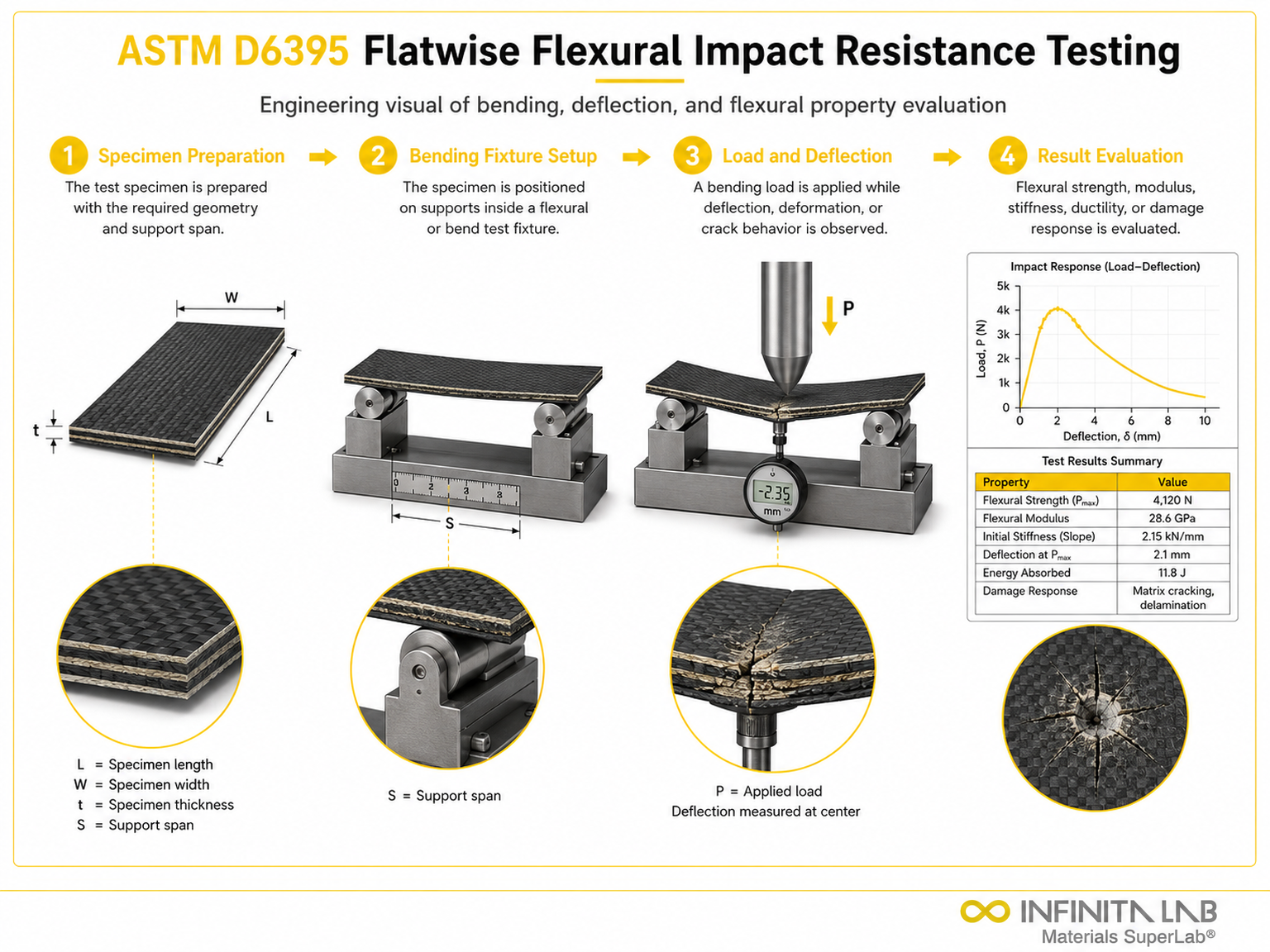
ASTM D6395 is used to determine the resistance of rigid plastic specimens to breakage or permanent deformation by flexural shock. One end of the specimen is subjected to impact on its wide face side and the other end is firmly clamped.
TRUSTED BY


Get ASTM D6395 compliant results — request your flatwise flexural impact testing quote
- Overview
- Scope, Applications, and Benefits
- Test Process
- Specifications
- Instrumentation
- Results and Deliverables
What Is ASTM D6395 Flatwise Flexural Impact?
ASTM D6395 is a standardized test method that determines the relative impact resistance of rigid plastic materials under flexural shock. This test method measures a material’s ability to resist sudden bending loads that may cause fracture or deformation.
This technique is invaluable for comparing multiple samples of similar thickness to determine changes resulting from treatments such as weathering. It is a good indicator of brittle surface development.

Applications and Benefits of ASTM D6395 Flatwise Flexural Impact Testing
Scope
ASTM D6395 evaluates:
- Flexural impact resistance of rigid plastics
- Effect of surface cracks and brittleness
- Changes in impact strength after environmental exposure
- Relative performance of similar thickness samples
- Fracture behavior (brittle vs ductile)
- Resistance to permanent deformation
The method primarily applies to non-elastomeric and rigid plastic materials in which fracture or yielding occurs during flexural impact.
Applications
- Plastic material qualification
- Automotive interior and exterior components
- Electrical enclosures
- Consumer products
- Building and construction plastics
- Research and development
- Quality control testing
- Weathering and aging studies
Benefits
- Quantitative measurement of impact resistance
- Detects brittle surface formation
- Sensitive to microcrack development
- Enables performance comparison
- Supports material selection
- Evaluates the effects of environmental degradation effects
- Standardized and repeatable method
Our ASTM D6395 Testing Procedure
Specimen Preparation
Specimens are prepared with a milled notch and controlled thickness.
1Mounting & Pendulum Impact
Specimens are secured and struck with a calibrated pendulum hammer.
2Fracture Observation & Energy Measurement
Fracture mode is observed, and absorbed energy is recorded.
3Data Calculation
Impact strength is calculated per unit width or cross-sectional area.
4ASTM D6395 Test Parameters and Requirements
| Parameter | Details |
|---|---|
| Applicable Materials | Rigid plastics, non-elastomers |
| Specimen Thickness | 1.6 mm (standard) |
| Thickness Ratio Requirement | Clamp distance to thickness = 2.5 ± 0.1 |
| Specimen Type | Notched specimen |
| Impact Mode | Single pendulum swing |


- Pendulum impact tester
- Calibrated impact hammers
- Specimen clamping fixture
- Notching machine
- Thickness gauge
- Data recording system
Equipment and Instrumentation Used for ASTM D6395 Testing
What You Receive: Test Report, Data, and Certification
- Energy absorbed per unit width
- Impact strength values
- Fracture behaviour classification
- Comparative performance reports
- Quality control documentation
- Material durability assessment
ASTM D6395 Flatwise Flexural Impact FAQs
ASTM D6395 determines the relative resistance of rigid plastics to breakage or permanent deformation from flexural impact. A pendulum strikes the wide face of a clamped plastic strip, and the energy absorbed during impact is measured.
The method is intended primarily for rigid, non-elastomeric plastics that can fracture, yield, or undergo permanent deformation under impact. It is generally not suitable for flexible plastics or elastomers that do not exhibit these responses.
One end of the specimen is firmly clamped while a pendulum strikes its wide face. The kinetic energy lost by the pendulum is used to determine the energy required to break or deform the specimen, with impact resistance calculated relative to the specimen cross-sectional area.
The method is particularly useful for comparing changes in impact performance after weathering or other environmental exposure. It can be sensitive to surface cracking and the development of brittle surface layers that reduce impact resistance.
Results can be influenced by specimen thickness, dimensions, orientation, molding stresses, conditioning, and surface condition. The method is primarily intended for comparing samples of approximately the same thickness, so consistent specimen preparation and conditioning are important.
Why Choose Infinita Lab for Flatwise Flexural Impact Testing?
At the core of this breadth is our network of 2,000+ accredited laboratories across the USA, offering access to over 10,000 testing methods and analytical services. From advanced materials characterization (SEM, TEM, RBS, XPS) to mechanical, chemical, environmental, biological, and standardized ASTM/ISO-compliant testing, we deliver unmatched flexibility, specialization, and scale. You are never limited by geography, facility, or methodology — Infinita Lab connects you to the right expertise and testing solution, every time.

Need ASTM D6395 Flatwise Flexural Impact Testing You Can Rely On?
Send query us at hello@infinitalab.com or call us at (888) 878-3090 to learn more about our services and how we can support you.



Request a Quote
Submit your material details and receive testing procedures, pricing, and turnaround time within 24 hours.
 Quick Turnaround and Hasslefree process
 Confidentiality Guarantee
 Free, No-obligation Consultation
 100% Customer Satisfaction
