


ASTM D1929: Ignition Temperature Plastics Testing Services
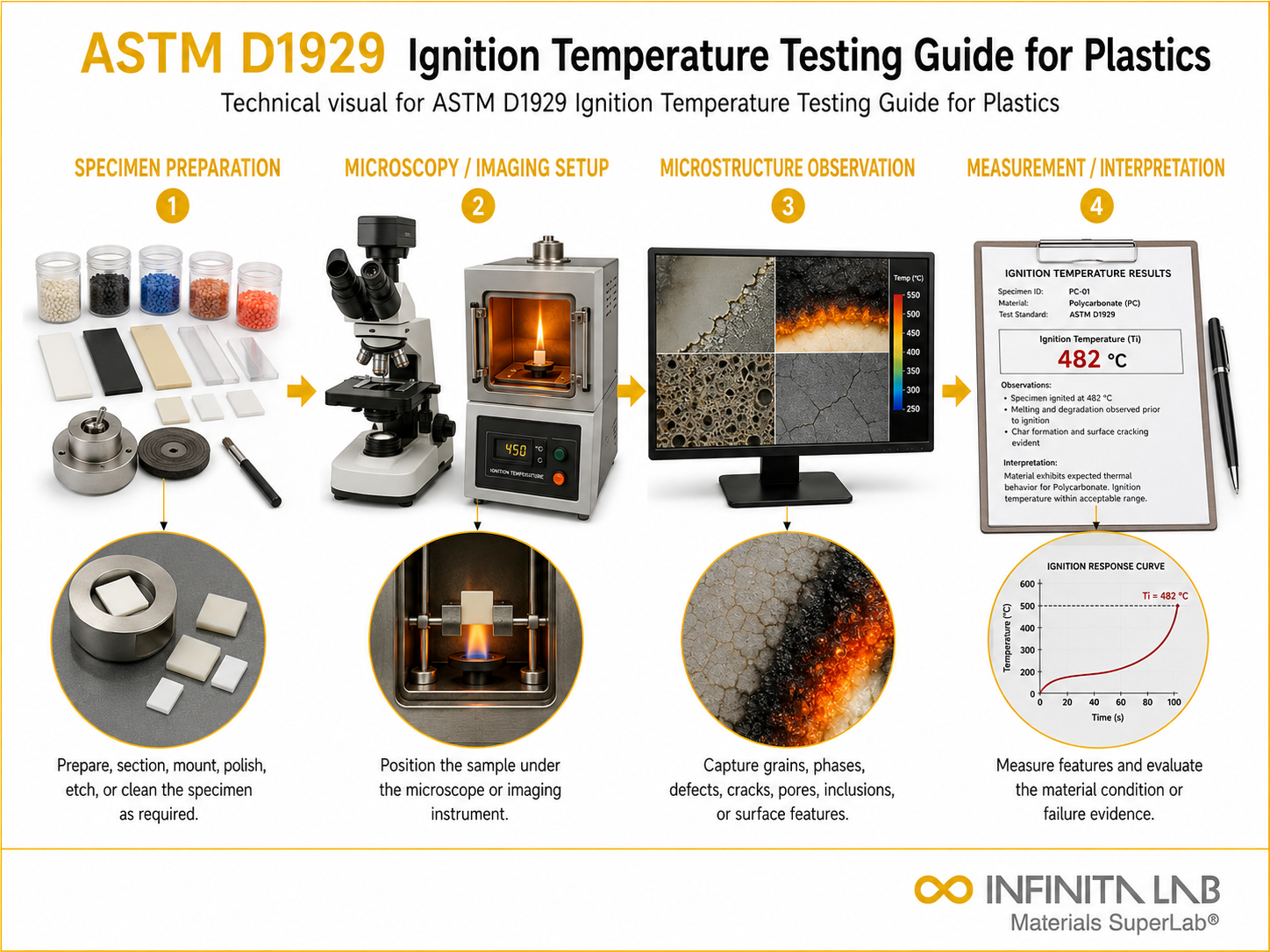
ASTM D1929 is a standard test method for determining the ignition temperature of plastics. This test method is used to evaluate the fire hazard of plastics by measuring the temperature at which they ignite when exposed to a heat source under controlled laboratory conditions.
TRUSTED BY


Get ASTM D1929 compliant results — request your ignition temperature plastics testing quote
- Overview
- Scope, Applications, and Benefits
- Test Process
- Specifications
- Instrumentation
- Results and Deliverables
What Is ASTM D1929 Ignition Temperature Plastics?
ASTM D1921 establishes a standardised method for determining the particle size distribution of plastic materials in granular or powdered form using sieve analysis. Understanding particle size is fundamental to predicting how a plastic material will process, flow, and perform in end-use applications.
The test involves passing a sample of plastic material through a series of calibrated sieves with progressively smaller openings. The weight retained on each sieve is measured and expressed as a percentage of the total sample weight. This data is used to generate a particle size distribution profile, which helps manufacturers maintain consistency in raw materials and finished products. ASTM D1921 provides two procedures: Procedure A for coarse particles and Procedure B for fine particles, making it applicable across a wide range of granule sizes used in plastic processing.

Applications and Benefits of ASTM D1929 Ignition Temperature Plastics Testing
Scope
ASTM D1921 evaluates the particle-size distribution of plastic granules and powders to assess the uniformity, consistency, and quality of raw materials. The test uses a standardised sieve analysis method to measure how the material is distributed across different particle size intervals. It helps quantify the percentage of material retained on each sieve, enabling manufacturers and quality control teams to verify whether the supplied material conforms to purchase specifications and processing requirements.
ASTM D1921 evaluates:
- Particle size distribution of plastic granules and powders
- Percentage of material retained at each sieve interval
- Uniformity and consistency of plastic raw materials
- Conformance of received materials to purchase specifications
- Fine particle content (dust) in granular materials
- Oversized particle content in powdered materials
Applications
- Plastic resin quality control
- Raw material incoming inspection
- Powder coating materials
- Rotational molding feedstocks
- Compounding and blending operations
- Recycled plastic material characterization
- Research and development
Benefits
- Ensures raw material consistency
- Supports process optimisation
- Reduces molding defects caused by non-uniform particle size
- Enables supplier qualification
- Provides compliance documentation
- Improves flow and packing characteristics in processing
Our ASTM D1929 Testing Procedure
Sample Preparation
A representative sample is dried and weighed to the specified mass.
1Sieve Stack Assembly
Sieves are arranged from largest to smallest opening and placed on a mechanical shaker.
2Sieving
The sample is placed on the top sieve and shaken for the prescribed duration.
3Weighing & Calculation
Material retained on each sieve is weighed, and percent retained/passing is calculated.
4ASTM D1929 Test Parameters and Requirements
| Parameter | Details |
|---|---|
| Test Principle | Mechanical sieve separation |
| Procedures | Procedure A (coarse), Procedure B (fine) |
| Applicable Materials | Plastic granules and powders |
| Output Units | % retained by weight per sieve fraction |
| Measured Outputs | Particle size distribution, percent fines, percent oversize |


- Calibrated wire-cloth test sieves
- Mechanical sieve shaker
- Analytical balance
- Drying oven
- Sample splitter/divider
- Data recording software
Equipment and Instrumentation Used for ASTM D1929 Testing
What You Receive: Test Report, Data, and Certification
- Particle size distribution table and curve
- Percent retained and percent passing values
- Oversized and fine content data
- Compliance documentation
- Quality assurance reports
- Comparative analysis against specification limits
ASTM D1929 Ignition Temperature Plastics FAQs
ASTM D1921 is a standard test method used to determine the particle size distribution of plastic materials in powdered, granular, or pelleted form using dry sieve analysis. It helps assess raw material uniformity and consistency.
This test is suitable for plastic powders, granules, pellets, and similar particulate polymer materials commonly supplied as raw materials for manufacturing and compounding processes.
Particle size directly affects flowability, feeding behaviour, blending efficiency, melting consistency, and processing performance during molding, extrusion, and compounding operations.
Since the method uses dry sieving, the lower limit is approximately 38 µm (No. 400 sieve). For particles smaller than this, sedimentation-based methods are generally recommended.
A known dry mass of material is placed on a stack of standard sieves arranged from coarse to fine. The stack is mechanically shaken, and the mass retained on each sieve is measured and reported as a percentage.
Why Choose Infinita Lab for Ignition Temperature Plastics Testing
At the core of this breadth is our network of 2,000+ accredited laboratories across the USA, offering access to over 10,000 testing methods and analytical services. From advanced materials characterization (SEM, TEM, RBS, XPS) to mechanical, chemical, environmental, biological, and standardized ASTM/ISO-compliant testing, we deliver unmatched flexibility, specialization, and scale. You are never limited by geography, facility, or methodology — Infinita Lab connects you to the right expertise and testing solution, every time.

Need ASTM D1929 Ignition Temperature Plastics Testing You Can Rely On?
Send query us at hello@infinitalab.com or call us at (888) 878-3090 to learn more about our services and how we can support you.



Request a Quote
Submit your material details and receive testing procedures, pricing, and turnaround time within 24 hours.
 Quick Turnaround and Hasslefree process
 Confidentiality Guarantee
 Free, No-obligation Consultation
 100% Customer Satisfaction
