

What Is ASTM C1070 Alumina Particle Size Laser Scattering?
ASTM C1070 specifies a standardized method for determining the particle size distribution of alumina powders using laser light scattering techniques. The method analyzes how particles scatter light to calculate size distribution, providing accurate and reproducible results for fine powders used in advanced industrial applications.
This standard is widely used in ceramics, electronics, and materials science industries where alumina powder characteristics directly influence processing behavior and final product performance. ASTM C1070 ensures precise measurement, enabling manufacturers to maintain quality control and optimize material properties.

Applications and Benefits of ASTM C1070 Alumina Particle Size Laser Scattering Testing
Scope
ASTM C1070 covers the determination of particle size distribution of alumina powders using laser diffraction principles. It defines sample preparation, dispersion methods, instrument calibration, and data interpretation to ensure consistent and reliable results.
Includes:
- Laser light scattering measurement of alumina powders
- Sample dispersion and preparation techniques
- Instrument calibration and alignment
- Data acquisition and particle size analysis
- Quality control and repeatability requirements
Applications
- Ceramic manufacturing
- Electronic substrates and components
- Refractory materials
- Abrasives and polishing compounds
- Powder metallurgy processes
- Advanced material research
Benefits
- High accuracy for fine particle measurement
- Rapid and reproducible analysis
- Wide particle size measurement range
- Non-destructive testing method
- Supports quality control and process optimization
- Reduces variability in powder processing
Our ASTM C1070 Testing Procedure
Sample Preparation
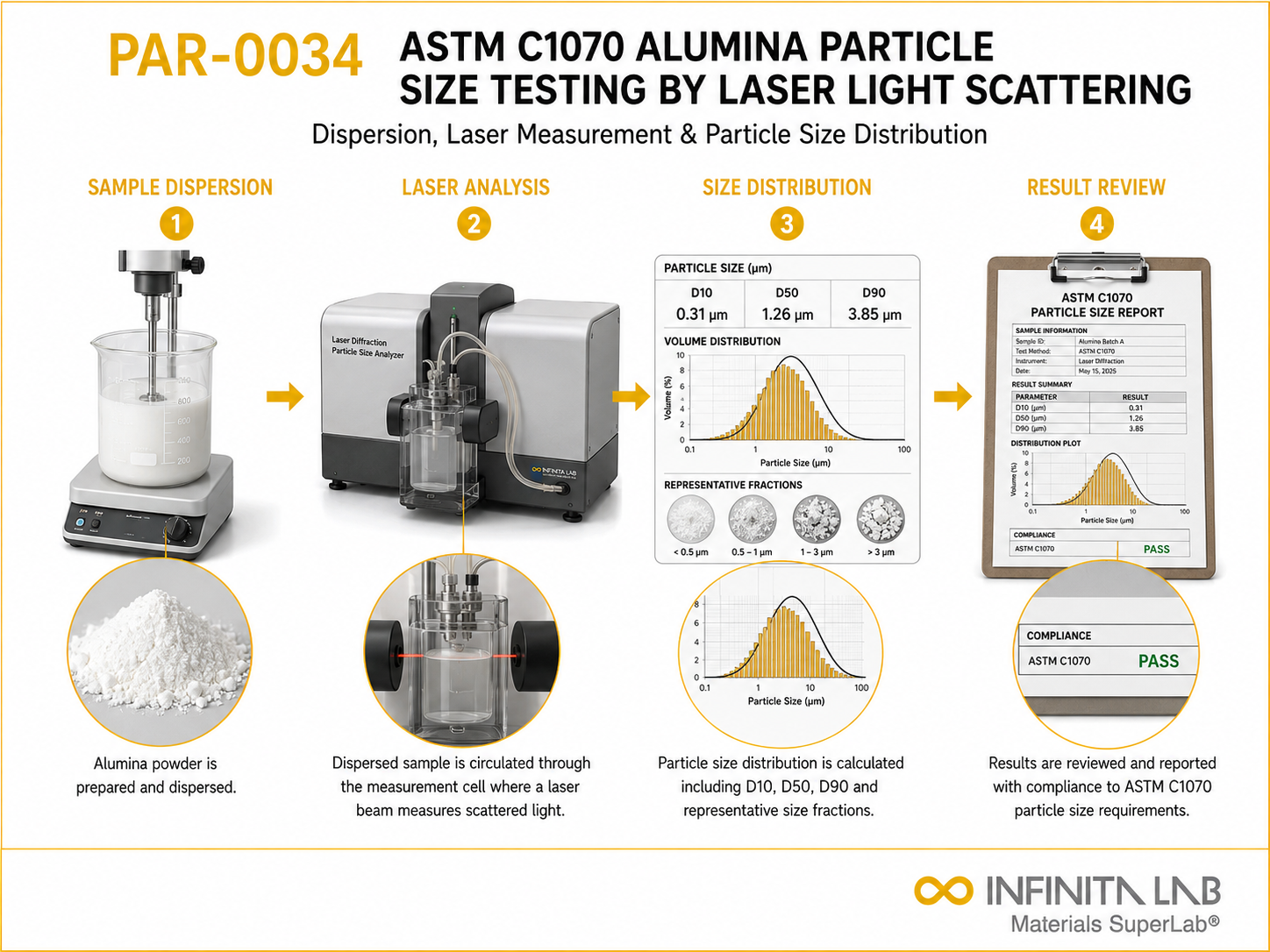
Alumina powder is dispersed in a suitable medium to prevent agglomeration and ensure uniform particle distribution.
1Instrument Setup
Laser diffraction equipment is calibrated and configured according to standard parameters.
2Measurement Process
Laser light is passed through the dispersed sample and scattering patterns are recorded for analysis.
3Data Analysis
Particle size distribution is calculated using scattering data and reported in standard formats.
4ASTM C1070 Test Parameters and Requirements
| Parameter | Details |
|---|---|
| Material Type | Alumina powders |
| Test Method | Laser light scattering (laser diffraction) |
| Particle Size Range | Typically sub-micron to several hundred microns |
| Measurement Principle | Light scattering intensity versus particle size |
| Dispersion Medium | Liquid or dry dispersion depending on sample |
| Data Output | Particle size distribution curves and statistics (D10, D50, D90) |


- Laser diffraction particle size analyzer
- Ultrasonic disperser
- Sample dispersion unit
- Computer with analysis software
- Calibration standards
- Stirring equipment
Equipment and Instrumentation Used for ASTM C1070 Testing
What You Receive: Test Report, Data, and Certification
- Particle size distribution report
- Graphical size distribution curves
- Statistical values (D10, D50, D90)
- Measurement conditions and parameters
- Compliance evaluation report
- Test summary and certification
ASTM C1070 Alumina Particle Size Laser Scattering FAQs
Laser diffraction estimates particle size distributions by measuring the angular change in the intensity of light scattered when a laser beam travels through a dispersed particulate sample. In relation to the laser beam, large particles scatter light at small angles, and microscopic particles scatter light at large angles.
Particle size distribution affects flowability, packing density, sintering behavior, and final product quality, making it essential for controlling manufacturing processes and achieving desired material properties.
Smaller particles scatter light of shorter wavelengths, such as blue light. Larger particles scatter longer wavelength light, like red light. If the scattering particles are large enough, the dispersed light appears white.
Mie scattering, substantially more potent than Rayleigh scattering, is a possible source of interference for this weaker light scattering mechanism.
D50 represents the median particle size, meaning 50 percent of the particles are smaller than this value, providing a key indicator of the overall particle size distribution
The method assumes spherical particle shapes and may require careful interpretation for irregular particles, as shape can influence scattering behavior and measurement accuracy.
Why Choose Infinita Lab for Alumina Particle Size Laser Scattering Testing?
At the core of this breadth is our network of 2,000+ accredited laboratories across the USA, offering access to over 10,000 testing methods and analytical services. From advanced materials characterization (SEM, TEM, RBS, XPS) to mechanical, chemical, environmental, biological, and standardized ASTM/ISO-compliant testing, we deliver unmatched flexibility, specialization, and scale. You are never limited by geography, facility, or methodology — Infinita Lab connects you to the right expertise and testing solution, every time.

Looking for an Accredited Partner for ASTM C1070 Alumina Particle Size Laser Scattering Testing?
Send query us at hello@infinitalab.com or call us at (888) 878-3090 to learn more about our services and how we can support you.





