


ASTM D746 Brittleness Temperature Testing for Plastics & Rubber
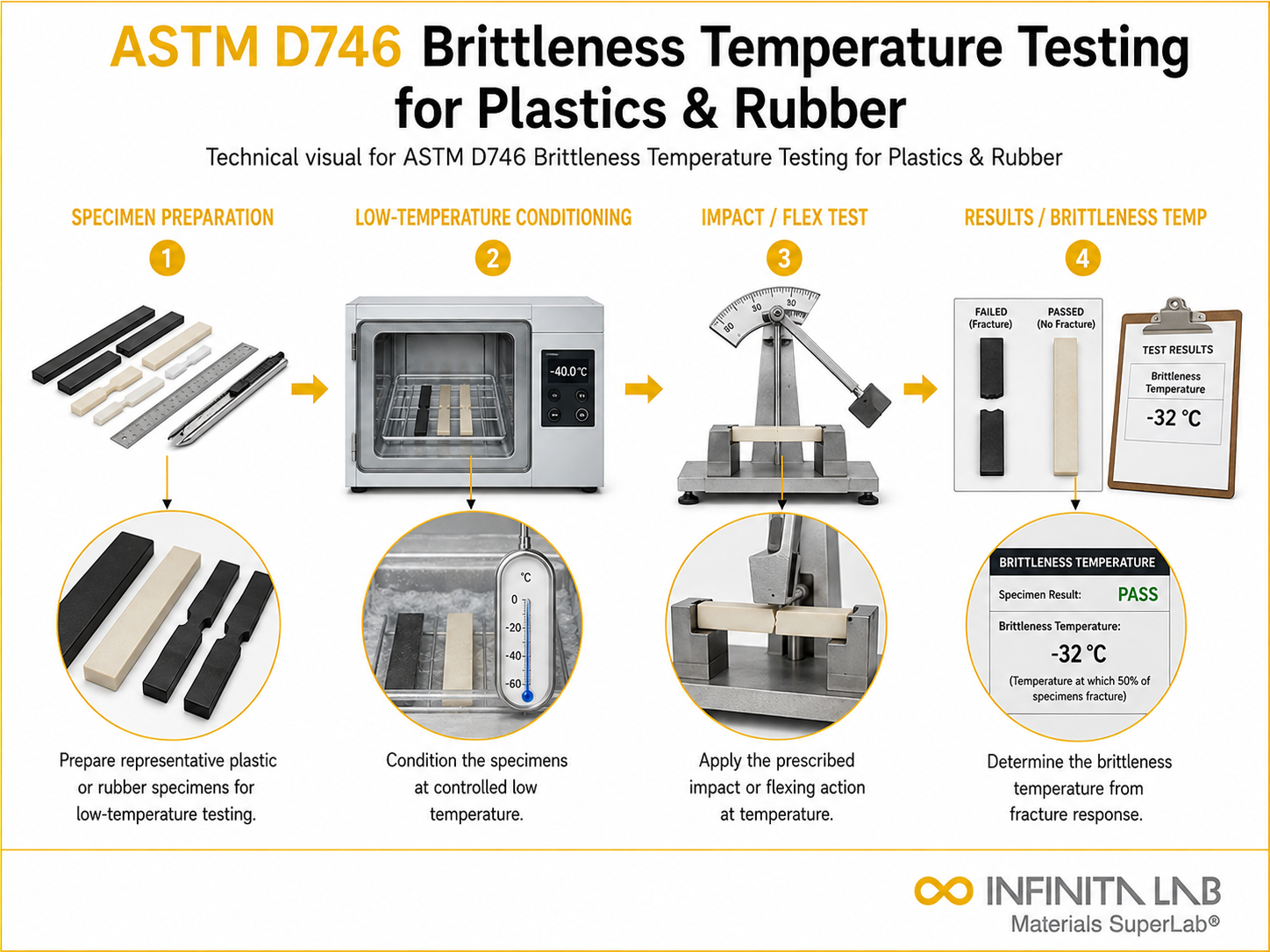
Determination of Brittleness Temperature of Plastics and Elastomers by Impact using ASTM D746, ISO 974 test method. The temperature at which half of the test specimens show brittle failure under specified conditions of impact is known as brittleness temperature.
TRUSTED BY


Precision-driven testing for dimensional accuracy and compliance
- Overview
- Scope, Applications, and Benefits
- Test Process
- Specifications
- Instrumentation
- Results and Deliverables
Overview
ASTM D746 describes a standard test method for determining the brittleness temperature of plastics and elastomers—the lowest temperature at which a material can withstand a specified impact without fracturing. This is a critical low-temperature performance parameter for materials used in outdoor, refrigerated, or cold-climate applications.
Understanding brittleness temperature helps engineers select appropriate materials for applications where impact loads may occur at low temperatures, such as automotive seals, refrigerator gaskets, and outdoor electrical insulation components.

Scope, Applications, and Benefits
Scope
ASTM D746 covers the determination of:
- Brittleness temperature (T50) — the temperature at which 50% of specimens fail
- Low-temperature impact resistance of plastics and elastomers
- Pass/fail behavior at specified service temperatures
- Comparative low-temperature performance between material formulations
Applications
- Automotive rubber seals and weather strips
- Refrigeration and cryogenic equipment gaskets
- Outdoor electrical cable insulation and jacketing
- Cold-climate consumer and industrial products
- Quality control of rubber and plastic compounds
Benefits
- Directly predicts low-temperature performance in service
- Simple, rapid comparative test
- Applicable to both plastics and elastomers
- Supports material selection for cold environment applications
- Widely recognized specification requirement
Test Process
Specimen Preparation
Cut or die-punch specimens to standard dimensions (typically 1.0 mm × 6.3 mm × 31.8 mm) from the material.
1Temperature Conditioning
Immerse specimens in a temperature-controlled bath for at least 3 minutes to reach thermal equilibrium.
2Impact Testing
Strike conditioned specimens at controlled velocity and record fractures vs. survivors.
3Brittleness Temperature Calculation
Test at multiple temperatures; calculate T50 (the temperature at which 50% of specimens fail) using statistical interpolation.
4Technical Specifications
| Parameter | Details |
|---|---|
| Standard | ASTM D746 |
| Test Principle | Impact loading at low temperature |
| Applicable Materials | Plastics and elastomers |
| Specimen Dimensions | 1.0 mm × 6.3 mm × 31.8 mm (typical) |
| Conditioning Time | Minimum 3 minutes in temperature bath |
| Measured Output | Brittleness temperature (T50) |
| Impact Velocity | 2.0 ± 0.2 m/s |


Instrumentation Used for Testing
- Low-temperature brittleness tester with impact arm
- Temperature-controlled liquid bath (ethanol or methanol-based)
- Calibrated thermometer or thermocouple
- Die or punch for specimen cutting
- Micrometer for specimen thickness measurement
- Timer for conditioning duration control
Results and Deliverables
- Brittleness temperature (T50) value in °C
- Pass/fail data at specific service temperatures
- Statistical failure rate vs. temperature table
- Comparative brittleness temperature across formulations
- Low-temperature performance certification data
- Material qualification reports
Frequently Asked Questions
T50 is the temperature at which exactly 50% of tested specimens fracture under the specified impact conditions. It is determined by testing specimens at multiple temperatures and statistically interpolating the 50% failure temperature
Tg is a material property measured by thermal analysis indicating the onset of the glassy-to-rubbery transition. Brittleness temperature is an impact-based practical measure of the lowest service temperature without fracture under defined loading conditions. They are related but not
Ethanol or methanol-based heat transfer fluids are commonly used for low-temperature conditioning baths, as they remain liquid and have good heat transfer properties at temperatures down to approximately -100°C.
Yes, ASTM D746 is applicable to both rigid plastics and flexible elastomers. The method is particularly informative for elastomers and flexible materials where low-temperature flexibility is a performance-critical requirement.
A minimum of 10 specimens per temperature is recommended for statistical reliability. Testing at multiple temperatures spanning the expected brittleness range is necessary to accurately calculate T50.
Why Choose Infinita Lab for Advanced Materials Testing and Characterization?
At the core of this breadth is our network of 2,000+ accredited laboratories across the USA, offering access to over 10,000 testing methods and analytical services. From advanced materials characterization (SEM, TEM, RBS, XPS) to mechanical, chemical, environmental, biological, and standardized ASTM/ISO-compliant testing, we deliver unmatched flexibility, specialization, and scale. You are never limited by geography, facility, or methodology — Infinita Lab connects you to the right expertise and testing solution, every time.

Looking for a Trusted Partner for Accurate and Reliable Testing Services?
Send query us at hello@infinitlab.com or call us at (888) 878-3090 to learn more about our services and how we can support you.



Request a Quote
Submit your material details and receive testing procedures, pricing, and turnaround time within 24 hours.
 Quick Turnaround and Hasslefree process
 Confidentiality Guarantee
 Free, No-obligation Consultation
 100% Customer Satisfaction
