


Micro-Raman Spectroscopy Testing for Molecular Identification & Stress Analysis
Micro-Raman Spectroscopy Testing for precise molecular identification and stress analysis. Non-destructive technique for material characterization, phase identification, chemical composition, and residual stress evaluation across semiconductors, polymers, and advanced materials.
TRUSTED BY


Precision Testing Solutions for Accurate, Reliable, and Standards-Compliant Results
- Overview
- Scope, Applications, and Benefits
- Test Process
- Specifications
- Instrumentation
- Results and Deliverables
Micro-Raman Spectroscopy Overview
Micro-Raman Spectroscopy is a powerful analytical technique used to identify molecular composition, crystal structure, and chemical bonding at microscopic scales. It is based on inelastic scattering of monochromatic laser light, providing a unique spectral fingerprint for different materials.
This technique is widely used for characterization of solids, thin films, polymers, and biological samples. With high spatial resolution and minimal sample preparation, Micro-Raman enables precise analysis of heterogeneous materials, phase identification, and stress or strain evaluation, making it essential in research, quality control, and failure analysis.

Scope, Applications, and Benefits
Scope
Micro-Raman Spectroscopy involves detailed molecular and structural characterization of materials at micro-scale resolution, supporting advanced analytical and research applications.
- Applicable to solids, powders, thin films, and biological samples
- Identifies molecular structure and chemical composition
- Detects crystalline phases and polymorphs
- Measures stress, strain, and material defects
- Suitable for micro-scale and localized analysis
- Enables mapping of heterogeneous materials
- Requires minimal or no sample preparation
- Used in materials science, pharmaceuticals, and nanotechnology
- Supports non-destructive chemical analysis
Applications
- Material identification and phase analysis
- Polymer and composite characterization
- Semiconductor and thin film analysis
- Pharmaceutical and biological studies
- Stress and strain measurement in materials
Benefits
- Non-destructive and highly precise
- Minimal sample preparation required
- High spatial resolution analysis
- Provides molecular-level information
- Suitable for a wide range of materials
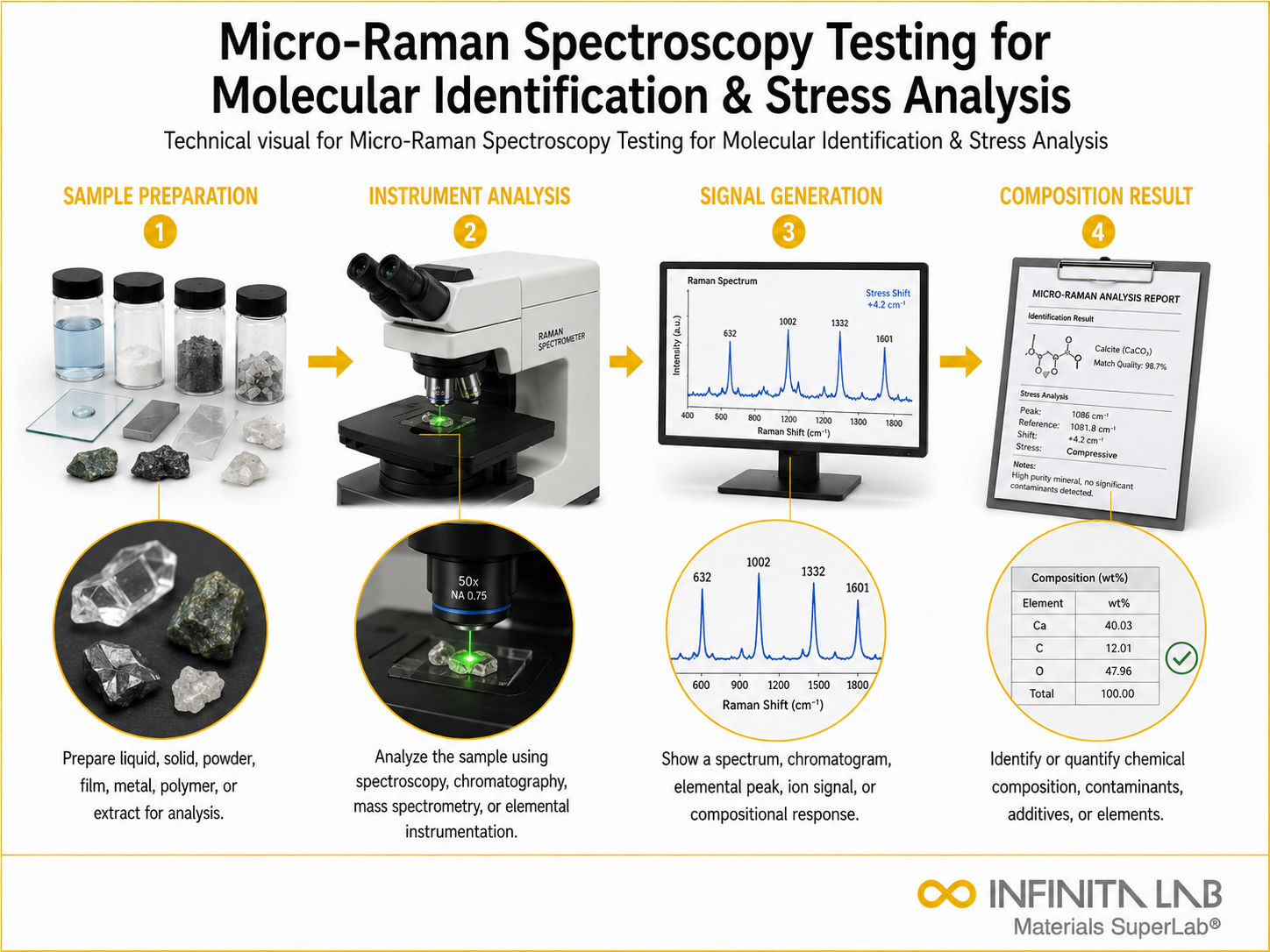
Micro-Raman Spectroscopy Process
Sample Preparation
Sample is placed on a microscope stage with minimal preparation to ensure proper laser interaction.
1Laser Excitation
A focused laser beam irradiates a micro-region of the sample to induce Raman scattering.
2Signal Collection
Scattered light is collected and filtered to isolate Raman signals from background noise.
3Spectral Analysis
Raman spectra are analyzed to identify molecular structure, phases, and material properties.
4Micro-Raman Spectroscopy Technical Specification
| Parameter | Details |
|---|---|
| Method | Inelastic scattering of monochromatic laser light |
| Measurement Type | Molecular structure and vibrational mode analysis |
| Sample Type | Solids, powders, thin films, biological samples |
| Loading Type | Laser irradiation (non-contact) |
| Units | cm⁻¹ (Raman shift), intensity (a.u.) |
| Spatial Resolution | Micrometer-scale |
| Laser Wavelength | Typically 532 nm, 633 nm, or 785 nm |


Instrumentation Used for Testing
- Raman spectrometer
- Optical microscope with focusing optics
- Laser source
- Monochromator/spectrograph
- CCD detector
Results and Deliverables
- Raman spectra with characteristic peaks
- Molecular and phase identification
- Stress/strain analysis data
- Chemical mapping images
- Detailed analytical report
Frequently Asked Questions
Raman scattering arises from vibrational energy transitions in molecules, producing unique spectral peaks corresponding to specific bonds and structures. These spectral patterns act as fingerprints, enabling precise identification of materials and their chemical composition.
Micro-Raman combines spectroscopy with microscopy, allowing localized analysis of small regions. This enables detailed study of heterogeneous materials, defects, and interfaces without altering the sample.
Laser wavelength influences signal intensity and fluorescence interference. Shorter wavelengths provide stronger signals but may increase fluorescence, while longer wavelengths reduce fluorescence but may lower sensitivity.
Raman shift represents the change in energy between incident and scattered photons, corresponding to molecular vibrations. It is the key parameter used to identify chemical bonds and structures.
It provides precise molecular and structural information at micro-scale, enabling detailed characterization and innovation in material development.
Why Choose Infinita Lab for Advanced Materials Testing and Characterization?
At the core of this breadth is our network of 2,000+ accredited laboratories across the USA, offering access to over 10,000 testing methods and analytical services. From advanced materials characterization (SEM, TEM, RBS, XPS) to mechanical, chemical, environmental, biological, and standardized ASTM/ISO-compliant testing, we deliver unmatched flexibility, specialization, and scale. You are never limited by geography, facility, or methodology — Infinita Lab connects you to the right expertise and testing solution, every time.

Looking for a Trusted Partner for Accurate and Reliable Testing Services?
Send query us at hello@infinitlab.com or call us at (888) 878-3090 to learn more about our services and how we can support you.



Request a Quote
Submit your material details and receive testing procedures, pricing, and turnaround time within 24 hours.
 Quick Turnaround and Hasslefree process
 Confidentiality Guarantee
 Free, No-obligation Consultation
 100% Customer Satisfaction
