


ISO 75 Deflection Temperature Under Load (DTUL) Testing
ISO-75 test method provides details about the plastic products by determining the deflection temperature under load in specific environmental conditions. This method is particularly for fiber-reinforced plastics. The final results of this test method are expressed in inch-pound units or SI units.
TRUSTED BY


Precision-driven testing for dimensional accuracy and compliance
- Overview
- Scope, Applications, and Benefits
- Test Process
- Specifications
- Instrumentation
- Results and Deliverables
ISO 75 Heat Deflection Temperature (HDT) Overview
ISO 75 is the standard test procedure to determine the heat deflection temperature of plastic materials. The test procedure evaluates a plastic specimen’s ability to withstand deformation under a specific load at elevated temperatures.
The test procedure involves observing flexural and compressive properties by applying a constant load as the temperature increases. The temperature at which the specimen reaches a specified deflection is measured as the Heat Deflection Temperature (HDT). The results of this test procedure are essential in material selection, product design, research, and quality control of plastic components.

Scope, Applications, and Benefits
Scope
ISO 75 testing evaluates:
- Heat deflection temperature (°C)
- Thermal resistance under load
- Flexural deformation behavior
- Stiffness retention at elevated temperatures
- Material performance under combined thermal and mechanical stress
Applications
- Thermoplastics (PE, PP, ABS, PVC, PC, Nylon)
- Thermosetting plastics and composites
- Automotive components (dashboards, housings)
- Electrical and electronic enclosures
- Packaging and structural plastic parts
Benefits
- Determines the short-term heat resistance of plastics
- Supports material selection for high-temperature applications
- Enables comparison between polymer grades
- Helps optimize injection molding and processing
- Improves product reliability under thermal stress
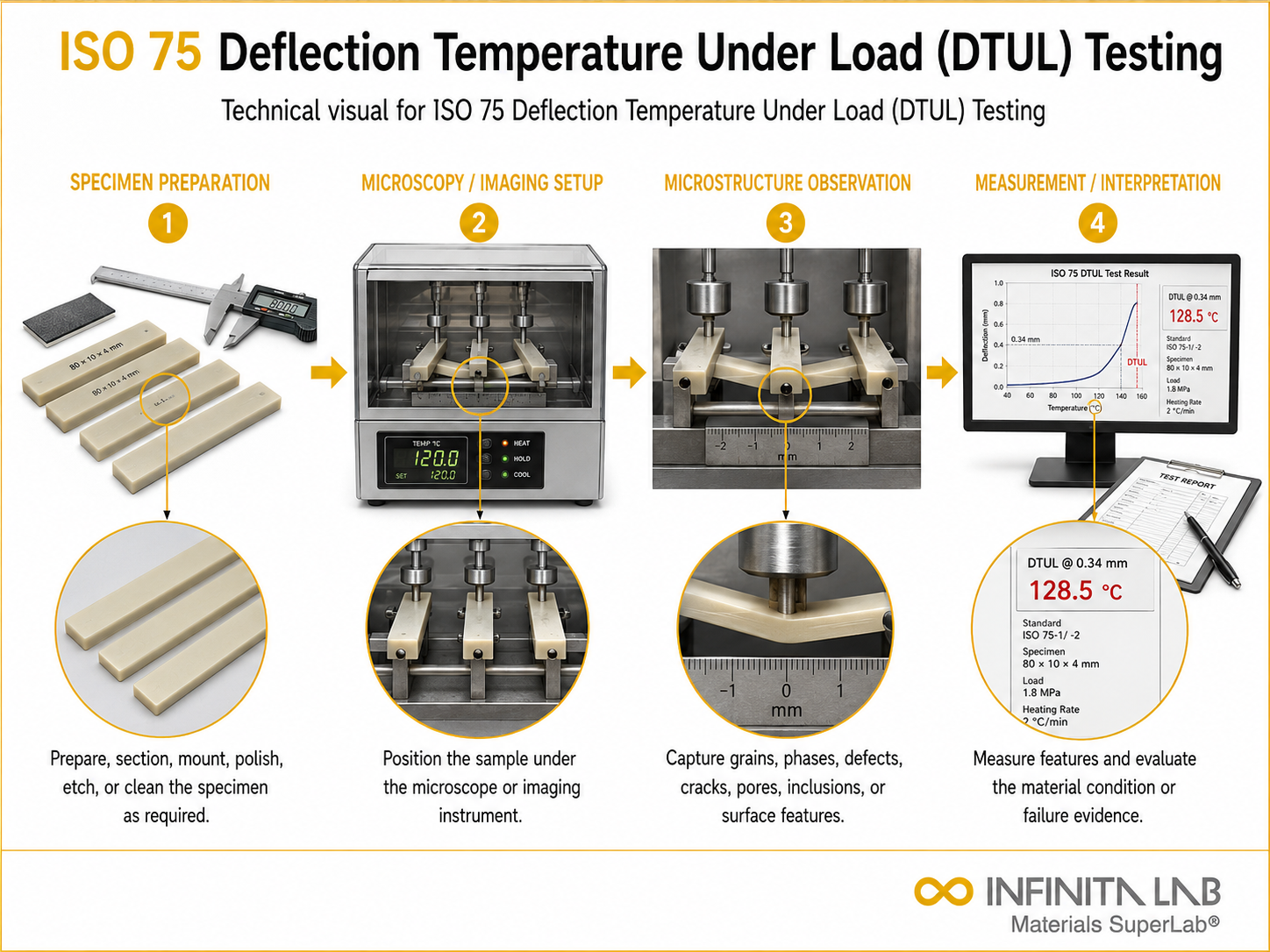
ISO 75 Test Process
Sample Preparation
Standard specimens (~80 × 10 × 4 mm) are molded and conditioned under controlled conditions.
1Load Application
A constant flexural stress (e.g., 0.45 MPa, 1.8 MPa, or 8 MPa) is applied using a three-point bending setup.
2Heating
The sample is heated at a controlled rate (~2°C/min) in an oil bath or heating chamber.
3Data Analysis
The temperature at which the specimen deflects by 0.25 mm is recorded as the HDT value.
4ISO 75 Technical Specifications
| Parameter | Details |
|---|---|
| Applicable Materials | Thermoplastics, thermosets, reinforced plastics |
| Specimen Length | Typically up to 7.5 mm thickness (as per requirement) |
| Heating Rate | ~2°C/min |
| Deflection Criterion | 0.25 mm |
| Loading Type | Flexural loading (three-point bending) |
| Measured Property | Heat Deflection Temperature (HDT) |
| Output Units | Temperature (°C) |


Instrumentation Used for Testing
- Heat deflection temperature (HDT) tester
- Three-point bending fixture
- Oil bath or heating chamber
- Load the application system
- Deflection measurement sensor
- Temperature sensors (thermocouples)
- Data acquisition system
Results and Deliverables
- Heat deflection temperature (°C)
- Load vs deflection behavior
- Thermal resistance performance data
- Comparative analysis across materials
- Suitability for high-temperature applications
Frequently Asked Questions
ISO 75 is used to determine the temperature at which a plastic material deforms under a specified load, helping evaluate thermal resistance and suitability for high-temperature applications.
HDT is the temperature at which a material bends by 0.25 mm under a defined load. It indicates how well a plastic maintains stiffness when exposed to heat.
Typical loads include 0.45 MPa (Method B), 1.8 MPa (Method A), and 8 MPa (Method C), depending on material stiffness and application requirements.
ISO 75 measures deformation under load (HDT), while ISO 306 determines Vicat softening temperature without mechanical loading. Both evaluate thermal behavior but under different conditions.
ISO 75 helps engineers understand how plastics behave under heat and load, ensuring proper material selection for applications where dimensional stability at elevated temperatures is critical.
Why Choose Infinita Lab for Advanced Materials Testing and Characterization?
At the core of this breadth is our network of 2,000+ accredited laboratories across the USA, offering access to over 10,000 testing methods and analytical services. From advanced materials characterization (SEM, TEM, RBS, XPS) to mechanical, chemical, environmental, biological, and standardized ASTM/ISO-compliant testing, we deliver unmatched flexibility, specialization, and scale. You are never limited by geography, facility, or methodology — Infinita Lab connects you to the right expertise and testing solution, every time.

Looking for a Trusted Partner for Accurate and Reliable Testing Services?
Send query us at hello@infinitlab.com or call us at (888) 878-3090 to learn more about our services and how we can support you.



Request a Quote
Submit your material details and receive testing procedures, pricing, and turnaround time within 24 hours.
 Quick Turnaround and Hasslefree process
 Confidentiality Guarantee
 Free, No-obligation Consultation
 100% Customer Satisfaction
