


ISO 1716: Building Material Gross Heat Combustion Testing Services
Different building materials have different thermal properties, and the ISO 1716 standard from the International Organization for Standardization is one of the most widely recognized ways to measure their combustive properties. This test is applicable to solid products such as sealing compounds, insulation materials, and reinforced cement. It determines the maximum total heat that a product can emit while it is completely burning.
TRUSTED BY


Get ISO 1716 compliant results — request your building material gross heat combustion testing quote
- Overview
- Scope, Applications, and Benefits
- Test Process
- Specifications
- Instrumentation
- Results and Deliverables
What Is ISO 1716 Building Material Gross Heat Combustion?
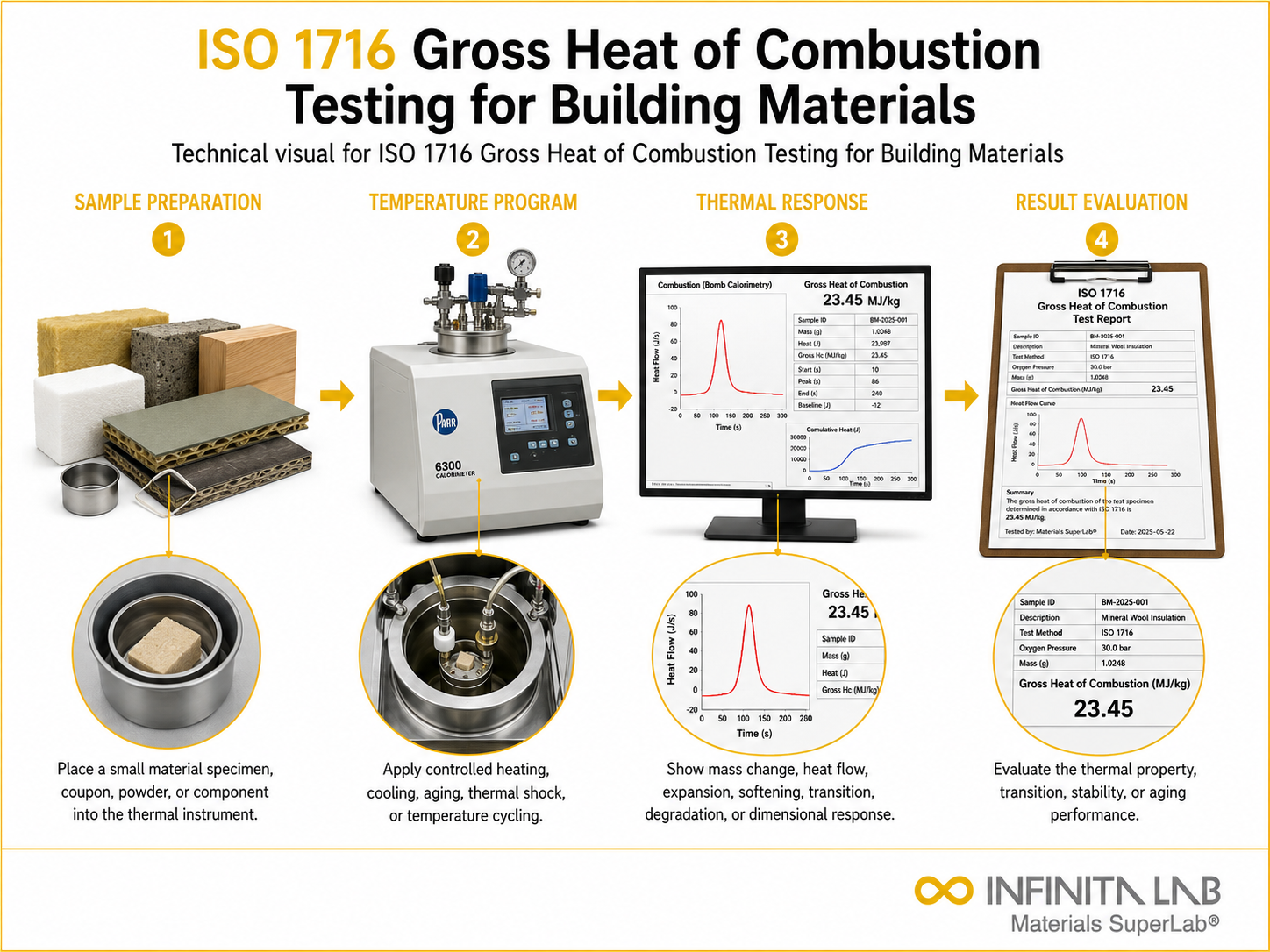
ISO 1716 is an international standard for determining the gross heat of combustion (calorific value) of building materials. It measures the total heat energy released when a material undergoes complete combustion under controlled conditions in a bomb calorimeter.
This test is critical for evaluating fire performance and classifying construction products. The results are expressed in megajoules per kilogram (MJ/kg) and are used in fire classification systems (such as EN 13501-1) to determine whether materials contribute significantly to fire growth.

Applications and Benefits of ISO 1716 Building Material Gross Heat Combustion Testing
Scope
ISO 1716 testing evaluates:
- Gross heat of combustion (PCS, MJ/kg)
- Net heat of combustion (PCI, MJ/kg)
- Total heat release potential of materials
- Combustibility contribution to fire growth
- Energy content of homogeneous and composite products
Applications
- Building and construction materials
- Insulation products (mineral wool, foams)
- Coatings, sealants, and composites
- Flooring and façade materials
- Fire classification testing of construction products
Benefits
- Determines the total fire load contribution of materials
- Supports fire safety classification (A1, A2, etc.)
- Enables safer material selection in construction
- Provides standardized and comparable results
- Helps meet regulatory fire safety requirements
Our ISO 1716 Testing Procedure
Sample Preparation
Samples (~50–60 g) are prepared and conditioned to standard temperature and humidity conditions.
1Combustion
A small specimen is burned completely in oxygen inside a bomb calorimeter at constant volume.
2Temperature Measurement
Heat released raises water temperature, which is precisely measured.
3Data Analysis
Calorific value (MJ/kg) is calculated based on temperature rise and calibration data.
4ISO 1716 Test Parameters and Requirements
| Parameter | Details |
|---|---|
| Standard | ISO 1716:2018 |
| Applicable Materials | Solid building products and components |
| Sample Size | ~50–60 g (depending on material) |
| Oxygen Purity | ≥99.5% |
| Measurement Unit | MJ/kg (megajoules per kilogram) |
| Calorimeter Volume | ~300 ± 50 mL |
| Measured Outputs | Gross and net heat of combustion |


- Bomb calorimeter system
- Oxygen supply system (≥99.5% purity)
- Temperature measurement sensors (high precision)
- Calorimetric vessel and ignition system
- Analytical balance
- Data acquisition and calculation software
Equipment and Instrumentation Used for ISO 1716 Testing
What You Receive: Test Report, Data, and Certification
- Gross heat of combustion (PCS, MJ/kg)
- Net calorific value (PCI, MJ/kg)
- Fire load contribution analysis
- Input data for fire classification (A1, A2 categories)
- Comparative performance of materials
- Test report
ISO 1716 Building Material Gross Heat Combustion FAQs
ISO 1716 is used to measure the total heat released by a material during complete combustion. It helps determine how much a material contributes to fire growth in building applications.
Gross heat of combustion represents the total energy released when a material burns completely, including the heat from condensation of water vapor. It is typically expressed in MJ/kg.
ISO 1716 measures heat release (calorific value), while ISO 1182 determines whether a material is non-combustible. Both tests are used together for fire classification of building materials.
Materials such as insulation, coatings, composites, and construction products are tested to evaluate their fire performance and suitability for building applications.
Calorific value indicates how much energy a material can release during combustion. Higher values mean greater fire risk, making it a critical parameter for safety assessment and material selection.
Why Choose Infinita Lab for Building Material Gross Heat Combustion Testing?
At the core of this breadth is our network of 2,000+ accredited laboratories across the USA, offering access to over 10,000 testing methods and analytical services. From advanced materials characterization (SEM, TEM, RBS, XPS) to mechanical, chemical, environmental, biological, and standardized ASTM/ISO-compliant testing, we deliver unmatched flexibility, specialization, and scale. You are never limited by geography, facility, or methodology — Infinita Lab connects you to the right expertise and testing solution, every time.

Need ISO 1716 Building Material Gross Heat Combustion Testing You Can Rely On?
Send query us at hello@infinitalab.com or call us at (888) 878-3090 to learn more about our services and how we can support you.



Request a Quote
Submit your material details and receive testing procedures, pricing, and turnaround time within 24 hours.
 Quick Turnaround and Hasslefree process
 Confidentiality Guarantee
 Free, No-obligation Consultation
 100% Customer Satisfaction
