


ASTM E1428: Antimicrobial Performance Evaluation Testing Services
The performance of antimicrobial drugs employed in or on synthetic polymeric materials against staining by the actinomycete Streptoverticillium reticulum is determined using this test method ASTM E1428. These treatments require a working knowledge of microbiological techniques.
TRUSTED BY


Get ASTM E1428 compliant results — request your antimicrobial performance evaluation testing quote
- Overview
- Scope, Applications, and Benefits
- Test Process
- Specifications
- Instrumentation
- Results and Deliverables
What Is ASTM E1428 Antimicrobial Performance Evaluation?
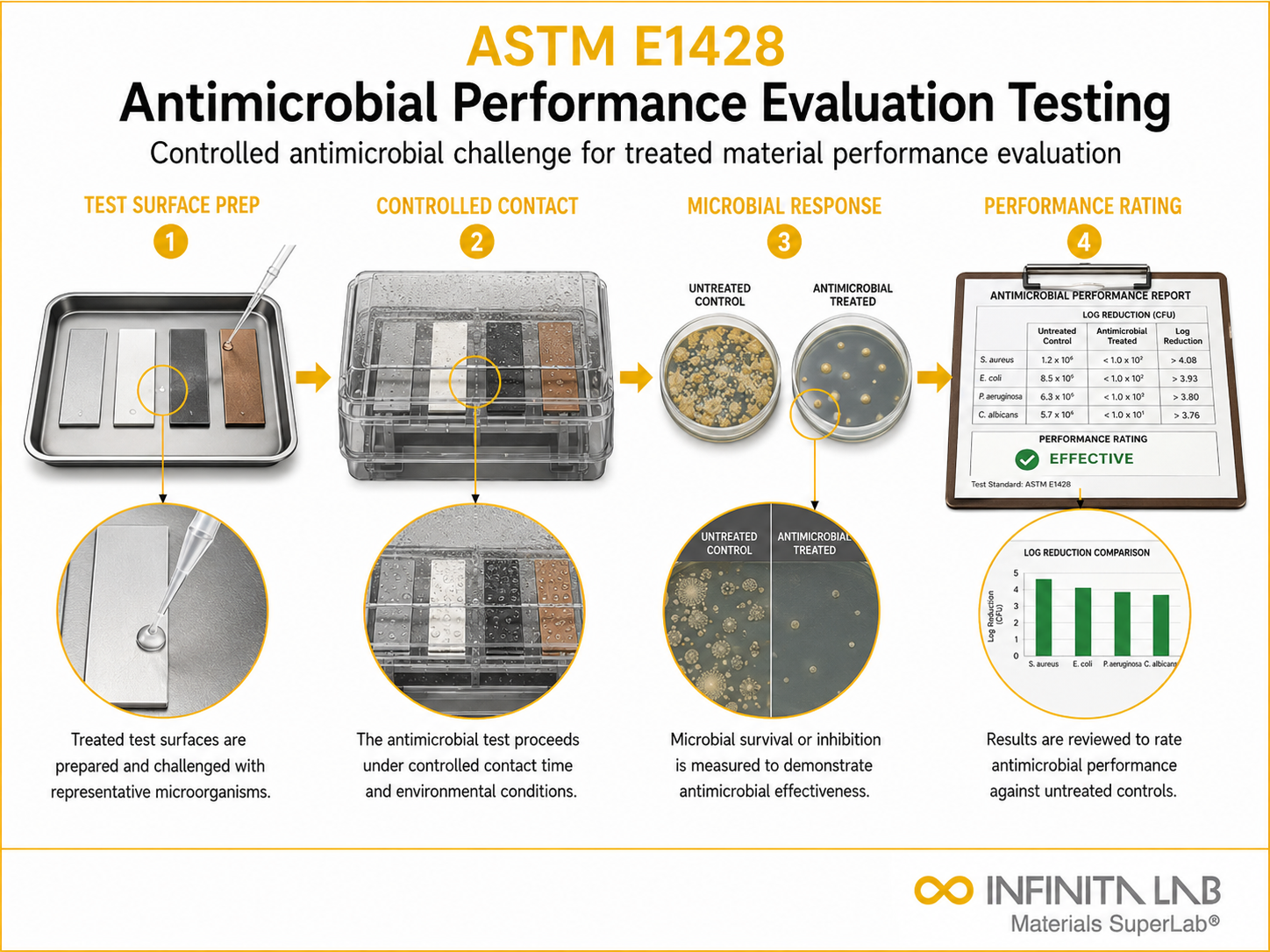
ASTM E1428 provides a standardized method to evaluate the effectiveness of antimicrobial agents on treated surfaces or materials. It quantifies the ability of antimicrobial coatings or additives to inhibit or reduce microbial growth under controlled laboratory conditions.
The method is essential for assessing antimicrobial performance in products where microbial control is critical, such as healthcare materials, coatings, and treated textiles. It ensures reliable comparison of antimicrobial efficacy, helping manufacturers validate claims and maintain consistency in product performance across different applications.

Applications and Benefits of ASTM E1428 Antimicrobial Performance Evaluation Testing
Scope
ASTM E1428 applies to the evaluation of antimicrobial activity on treated surfaces and materials under controlled test conditions. It determines the effectiveness of antimicrobial agents against specific microorganisms.
- Evaluation of antimicrobial-treated materials
- Measurement of microbial reduction or inhibition
- Applicable to coatings, polymers, and textiles
- Testing against bacteria, fungi, or other microorganisms
- Laboratory-controlled performance assessment
Applications
- Antimicrobial coatings for surfaces
- Medical device and healthcare materials
- Textiles with antimicrobial treatment
- HVAC and filtration systems
- Consumer products with antimicrobial claims
- Packaging materials for hygiene-sensitive applications
Benefits
- Provides quantitative antimicrobial performance data
- Ensures reliable validation of antimicrobial claims
- Helps maintain product quality and consistency
- Supports regulatory and compliance requirements
- Reduces microbial contamination risks
- Enhances safety in critical applications
Our ASTM E1428 Testing Procedure
Sample Preparation
Prepare treated and control specimens under sterile conditions.
1Microbial Inoculation
Apply a known concentration of microorganisms to the test surface.
2Incubation
Maintain samples under controlled environmental conditions for a specified time.
3Microbial Analysis
Measure surviving microorganisms and calculate antimicrobial effectiveness.
4ASTM E1428 Test Parameters and Requirements
| Parameter | Details |
|---|---|
| Test Type | Antimicrobial performance evaluation |
| Microorganisms | Bacteria, fungi, or specified strains |
| Inoculum Level | Controlled microbial concentration |
| Incubation Conditions | Temperature and humidity controlled |
| Contact Time | Defined exposure duration |
| Reduction Measurement | Log reduction of microbial population |
| Surface Type | Treated and untreated control samples |
| Detection Method | Culture-based microbial counting |


- Microbiological incubator
- Sterile culture media and plates
- Microbial inoculation equipment
- Laminar flow biosafety cabinet
- Colony counter
- Environmental control chamber
- Micropipettes and sterile tools
Equipment and Instrumentation Used for ASTM E1428 Testing
What You Receive: Test Report, Data, and Certification
- Microbial reduction (log reduction values)
- Comparative performance against control samples
- Antimicrobial efficacy report
- Colony forming unit (CFU) data
- Statistical analysis of microbial reduction
- Test certification documentation
ASTM E1428 Antimicrobial Performance Evaluation FAQs
The main objective is to evaluate how effectively antimicrobial-treated materials inhibit or reduce microbial growth. It provides a standardized method to quantify performance, ensuring that antimicrobial claims are supported by reliable and reproducible laboratory data.
Effectiveness is typically measured using log reduction values, which compare the number of microorganisms on treated samples to untreated controls. A higher log reduction indicates stronger antimicrobial activity and better performance.
A control sample provides a baseline for comparison. It represents untreated conditions, allowing accurate determination of the antimicrobial agent’s effectiveness by comparing microbial growth between treated and untreated surfaces.
Factors include microbial strain, inoculum concentration, surface properties, incubation conditions, and contact time. Variations in any of these can significantly impact the observed antimicrobial performance and test reproducibility.
Contact time determines how long microorganisms are exposed to the antimicrobial surface. Longer exposure may result in higher microbial reduction, while shorter times may not fully demonstrate the agent’s effectiveness.
Why Choose Infinita Lab for Antimicrobial Performance Evaluation Testing
At the core of this breadth is our network of 2,000+ accredited laboratories across the USA, offering access to over 10,000 testing methods and analytical services. From advanced materials characterization (SEM, TEM, RBS, XPS) to mechanical, chemical, environmental, biological, and standardized ASTM/ISO-compliant testing, we deliver unmatched flexibility, specialization, and scale. You are never limited by geography, facility, or methodology — Infinita Lab connects you to the right expertise and testing solution, every time.

Looking for an Accredited Partner for ASTM E1428 Antimicrobial Performance Evaluation Testing?
Send query us at hello@infinitalab.com or call us at (888) 878-3090 to learn more about our services and how we can support you.



Request a Quote
Submit your material details and receive testing procedures, pricing, and turnaround time within 24 hours.
 Quick Turnaround and Hasslefree process
 Confidentiality Guarantee
 Free, No-obligation Consultation
 100% Customer Satisfaction
