


ASTM D6703: Asphalt Heithaus Titrimetry Testing Services
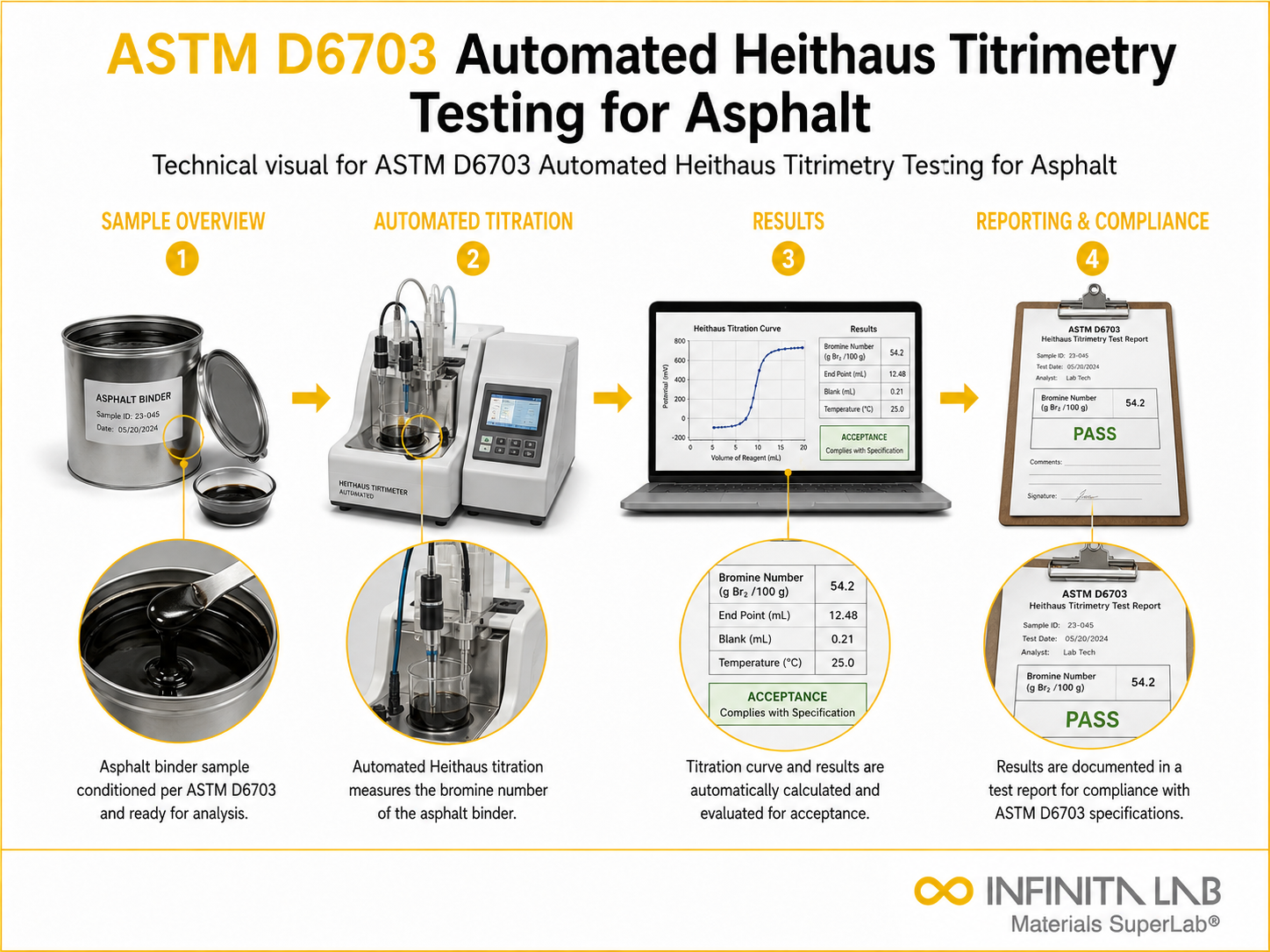
ASTM D6703 explains how to calculate three Heithaus compatibility parameters, which measure the colloidal stability of asphalts, asphalt cross blends, and aged asphalt. The values are considered as a standard when expressed in SI units.
TRUSTED BY


Get ASTM D6703 compliant results — request your asphalt heithaus titrimetry testing quote
- Overview
- Scope, Applications, and Benefits
- Test Process
- Specifications
- Instrumentation
- Results and Deliverables
What Is ASTM D6703 Asphalt Heithaus Titrimetry?
ASTM D6703 is a standard test method for characterizing the stability and peptizability of asphaltenes in petroleum residua, crude oils, and bituminous materials using automated Heithaus titrimetry. The Heithaus method quantifies the colloidal stability of asphaltene-containing systems through titration with a precipitating solvent (typically heptane) and a deflocculating solvent (typically toluene).
Asphaltene instability can lead to fouling in pipelines, process equipment, and refinery operations. The Heithaus parameters derived from this test—P₀ (peptizability of asphaltenes), Pa (dispersing power of the oil), and P (flocculation ratio)—are widely used in refinery operations and crude oil compatibility assessment.

Applications and Benefits of ASTM D6703 Asphalt Heithaus Titrimetry Testing
Scope
ASTM D6703 evaluates:
- Heithaus colloidal stability parameters (P, P₀, Pa) for petroleum systems
- Asphaltene peptizability and flocculation tendency
- Compatibility of crude oil blends and residua
- Risk of asphaltene deposition in process streams
Applications
- Crude oil and residua blending compatibility assessment
- Refinery fouling prevention and pipeline flow assurance
- Heavy fuel oil quality control
- Bitumen and asphalt binder characterization
- Upstream production chemistry and flow assurance
Benefits
- Automates and standardizes the Heithaus titrimetric procedure
- Provides quantitative colloidal stability parameters
- Predicts asphaltene flocculation risk in blends
- Reduces analytical variability compared to manual titration
- Supports refinery blending optimization and fouling management
Our ASTM D6703 Testing Procedure
Sample Dissolution
The petroleum sample is dissolved in a known volume of toluene at specified concentration
1Automated Titration
An automated titrator adds heptane (precipitant) incrementally to the sample solution while detecting the flocculation onset optically.
2Back-Titration
After flocculation, toluene is added back to redisperse asphaltenes; flocculation and deflocculation endpoints are recorded.
3Parameter Calculation
Heithaus parameters P, P₀, and Pa are calculated from the titration data and reported with colloidal stability interpretation.
4ASTM D6703 Test Parameters and Requirements
| Parameter | Details |
|---|---|
| Standard | ASTM D6703 |
| Test Principle | Automated optical detection Heithaus titrimetry |
| Applicable Materials | Crude oils, petroleum residua, bitumen, heavy fuel oils |
| Measured Outputs | Heithaus parameters P, P₀, Pa |
| Titrants | Heptane (precipitant) and toluene (dispersant) |
| Detection | Optical turbidity detection |


- Automated Heithaus titrimeter with optical detector
- Precision burette or auto-dispensing syringe system
- Analytical balance
- Toluene and n-heptane reagents (analytical grade)
- Data acquisition and parameter calculation software
Equipment and Instrumentation Used for ASTM D6703 Testing
What You Receive: Test Report, Data, and Certification
- Heithaus flocculation ratio (P)
- Asphaltene peptizability index (P₀)
- Oil dispersing power (Pa)
- Colloidal stability assessment and compatibility interpretation
- Blending compatibility reports for crude oil and residua
ASTM D6703 Asphalt Heithaus Titrimetry FAQs
P is the flocculation ratio indicating overall colloidal stability; P₀ quantifies the peptizability (ease of keeping asphaltenes dispersed); and Pa measures the dispersing power of the oil phase. A system with P > 1 is colloidally stable.
Unstable asphaltenes flocculate and deposit on heat exchangers, pipelines, and process vessels, causing fouling that reduces throughput, increases energy consumption, and leads to costly cleaning shutdowns.
Yes, by testing individual crudes and their blends with automated Heithaus titrimetry, refiners can identify incompatible blends where asphaltene destabilization is likely before blending at scale.
Automated titration improves reproducibility by eliminating subjective endpoint detection, reduces analyst time, and provides more precise and consistent flocculation onset determination.
ASTM D6703 is most relevant for heavy, asphaltene-rich crudes, vacuum residua, and bitumen. Light crudes with negligible asphaltene content are not typically characterized by this method.
Why Choose Infinita Lab for Asphalt Heithaus Titrimetry Testing?
At the core of this breadth is our network of 2,000+ accredited laboratories across the USA, offering access to over 10,000 testing methods and analytical services. From advanced materials characterization (SEM, TEM, RBS, XPS) to mechanical, chemical, environmental, biological, and standardized ASTM/ISO-compliant testing, we deliver unmatched flexibility, specialization, and scale. You are never limited by geography, facility, or methodology — Infinita Lab connects you to the right expertise and testing solution, every time.

Looking for an Accredited Partner for ASTM D6703 Asphalt Heithaus Titrimetry Testing?
Send query us at hello@infinitalab.com or call us at (888) 878-3090 to learn more about our services and how we can support you.



Request a Quote
Submit your material details and receive testing procedures, pricing, and turnaround time within 24 hours.
 Quick Turnaround and Hasslefree process
 Confidentiality Guarantee
 Free, No-obligation Consultation
 100% Customer Satisfaction
